What is the purpose of post hoc tests after an ANOVA?
Post hoc tests identify which specific means are different after an ANOVA rejects the null hypothesis. They help answer which groups differ from each other.
What does the Tukey test compare in a dataset?
The Tukey test compares pairs of means to determine which pairs are significantly different. It tests each pair individually.
What must be true before running a Tukey test?
You must have rejected the null hypothesis in an ANOVA, indicating at least one mean is different. This ensures the Tukey test is appropriate.
What distribution is used to find the critical value for the Tukey test?
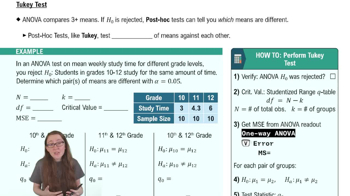
The Tukey test uses the studentized range distribution (q table) to find the critical value. The correct cell is chosen based on alpha, degrees of freedom, and number of groups.
How do you calculate degrees of freedom for the Tukey test?
Degrees of freedom are calculated as the total number of observations minus the number of groups. For example, 30 observations and 3 groups gives 27 degrees of freedom.
What is the formula for the Tukey test statistic (q)?
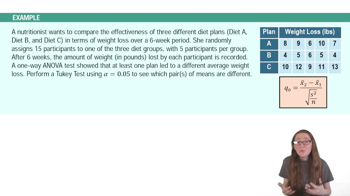
The formula is (mean_1 - mean_2) divided by the square root of (MS_E/n). MS_E is the mean squares due to error, and n is the sample size per group.
What does MS_E represent in the Tukey test?
MS_E is the mean squares due to error from the ANOVA output. It is also known as the variance within groups.
What is the null hypothesis for each pairwise comparison in the Tukey test?
The null hypothesis is that the two group means being compared are equal. The alternative is that they are different.
How do you decide whether to reject the null hypothesis in a Tukey test?
Compare the q statistic to the critical value; if q is greater than the critical value, reject the null hypothesis. If q is less, fail to reject it.
What happens if the q statistic is less than the critical value in a Tukey test?
You fail to reject the null hypothesis for that pair, concluding the means are not significantly different. No evidence of a difference is found.
What happens if the q statistic is greater than the critical value in a Tukey test?
You reject the null hypothesis for that pair, concluding the means are significantly different. There is evidence of a difference.
What values do you need from the ANOVA output to run a Tukey test?
You need the mean squares due to error (MS_E) and the means for each group. These are used in the Tukey formula.
Can you get a p-value from the q table in the Tukey test?
No, the q table only provides critical values, not p-values. You must use critical value comparison.
What is the sample size per group used for in the Tukey test formula?
The sample size per group (n) is used in the denominator of the Tukey formula to adjust for group size. It helps calculate the standard error.
What conclusion can you draw if you reject the null hypothesis for a pair in the Tukey test?
You conclude that the two group means are significantly different. This identifies which specific groups differ.
 Back
Back
 08:22
08:22