Back

Multiplication Rule: Independent Events definitions

Control buttons has been changed to "navigation" mode.
1/15
  • Independent Events

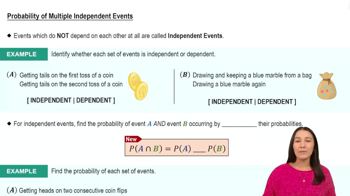
    Two occurrences where the result of one has no influence on the result of the other.
  • Dependent Events

    Two occurrences where the result of one alters the likelihood of the other.
  • Probability

    A numerical measure expressing the chance of a specific outcome among all possible outcomes.
  • And Probability

    The likelihood of multiple occurrences happening together, calculated by multiplying their individual chances.
  • Multiplication Rule

    A method for finding the joint chance of independent occurrences by multiplying their separate probabilities.
  • Set Notation

    A symbolic representation, often using an upside-down U, to denote the intersection of occurrences.
  • Joint Probability

    A measure of the chance that two or more occurrences happen simultaneously.
  • Outcome

    A possible result from a random process, such as a coin flip or die roll.
  • Sample Space

    The complete collection of all possible results from a random process.
  • Consecutive Trials

    Multiple random processes performed one after another, such as repeated coin flips.
  • Event

    A specific result or group of results from a random process.
  • Intersection

    The set of results where multiple occurrences happen together, often denoted by an upside-down U.
  • Decimal Probability

    A chance expressed as a number between 0 and 1, representing the proportion of favorable results.
  • Numerator

    The top part of a fraction representing favorable results in probability calculations.
  • Denominator

    The bottom part of a fraction representing the total number of possible results in probability calculations.