Skip to main content
Introductory Statistics
My Course
Learn
Exam Prep
AI Tutor
Study Guides
Textbook Solutions
Flashcards
Explore
Try the app
My Course
Learn
Exam Prep
AI Tutor
Study Guides
Textbook Solutions
Flashcards
Explore
Try the app
Back
Performing Hypothesis Tests: Proportions quiz
You can tap to flip the card.
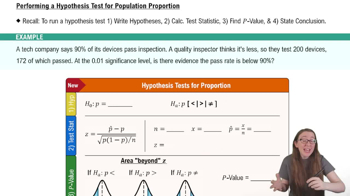
What are the four main steps in performing a hypothesis test for a population proportion?
You can tap to flip the card.
👆
What are the four main steps in performing a hypothesis test for a population proportion?
The four steps are: write the hypotheses, calculate the test statistic, find the p-value, and state the conclusion.
Track progress
Control buttons has been changed to "navigation" mode.
1/15
Related flashcards
Related practice
Recommended videos
Performing Hypothesis Tests: Proportions definitions
Performing Hypothesis Tests: Proportions
15 Terms
Performing Hypothesis Tests: Proportions
9. Hypothesis Testing for One Sample
5 problems
Topic
Ernest
9. Hypothesis Testing for One Sample - Part 1 of 2
5 topics
14 problems
Chapter
David-Paige
9. Hypothesis Testing for One Sample - Part 2 of 2
1 topic
3 problems
Chapter
Justin
Guided course
05:52
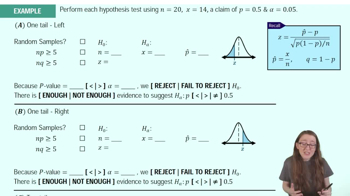
Performing Hypothesis Tests: Proportions
1164
views
15
rank
Guided course
07:06
Performing Hypothesis Tests: Proportions Example 1
787
views
14
rank
Guided course
03:32
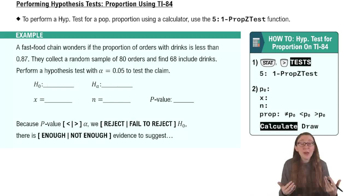
Performing Hypothesis Tests: Proportions Using TI-84
416
views
4
rank
Terms in this set (15)
Hide definitions
What are the four main steps in performing a hypothesis test for a population proportion?
The four steps are: write the hypotheses, calculate the test statistic, find the p-value, and state the conclusion.
In hypothesis testing, what does the null hypothesis (H0) typically state about the population proportion?
The null hypothesis states that the population proportion is equal to the expected value.
How do you calculate the sample proportion (p̂) in a hypothesis test?
Divide the number of successes (x) by the sample size (n).
What formula is used to calculate the z-score for a population proportion hypothesis test?
The z-score is (p̂ - p) divided by the square root of [p(1-p)/n].
What does the p-value represent in a hypothesis test?
The p-value is the probability of obtaining a test statistic as extreme as, or more extreme than, the observed value under the null hypothesis.
How do you determine if a hypothesis test is left-tailed, right-tailed, or two-tailed?
Look at the alternative hypothesis: '<' means left-tailed, '>' means right-tailed, and '≠' means two-tailed.
What is the significance level (alpha, α) in hypothesis testing?
Alpha is the threshold probability for rejecting the null hypothesis, commonly set at 0.05 or 0.01.
What decision do you make if the p-value is greater than alpha?
You fail to reject the null hypothesis.
What are the two conditions involving n, p, and q that must be checked before performing a hypothesis test for a proportion?
Both n*p and n*q must be at least 5.
What does it mean to 'fail to reject the null hypothesis' in the context of a population proportion?
It means there is not enough evidence to support the alternative hypothesis about the population proportion.
Why is it important to check if the sample was randomly selected in hypothesis testing?
Random sampling ensures the validity of the test results and that the sample represents the population.
On a TI-84 calculator, which function is used to perform a hypothesis test for a population proportion?
Use the '1-PropZTest' function.
What values must you input into the calculator to perform a 1-PropZTest?
You need the expected population proportion (p0), the number of successes (x), and the sample size (n).
If the alternative hypothesis is p < p0, which type of test are you performing?
You are performing a left-tailed test.
What conclusion do you draw if the p-value is less than alpha in a hypothesis test for a proportion?
You reject the null hypothesis, indicating sufficient evidence for the alternative hypothesis.
 BackBack

 05:52
05:52