 Back
Chapter 5: Probability – Rules, Models, and Applications
Study Guide - Smart Notes
 Tailored notes based on your materials, expanded with key definitions, examples, and context.
Probability: Foundations and Applications
Introduction to Probability
Probability is a mathematical framework for quantifying uncertainty in everyday life and scientific contexts. It allows us to describe variation, identify patterns, and estimate the likelihood of different outcomes. Probability is fundamental to statistical inference, which uses sample data to draw conclusions about populations.
Key Point: Probability models help us understand random processes such as travel times, weather, and product quality.
Example: Estimating the chance of arriving within 30 minutes for a daily commute.
Probability and Statistical Inference
Probability provides tools (distributions, expected value, variance) for analyzing random phenomena. Inference uses these tools for estimation (confidence intervals) and decision-making (hypothesis testing).
Probability: Assumptions → Data
Inference: Data → Assumptions
Section 5.1 – Probability Rules
Random Experiments, Sample Space, and Events
A random experiment is a process with uncertain outcomes. The sample space (S) is the set of all possible outcomes. An event is a subset of the sample space, representing one or more outcomes.
Examples: Flipping a coin, rolling a die, drawing a letter, or choosing an integer.
Sample Space: For flipping a coin twice: S = {HH, HT, TH, TT}
Event: Getting at least one tail: E = {HT, TH, TT}
Probability Models and Rules
A probability model lists possible outcomes and their probabilities. It must satisfy two rules:
Rule 1: For any event E,
Rule 2: The sum of probabilities for all outcomes equals 1:
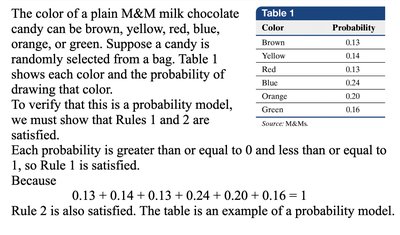
Example: Probability model for M&M colors:
Color | Probability |
|---|---|
Brown | 0.13 |
Yellow | 0.14 |
Red | 0.13 |
Blue | 0.24 |
Orange | 0.20 |
Green | 0.16 |
Each probability is between 0 and 1, and their sum is 1, so this is a valid probability model.
Types of Events
Impossible Event:
Certain Event:
Unusual Event: Low probability (commonly, )
Classical Method of Probability
When outcomes are equally likely, the probability of an event E is:
Example: Rolling a die, probability of even number:
Example: Probability of blood type not O:
Empirical Method of Probability
Probability can be estimated from observed data:
Example: Survey of travel methods. Probability of carpooling:
Example: Probability of walking: (unusual event)
Section 5.2 – Probability as Long-Term Frequency
The Law of Large Numbers
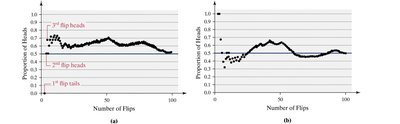
As the number of independent repetitions increases, the relative frequency of an outcome approaches its probability.
Example: Tossing a fair coin many times, proportion of heads approaches 0.5.
Set Operations and Probability
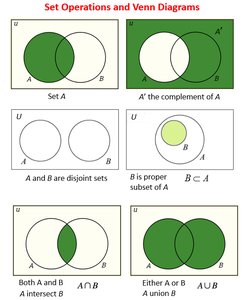
Set Operations: Union, Intersection, Complement
Events can be combined using set operations:
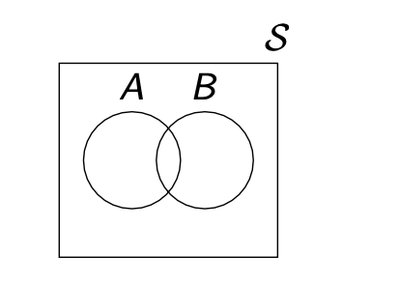
Union (A ∪ B): Outcomes in A or B or both.
Intersection (A ∩ B): Outcomes in both A and B.
Complement (Ac): Outcomes not in A.
Mutually Exclusive (Disjoint): No outcomes in common.
Addition Rule for Probabilities
For any two events A and B:
Special Case (Disjoint Events): if
Complement Rule
The probability that event A does not occur:
Example: Probability of testing negative:
Contingency Tables and Probability
Contingency Tables
A contingency table (two-way table) summarizes data for two categorical variables. Each cell gives the count for a combination of categories.
Gender | Polydactyly: Yes | Polydactyly: No | Total |
|---|---|---|---|
Male | 15 | 940 | 955 |
Female | 10 | 897 | 907 |
Total | 25 | 1837 | 1862 |

Example: Probability a randomly selected child is male or has polydactyly:
Summary Table: Probability Rules and Methods
Rule/Method | Formula | Example |
|---|---|---|
Classical Probability | Rolling a die: | |
Empirical Probability | Survey: | |
Addition Rule | Card: | |
Complement Rule | Test: |
