Back
BackHypothesis Tests Regarding a Parameter: Structured Study Notes
Study Guide - Smart Notes
 Tailored notes based on your materials, expanded with key definitions, examples, and context.
Chapter 10: Hypothesis Tests Regarding a Parameter
Section 10.1: The Language of Hypothesis Testing
Hypothesis testing is a fundamental statistical method used to make inferences about population parameters based on sample data. This section introduces the terminology and logic behind hypothesis testing, including the types of hypotheses, errors, and the process of drawing conclusions.
Learning Objectives:
Determine the null and alternative hypotheses
Explain Type I and Type II errors
State conclusions to hypothesis tests
Example: Is Your Friend Cheating?
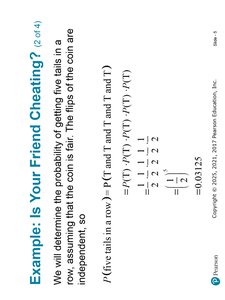
This example illustrates the logic of hypothesis testing using a coin-flipping game. If a friend flips a coin five times and gets tails each time, we calculate the probability of this outcome assuming the coin is fair.
Probability Calculation:
Each flip is independent, and the probability of tails is .
Probability of five tails in a row:
Interpretation:
Such an outcome is possible but unlikely.
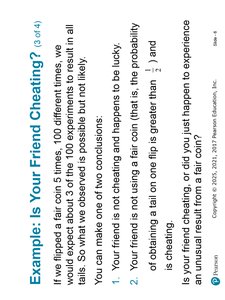
Two possible conclusions: (1) The friend is lucky, or (2) The coin is not fair.
Hypothesis Testing Logic:
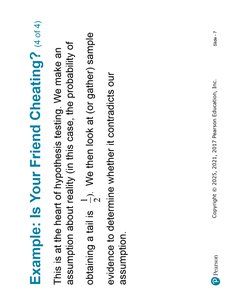
Assume the probability of tails is (null hypothesis).
Collect sample evidence to determine if this assumption is contradicted.

Definitions
Hypothesis: A statement regarding a characteristic of one or more populations.
Hypothesis Testing: A procedure based on sample evidence and probability, used to test statements regarding population characteristics.
Steps in Hypothesis Testing
Make a statement regarding the nature of the population.
Collect evidence (sample data) to test the statement.
Analyze the data to assess the plausibility of the statement.
Null and Alternative Hypotheses
Null Hypothesis (): Statement of no change, no effect, or no difference. Assumed true until evidence indicates otherwise.
Alternative Hypothesis (): Statement that we are trying to find evidence to support.
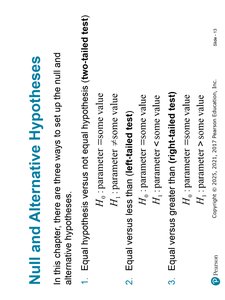
Types of Hypothesis Tests
Two-tailed test: : parameter = some value; : parameter ≠ some value
Left-tailed test: : parameter = some value; : parameter < some value
Right-tailed test: : parameter = some value; : parameter > some value
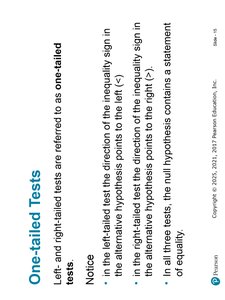
One-tailed Tests
Left- and right-tailed tests are referred to as one-tailed tests.
In left-tailed tests, the alternative hypothesis uses <.
In right-tailed tests, the alternative hypothesis uses >.
In all cases, the null hypothesis contains a statement of equality.
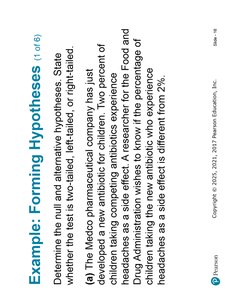
Examples: Forming Hypotheses
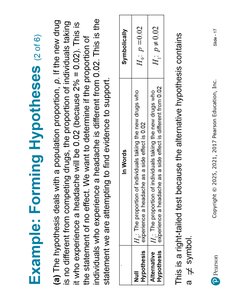
These examples demonstrate how to set up null and alternative hypotheses for different scenarios, and identify the type of test (two-tailed, left-tailed, or right-tailed).
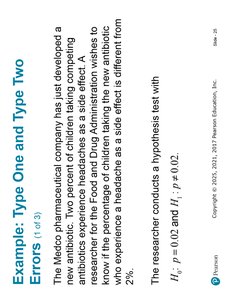
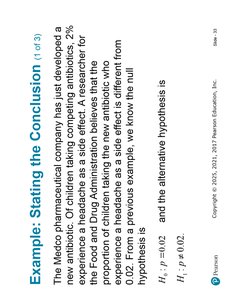
Population Proportion Example: Testing if the proportion of children experiencing headaches with a new drug is different from 2%.
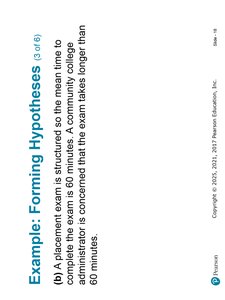
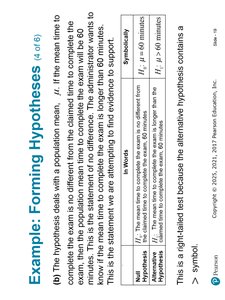
Population Mean Example: Testing if the mean time to complete an exam is longer than 60 minutes.
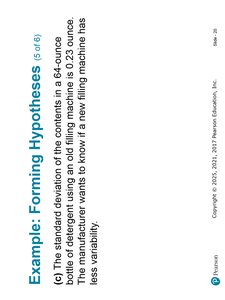
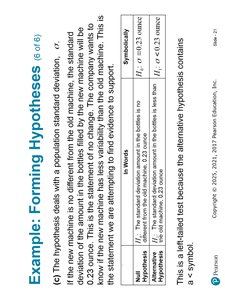
Population Standard Deviation Example: Testing if a new filling machine has less variability than the old one.
Errors in Hypothesis Testing
When conducting hypothesis tests, two types of errors can occur:
Type I Error: Rejecting the null hypothesis when it is true.
Type II Error: Not rejecting the null hypothesis when the alternative hypothesis is true.
Four Outcomes from Hypothesis Testing
Reject when is true (correct decision)
Do not reject when $H_0$ is true (correct decision)
Reject when $H_0$ is true (Type I error)
Do not reject when is true (Type II error)
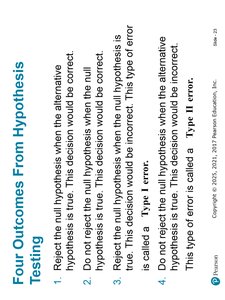
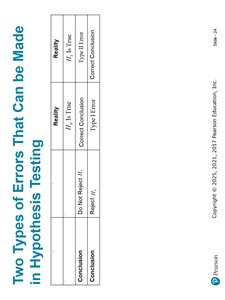
Table: Two Types of Errors in Hypothesis Testing
Reality | Conclusion | Result |
|---|---|---|
is true | Do not reject | Correct conclusion |
is true | Reject | Type I error |
is true | Do not reject | Type II error |
is true | Reject | Correct conclusion |
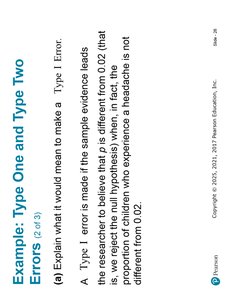
Example: Type One and Type Two Errors
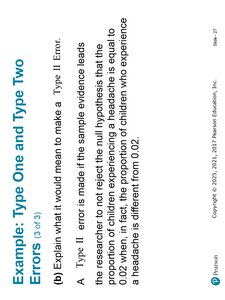
Using the pharmaceutical example, a Type I error would be concluding the proportion is different from 0.02 when it is not, and a Type II error would be failing to detect a difference when one exists.
Probability of Making Errors
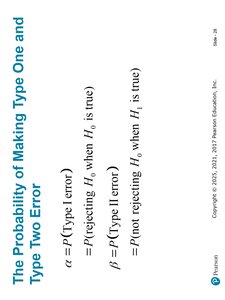
Relationship Between Type I and Type II Errors
As the probability of a Type I error increases, the probability of a Type II error decreases, and vice versa.

Caution in Hypothesis Testing
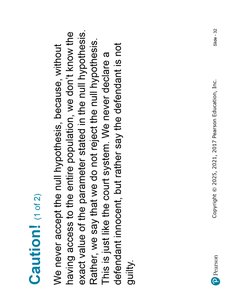
We never accept the null hypothesis; we only fail to reject it. This is because we do not have access to the entire population and cannot know the exact value of the parameter. This approach is similar to the legal system, where a defendant is declared "not guilty" rather than "innocent."
Example: Stating the Conclusion
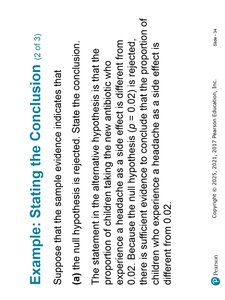
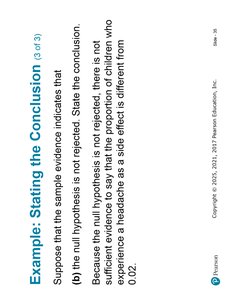
Conclusions are based on whether the null hypothesis is rejected or not. If rejected, there is sufficient evidence to support the alternative hypothesis. If not rejected, there is insufficient evidence to support the alternative hypothesis.
Section 10.2: Hypothesis Tests for a Population Proportion
This section focuses on hypothesis testing for population proportions, including the logic, application, and use of the binomial probability distribution.
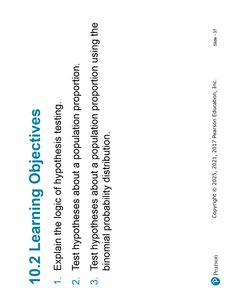
Learning Objectives:
Explain the logic of hypothesis testing
Test hypotheses about a population proportion
Test hypotheses about a population proportion using the binomial probability distribution
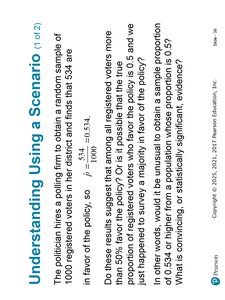
Understanding Using a Scenario
Given a random sample of voters, we use the sample proportion to infer whether the population proportion is greater than, less than, or equal to a specified value. Statistical significance is determined by whether the observed results are unlikely under the null hypothesis.
Statistical Significance
When observed results are unlikely under the assumption that the null hypothesis is true, we say the result is statistically significant and reject the null hypothesis.