Skip to main content
Trigonometry
My Course
Learn
Exam Prep
AI Tutor
Study Guides
Textbook Solutions
Flashcards
Explore
Try the app
My Course
Learn
Exam Prep
AI Tutor
Study Guides
Textbook Solutions
Flashcards
Explore
Try the app
Back
Asymptotes definitions
You can tap to flip the card.
Asymptote
You can tap to flip the card.
👆
Asymptote
Imaginary line that a graph approaches infinitely close but never touches or crosses, acting as a boundary for the graph's behavior.
Track progress
Control buttons has been changed to "navigation" mode.
1/15
Related flashcards
Related practice
Recommended videos
Asymptotes quiz
Asymptotes
15 Terms
Asymptotes
0. Review of College Algebra
3 problems
Topic
Solving Linear Equations
0. Review of College Algebra
5 problems
Topic
Patrick
0. Review of College Algebra - Part 1 of 2
4 topics
9 problems
Chapter
Patrick
0. Review of College Algebra - Part 2 of 2
5 topics
10 problems
Chapter
Patrick
Guided course
4:42
Asymptotes
790
views
8
rank
Terms in this set (15)
Hide definitions
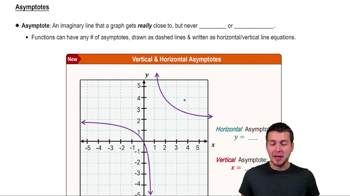
Asymptote
Imaginary line that a graph approaches infinitely close but never touches or crosses, acting as a boundary for the graph's behavior.
Horizontal Asymptote
Boundary parallel to the x-axis, represented by y equals a constant, where the graph flattens as it extends left or right.
Vertical Asymptote
Boundary parallel to the y-axis, represented by x equals a constant, where the graph becomes steep and approaches infinity.
Equation
Mathematical statement used to represent the location of an asymptote, typically in the form y equals or x equals a number.
Graph
Visual representation of a function or equation, showing how it behaves near asymptotes and other features.
Infinity
Concept describing how a graph extends endlessly in a direction, often near vertical asymptotes.
Axis
Reference line, either x or y, that can serve as the location for horizontal or vertical asymptotes.
Barrier
Invisible boundary set by an asymptote, preventing the graph from crossing or touching it.
Symmetry
Property where a graph exhibits similar behavior on both sides of an axis or asymptote.
Dashed Line
Visual cue used to indicate the presence of an asymptote on a graph, distinguishing it from the actual curve.
Steepness
Characteristic of a graph near a vertical asymptote, where the curve becomes nearly vertical.
Flatness
Characteristic of a graph near a horizontal asymptote, where the curve becomes nearly horizontal.
Function
Mathematical relationship whose graph may exhibit asymptotic behavior, regardless of its specific form.
Behavior
Pattern describing how a graph approaches, but never reaches, an asymptote as it extends in either direction.
Value
Specific number that defines the location of an asymptote, such as y equals 2 or x equals -2.
 BackBack
 4:42
4:42