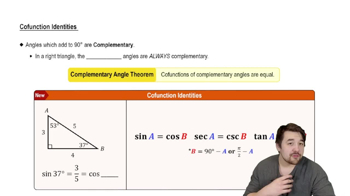
In a right triangle, if sin(M) = 0.759, what is the value of cos(N), where angles M and N are the non-right angles?
In a right triangle, the non-right angles are complementary, so cos(N) = sin(M). Therefore, cos(N) = 0.759.
Which trigonometric expression is equivalent to cos(70°) using a cofunction identity?
cos(70°) is equivalent to sin(20°), since cosine and sine are cofunctions and 70° and 20° are complementary angles.
Which trigonometric expression is equivalent to sin(51°) using a cofunction identity?
sin(51°) is equivalent to cos(39°), since sine and cosine are cofunctions and 51° and 39° are complementary angles.
What is the cofunction identity for tangent in terms of its complementary angle?
The cofunction identity for tangent is cotangent of the complementary angle. Specifically, tan(x) = cot(90° - x) for angles in degrees.
How do you find the complementary angle when working in radians instead of degrees?
To find the complementary angle in radians, subtract the given angle from π/2. For example, the complementary angle to θ is π/2 - θ.
If secant is the original function, what is its cofunction and how do you express it for an angle x?
The cofunction of secant is cosecant. You express it as sec(x) = csc(90° - x) in degrees or sec(x) = csc(π/2 - x) in radians.
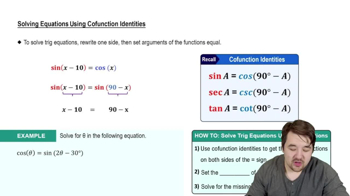
What algebraic step allows you to solve for a variable after rewriting both sides of a trigonometric equation using cofunction identities?
After rewriting both sides with the same trigonometric function, set the arguments equal to each other. Then solve the resulting equation using standard algebraic techniques.
Why are the non-right angles in a right triangle always complementary?
The non-right angles in a right triangle are always complementary because the sum of all angles in a triangle is 180°, and one angle is 90°. Therefore, the other two must add up to 90°.
What is the first step when solving a trigonometric equation involving sine and cosine using cofunction identities?
The first step is to rewrite one side of the equation using the cofunction identity so both sides have the same trigonometric function. This allows you to compare the arguments directly.
How do you simplify the expression cos(5π/18) using a cofunction identity?
You rewrite cos(5π/18) as sin(π/2 - 5π/18), then simplify to sin(2π/9). This uses the cofunction identity for cosine and sine in radians.
 Back
Back
 4:42
4:42