Eliminate the Parameter quiz #1 Flashcards

Eliminate the Parameter quiz #1
Control buttons has been changed to "navigation" mode.
1/10
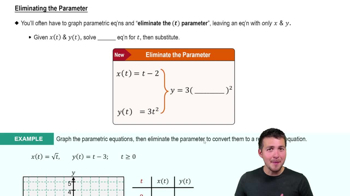
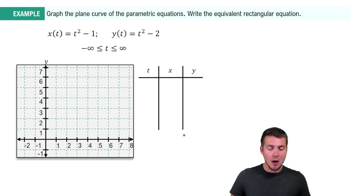
  • How do you eliminate the parameter from a set of parametric equations to find a Cartesian (rectangular) equation of the curve?
    To eliminate the parameter from parametric equations, solve one equation for the parameter (t) and substitute it into the other equation. For example, if x = f(t) and y = g(t), solve for t in terms of x (or y), then substitute into the other equation to get a relationship involving only x and y. For parametric equations involving trigonometric functions, solve each equation for the trigonometric function (e.g., x = cos(t), y = 3sin(t)), then use a Pythagorean identity (such as sin²(t) + cos²(t) = 1) to relate x and y, resulting in a Cartesian equation like x² + (y/3)² = 1.
  • What is the main goal when eliminating the parameter from parametric equations?
    The main goal is to rewrite the equations so that only x and y remain, removing the parameter t. This results in a rectangular equation that relates x and y directly.
  • Why is it usually preferable to solve for t in the x equation rather than the y equation when eliminating the parameter?
    Solving for t in the x equation often leads to a more familiar and simpler rectangular equation. Solving for t in the y equation can sometimes result in less familiar forms, such as x in terms of the square root of y.
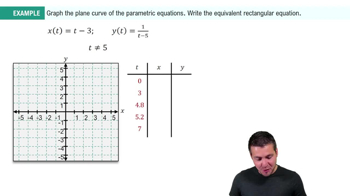
  • How do restrictions on the parameter t affect the graph of the rectangular equation obtained after elimination?
    Restrictions on t limit the portion of the graph that is represented by the parametric equations. The resulting rectangular equation may describe a larger curve, but only a segment corresponding to the allowed t values is actually graphed.
  • What is the first step when eliminating the parameter from parametric equations involving trigonometric functions?
    The first step is to solve each equation for the trigonometric function in terms of x or y. For example, if x = cos(t), write cos(t) = x, and if y = 3sin(t), write sin(t) = y/3.
  • Why does substituting inverse trigonometric functions when eliminating the parameter often lead to complicated expressions?
    Substituting inverse trigonometric functions, like using arccos(x), can result in messy and unfamiliar equations. This approach is generally avoided in favor of using trigonometric identities.
  • Which Pythagorean identity is typically used when eliminating the parameter from equations involving sine and cosine?
    The identity sin²(t) + cos²(t) = 1 is typically used. This allows you to relate x and y directly by substituting the expressions for sine and cosine.
  • What familiar geometric shape is represented by the equation x² + (y/3)² = 1 after eliminating the parameter from x = cos(t), y = 3sin(t)?
    The equation x² + (y/3)² = 1 represents an ellipse. This is a standard form for the equation of an ellipse centered at the origin.
  • How does the process of eliminating the parameter from parametric equations compare to the substitution method in solving systems of equations?
    Both processes involve solving one equation for a variable and substituting it into the other equation. This substitution eliminates one variable, simplifying the system.
  • What happens to the graph of a parametric equation if t is restricted to positive values and x = sqrt(t)?
    If t is restricted to positive values, x will only take non-negative values, so the graph will represent only the right half of the corresponding rectangular equation. This restriction prevents the graph from showing the entire curve.