Pearson+ LogoPearson+ Logo

Functions quiz #1 Flashcards

Back
Functions quiz #1
Control buttons has been changed to "navigation" mode.
1/10
  • In the context of functions, what does the degree of a polynomial indicate?

    The degree of a polynomial indicates the highest power of the variable in the polynomial. It determines the general shape of the graph and the maximum number of roots or x-intercepts the polynomial can have.
  • What is the domain of the function f(x) = cos(x)?

    The domain of f(x) = cos(x) is all real numbers, or (-∞, ∞), because cosine is defined for every real value of x.
  • What does the vertical line test determine about a graph?

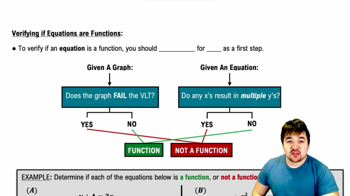
    The vertical line test determines if a graph represents a function by checking if any vertical line crosses the graph more than once. If it does, the graph is not a function.
  • How do you verify if an equation is a function using algebraic methods?

    You solve for y and check if any x-value results in more than one y-value. If this happens, the equation is not a function.
  • What is the 'squish strategy' for finding the domain of a graph?

    The 'squish strategy' involves compressing the graph onto the x-axis to see all possible x-values. This set of x-values represents the domain.
  • When using interval notation, what do brackets and parentheses indicate?

    Brackets indicate that an endpoint is included in the interval, while parentheses mean the endpoint is not included. This distinction is important for accurately describing domains and ranges.
  • Why can't the denominator of a function be zero when finding its domain?

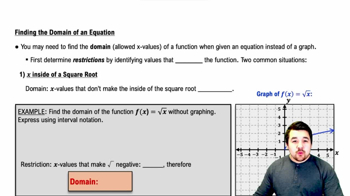
    Division by zero is undefined in mathematics, so any x-value that makes the denominator zero must be excluded from the domain. This ensures the function remains valid for all allowed x-values.
  • What is unique about the range of the square function f(x) = x^2?

    The range of the square function is all real numbers greater than or equal to zero. Negative y-values are not possible outputs for this function.
  • How does the cube root function differ from the square root function in terms of domain?

    The cube root function has a domain of all real numbers, including negatives, while the square root function only allows x-values greater than or equal to zero. This is because cube roots of negative numbers are defined, but square roots of negatives are not.
  • What does function notation f(x) represent in the context of equations?

    Function notation f(x) replaces y to explicitly show the output as a function of the input x. It is only used when the equation represents a function.