What is the period of the basic cosecant function y = csc(x)?
The period of the basic cosecant function y = csc(x) is 2π.
Where are the vertical asymptotes located for the basic cosecant function y = csc(x)?
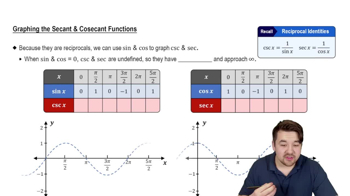
The vertical asymptotes for y = csc(x) are at x = 0, x = π, x = 2π, and so on, at every integer multiple of π. These occur where the sine function is zero.
What happens to the graph of y = csc(x) near the points where sin(x) approaches zero?
As sin(x) approaches zero, the values of csc(x) become very large in magnitude, approaching infinity or negative infinity. This causes the graph to have vertical asymptotes at those points.
How do the 'smiley' and 'frowny' faces appear in the graph of y = csc(x)?
The 'smiley' and 'frowny' faces in the graph of y = csc(x) occur between the asymptotes, corresponding to the peaks and valleys of the sine function. They represent the reciprocal behavior of the sine curve in those intervals.
What is the reciprocal identity that defines the secant function?
The secant function is defined as the reciprocal of the cosine function, so sec(x) = 1/cos(x). This relationship is used to graph secant based on the cosine graph.
At which x-values does the graph of y = sec(x) have vertical asymptotes?
The graph of y = sec(x) has vertical asymptotes at x = π/2, 3π/2, 5π/2, and so on, at every odd multiple of π/2. These are the points where cos(x) is zero.
How do the graphs of secant and cosecant functions compare in terms of their asymptote locations?
The graphs of secant and cosecant both have vertical asymptotes, but the locations differ: cosecant has asymptotes at integer multiples of π, while secant has them at odd multiples of π/2. This difference is due to the zeros of sine and cosine, respectively.
What transformation rules apply to the graphs of secant and cosecant functions?
The same transformation rules that apply to sine and cosine graphs, such as stretches and shifts, also apply to secant and cosecant graphs. This means you can use amplitude, period, phase shift, and vertical shift in the same way.
When graphing y = csc(2x), how do you determine the period of the function?
To determine the period of y = csc(2x), first find the period of y = sin(2x), which is 2π divided by 2, giving π. The period of y = csc(2x) is therefore π.
What is the recommended first step when graphing a transformed cosecant or secant function?
The recommended first step is to graph the corresponding sine or cosine function to understand its behavior and key points. Then, use the reciprocal relationship to plot the secant or cosecant graph, including asymptotes and reciprocal values.
 Back
Back

 6:22
6:22