What is the axis of symmetry for the graph of the function y = |x|?
The axis of symmetry for the graph of y = |x| is the y-axis, or the line x = 0.
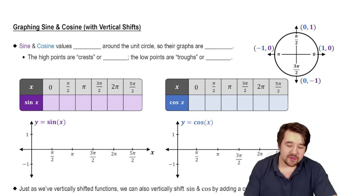
What coordinate from the unit circle does the sine function use to determine its graph values?
The sine function uses the y-coordinate from the unit circle. This association causes the sine graph to reflect the vertical position on the circle as x changes.
How does the starting value of the cosine graph at x = 0 differ from that of the sine graph?
The cosine graph starts at an output of 1 when x = 0, while the sine graph starts at 0. This difference is due to cosine using the x-coordinate and sine using the y-coordinate of the unit circle at 0 radians.
What are the terms for the highest and lowest points on a sine or cosine graph?
The highest points are called peaks or crests, and the lowest points are called valleys or troughs. These terms describe the maximum and minimum values the graph reaches.
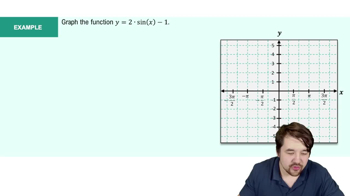
What effect does adding a positive constant k to a sine or cosine function have on its graph?
Adding a positive constant k shifts the entire graph vertically upward by k units. This is known as a vertical shift.
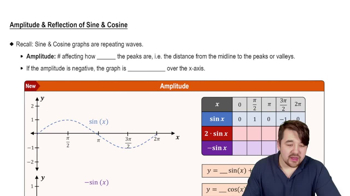
How do you determine the amplitude of a sine or cosine graph?
The amplitude is the distance from the midline of the graph to a peak or valley. It is given by the absolute value of the coefficient in front of the sine or cosine function.
What transformation occurs when the amplitude of a sine or cosine function is negative?
A negative amplitude reflects the graph over the x-axis. This means all the peaks become valleys and vice versa.
How does multiplying the input x by a number b inside the sine or cosine function affect the period?
Multiplying x by b changes the period to 2π divided by b. This means the graph completes one full cycle in a shorter or longer interval depending on b.
What happens to the period of the sine graph if the function is y = sin(2x)?
The period becomes π instead of 2π. This is because the period formula is 2π divided by 2, which equals π.
If the period of a cosine function is 1/2, what is the value of b in y = cos(bx)?
The value of b is 4π. This is found by setting 2π/b = 1/2 and solving for b.
What is the general formula for the zeros of the function y = sin(x)?
The zeros of y = sin(x) occur at x = nπ, where n is any integer.
What is the period of the function f(x) = sin(x)?
The period of f(x) = sin(x) is 2π.
How do you determine the period of y = sin(bx), and what is the period of y = sin(3x)?
The period of y = sin(bx) is given by 2π / b. For y = sin(3x), the period is 2π / 3.
What is the maximum value of the function f(x) = sin(x)?
 Back
Back

 02:43
02:43