Which equation represents a Pythagorean identity in trigonometry?
The primary Pythagorean identity is sin²θ + cos²θ = 1. Two other variations are tan²θ + 1 = sec²θ and 1 + cot²θ = csc²θ.
List the three main Pythagorean identities used to simplify trigonometric expressions.
The three main Pythagorean identities are: sin²θ + cos²θ = 1, tan²θ + 1 = sec²θ, and 1 + cot²θ = csc²θ.
What are the even-odd identities for the six trigonometric functions?
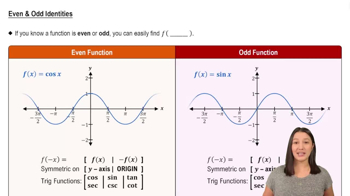
Cosine and secant are even functions: cos(-θ) = cos(θ), sec(-θ) = sec(θ). Sine, tangent, cosecant, and cotangent are odd functions: sin(-θ) = -sin(θ), tan(-θ) = -tan(θ), csc(-θ) = -csc(θ), cot(-θ) = -cot(θ).
How can you determine whether to use an even-odd identity when simplifying a trigonometric expression?
You should use an even-odd identity whenever the argument of the trigonometric function is negative. The argument is the value inside the parentheses of the trig function.
What property of even functions is reflected in the graph of the cosine function?
Even functions, like cosine, are symmetric about the y-axis. This means that folding the graph along the y-axis will align all points on either side.
How can the Pythagorean identity sin²θ + cos²θ = 1 be manipulated to express sin²θ in terms of cos²θ?
Subtract cos²θ from both sides to get sin²θ = 1 - cos²θ. This form is useful for simplifying expressions involving sin²θ.
What is the result of multiplying (1 - cosθ) by (1 + cosθ), and how does it relate to a Pythagorean identity?
Multiplying (1 - cosθ) by (1 + cosθ) gives 1 - cos²θ. According to the Pythagorean identity, this is equal to sin²θ.
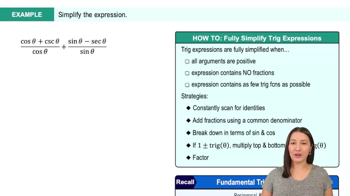
When simplifying trigonometric expressions, what are the three criteria for an expression to be considered fully simplified?
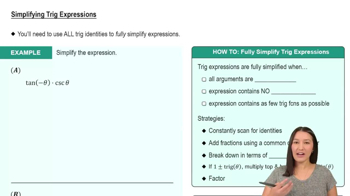
All arguments must be positive, the expression should contain no fractions, and it should have as few trigonometric functions as possible. Meeting these criteria ensures the simplest form.
What is a recommended first step when verifying a trigonometric identity involving two sides of an equation?
Start by simplifying the more complicated side of the equation. This often makes it easier to show that both sides are equal.
How can the trigonometric expression cos(θ) · csc(θ) · sin(θ) · cot(θ) be simplified using trigonometric identities?
First, rewrite all functions in terms of sine and cosine: cos(θ) · csc(θ) · sin(θ) · cot(θ) = cos(θ) · (1/sin(θ)) · sin(θ) · (cos(θ)/sin(θ)). The sin(θ) in the numerator and denominator cancel, leaving cos(θ) · (cos(θ)/sin(θ)) = cos²(θ)/sin(θ).
 Back
Back
 6:36
6:36