For which interval of x is the cancellation property sin⁻¹(sin(x)) = x valid?
The cancellation property sin⁻¹(sin(x)) = x is valid for x in the interval [−π/2, π/2].
Which of the following expressions is undefined: sin⁻¹(1), sin⁻¹(−2), cos⁻¹(0), or cos⁻¹(−1)?
The expression sin⁻¹(−2) is undefined because the inverse sine function is only defined for input values between −1 and 1.
In a right triangle, for which value of x does x equal cos⁻¹(y), where y is the cosine of angle x?
In a right triangle, if y = cos(x), then x = cos⁻¹(y); that is, the angle x is equal to the inverse cosine of its cosine value, provided x is in the interval [0, π].
What is the range of the inverse cosecant function y = csc⁻¹(x)?
The range of y = csc⁻¹(x) is [−π/2, 0) ∪ (0, π/2], excluding 0.
When evaluating inverse cosine, why is only the interval from 0 to π considered for possible angle solutions?
Only the interval from 0 to π is considered because the inverse cosine function is defined to return angles within this range to ensure it is a function and passes the vertical line test. This restriction avoids multiple possible outputs for a single input.
How do you interpret the expression cos⁻¹(1/2) using the unit circle?
You look for the angle on the unit circle whose cosine value is 1/2, but only consider angles between 0 and π. The answer is the angle π/3, since it is within the specified interval.
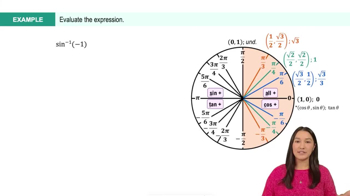
Why is the angle 7π/4 not used as a solution for sin⁻¹(−√2/2) even though its sine is −√2/2?
The angle 7π/4 is not used because it is not within the interval [−π/2, π/2] required for the inverse sine function. Instead, the equivalent angle −π/4 is used since it falls within the correct range.
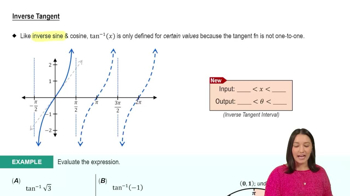
What is the domain of the inverse tangent function, and what is its output interval?
The domain of the inverse tangent function is all real numbers, from negative infinity to infinity. Its output interval is restricted to (−π/2, π/2).
How do you use a calculator to evaluate an inverse trigonometric function like sin⁻¹(x)?
You press the 'second' button followed by the corresponding trig function key (e.g., 'sin') to access the inverse function. Then, you enter the value and ensure the calculator is in radian mode unless otherwise specified.
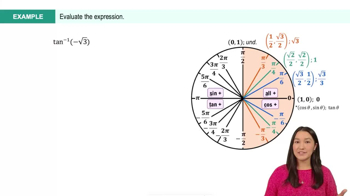
When finding tan⁻¹(√3), which angle from the unit circle is the correct answer and why?
The correct answer is π/3 because it is the angle in the interval (−π/2, π/2) whose tangent is √3. Only angles within this interval are valid outputs for the inverse tangent function.