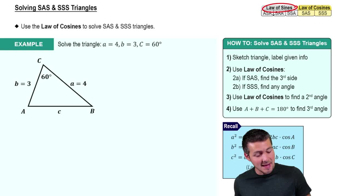
Which equation can be used to solve for side c in a triangle when you know sides a, b, and the included angle C?
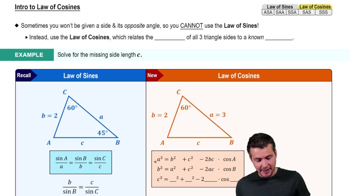
The Law of Cosines equation: c^2 = a^2 + b^2 - 2ab * cos(C).
Which equation can be used to find the value of side b in a triangle if side a and the included angle B are known?
The Law of Cosines equation: b^2 = a^2 + c^2 - 2ac * cos(B).
Which equation can be used to solve for the measure of angle ABC in a triangle when all three sides are known?
The Law of Cosines rearranged to solve for angle B: cos(B) = (a^2 + c^2 - b^2) / (2ac), then B = cos^(-1)[(a^2 + c^2 - b^2) / (2ac)].
What is the sum of the angle measures in a quadrilateral?
The sum of the angle measures in a quadrilateral is 360 degrees.
For which types of triangles can you use the Law of Cosines to solve for a missing side?
The Law of Cosines can be used to solve for a missing side in SAS (side-angle-side) and SSS (side-side-side) triangles.
If the diagonal of a rectangle or parallelogram is known, how can you use the Law of Cosines to find an unknown side or angle?
You can use the Law of Cosines by relating the diagonal (as one side of a triangle) to the other two sides and the included angle: d^2 = a^2 + b^2 - 2ab * cos(θ), where d is the diagonal and θ is the included angle.
If a kite has known side lengths and one diagonal, how can you use the Law of Cosines to find an unknown angle or side?
You can use the Law of Cosines by forming a triangle with two sides and the included angle or with all three sides, then applying the formula: c^2 = a^2 + b^2 - 2ab * cos(C).
In a right triangle, which equation can be used to solve for the hypotenuse c when the legs a and b are known?
The Pythagorean theorem, which is a special case of the Law of Cosines: c^2 = a^2 + b^2.
How can you find the length of a chord in a circle if you know the radius and the angle subtended by the chord at the center?
You can use the Law of Cosines: chord length^2 = 2r^2 - 2r^2 * cos(θ), where r is the radius and θ is the central angle in radians.
If triangle BCD is isosceles with BC = BD and the measure of angle BCD is known, how can you find the measure of the other angles?
In an isosceles triangle, the base angles are equal. If the vertex angle is known, subtract it from 180 degrees and divide the remainder by 2 to find each base angle.
Which equation correctly uses the Law of Cosines to solve for side y in a triangle with sides x, y, z and angle Y opposite side y?
The Law of Cosines: y^2 = x^2 + z^2 - 2xz * cos(Y).
If the lengths of the legs of a right triangle are 20 and 21, what is the length of the hypotenuse?
The hypotenuse is √(20^2 + 21^2) = √(400 + 441) = √841 = 29.
How can you determine if three given numbers can represent the sides of an obtuse triangle using the Law of Cosines?
For sides a, b, c (with c the largest), if c^2 > a^2 + b^2, the triangle is obtuse.
Given a triangle with sides b = 620 cm, angle C = 106°, and angle A = 48°, how can you find the length of side a?
First, find angle B using the angle sum property: B = 180° - 106° - 48° = 26°. Then use the Law of Sines: a / sin(A) = b / sin(B), so a = b * sin(A) / sin(B).
Given a triangle with side y = 940 inches, angle Y = 100°, and angle W = 38°, how can you find the length of side w?
First, find angle X: X = 180° - 100° - 38° = 42°. Then use the Law of Sines: w / sin(W) = y / sin(Y), so w = y * sin(W) / sin(Y).
For which pair of triangles is the cosine of angle B equal to the cosine of angle Z?
The cosine of angle B is equal to the cosine of angle Z if angle B and angle Z have the same measure.
How do you find the acute angle between two lines using trigonometry?
The acute angle θ between two lines with slopes m1 and m2 is given by θ = arccos(|(m1 - m2) / (1 + m1*m2)|).
 Back
Back
 4:35
4:35