How do you use the Law of Sines to solve for a missing angle in a triangle?
Set up the Law of Sines with the known side and angle, solve for the sine of the unknown angle, and use the inverse sine function to find the angle.
What is the Law of Sines formula for solving triangles?
sin(A)/a = sin(B)/b = sin(C)/c.
How do you determine if a triangle is possible with given side lengths and angles using the Law of Sines?
If the calculated sine value for an angle is between -1 and 1, a triangle is possible. If not, no triangle can be formed.
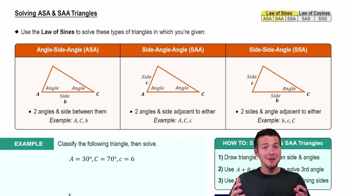
What is the process for solving a triangle using the Law of Sines when given two angles and one side?
1. Find the third angle using the angle sum property. 2. Use the Law of Sines to solve for the missing sides.
How do you use the Law of Sines to solve for a missing side 'b' if you know angle B, angle A, and side a?
Use the formula: b = (a / sin(A)) × sin(B).
What is the Law of Sines and when is it applicable?
The Law of Sines is a trigonometric equation used to solve for missing sides or angles in non-right triangles, especially in ASA, SAA, and SSA cases.
How do you use the Law of Sines to solve for a missing side in a triangle when given two angles and a side?
First, find the third angle using the angle sum property. Then, use the Law of Sines to solve for the missing side.
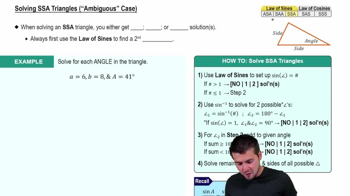
What is the ambiguous case in solving triangles, and how does the Law of Sines help resolve it?
The ambiguous case occurs in SSA triangles, where the Law of Sines may yield two possible values for an angle, leading to two possible triangles.
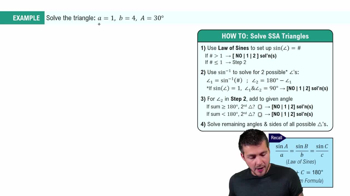
How do you use the Law of Sines to solve for a missing angle when given two sides and a non-included angle?
Set up the Law of Sines, solve for the sine of the unknown angle, and use the inverse sine function to find the angle.
What is the Law of Sines equation for a triangle with sides a, b, c and opposite angles A, B, C?
sin(A)/a = sin(B)/b = sin(C)/c.
How do you solve for a missing side in a triangle using the Law of Sines if you know two angles and one side?
Find the third angle using the angle sum property, then use the Law of Sines to solve for the missing side.
What is the process for solving a triangle when given two angles and a side not between them (SAA)?
1. Find the third angle using the angle sum property. 2. Use the Law of Sines to solve for the missing sides.
How do you check if a second triangle is possible in the ambiguous case using the Law of Sines?
After finding the first possible angle, subtract it from 180° to get the second possible angle. If the sum of the given angle and this second angle is less than 180°, a second triangle is possible.
What is the Law of Sines and how is it applied to solve triangles?
The Law of Sines relates the ratios of the sides of a triangle to the sines of their opposite angles and is used to solve for unknown sides or angles in non-right triangles.
How do you use the Law of Sines to solve for a missing side when given two angles and a side?
First, find the third angle using the angle sum property. Then, use the Law of Sines to solve for the missing side.
What is the ambiguous case in the Law of Sines, and how do you resolve it?
The ambiguous case occurs in SSA triangles. To resolve it, use the Law of Sines to find the possible value(s) for the unknown angle, and check if one or two triangles are possible based on the sum of the angles.
How do you use the Law of Sines to solve for a missing angle in a triangle?
Set up the Law of Sines with the known side and angle, solve for the sine of the unknown angle, and use the inverse sine function to find the angle.
What is the Law of Sines formula for solving triangles?
sin(A)/a = sin(B)/b = sin(C)/c.
How do you determine if a triangle is possible with given side lengths and angles using the Law of Sines?
If the calculated sine value for an angle is between -1 and 1, a triangle is possible. If not, no triangle can be formed.
What is the process for solving a triangle using the Law of Sines when given two angles and one side?
1. Find the third angle using the angle sum property. 2. Use the Law of Sines to solve for the missing sides.
How do you use the Law of Sines to solve for a missing side 'b' if you know angle B, angle A, and side a?
Use the formula: b = (a / sin(A)) × sin(B).
What is the Law of Sines and when is it applicable?
The Law of Sines is a trigonometric equation used to solve for missing sides or angles in non-right triangles, especially in ASA, SAA, and SSA cases.
How do you use the Law of Sines to solve for a missing side in a triangle when given two angles and a side?
First, find the third angle using the angle sum property. Then, use the Law of Sines to solve for the missing side.
What is the ambiguous case in solving triangles, and how does the Law of Sines help resolve it?
The ambiguous case occurs in SSA triangles, where the Law of Sines may yield two possible values for an angle, leading to two possible triangles.
How do you use the Law of Sines to solve for a missing angle when given two sides and a non-included angle?
Set up the Law of Sines, solve for the sine of the unknown angle, and use the inverse sine function to find the angle.
What is the Law of Sines equation for a triangle with sides a, b, c and opposite angles A, B, C?
sin(A)/a = sin(B)/b = sin(C)/c.
How do you solve for a missing side in a triangle using the Law of Sines if you know two angles and one side?
Find the third angle using the angle sum property, then use the Law of Sines to solve for the missing side.
What is the process for solving a triangle when given two angles and a side not between them (SAA)?
1. Find the third angle using the angle sum property. 2. Use the Law of Sines to solve for the missing sides.
How do you check if a second triangle is possible in the ambiguous case using the Law of Sines?
After finding the first possible angle, subtract it from 180° to get the second possible angle. If the sum of the given angle and this second angle is less than 180°, a second triangle is possible.
What is the Law of Sines and how is it applied to solve triangles?
The Law of Sines relates the ratios of the sides of a triangle to the sines of their opposite angles and is used to solve for unknown sides or angles in non-right triangles.
How do you use the Law of Sines to solve for a missing side when given two angles and a side?
First, find the third angle using the angle sum property. Then, use the Law of Sines to solve for the missing side.
What is the ambiguous case in the Law of Sines, and how do you resolve it?
The ambiguous case occurs in SSA triangles. To resolve it, use the Law of Sines to find the possible value(s) for the unknown angle, and check if one or two triangles are possible based on the sum of the angles.
How do you use the Law of Sines to solve for a missing angle in a triangle?
Set up the Law of Sines with the known side and angle, solve for the sine of the unknown angle, and use the inverse sine function to find the angle.
What is the Law of Sines formula for solving triangles?
sin(A)/a = sin(B)/b = sin(C)/c.
How do you determine if a triangle is possible with given side lengths and angles using the Law of Sines?
If the calculated sine value for an angle is between -1 and 1, a triangle is possible. If not, no triangle can be formed.
What is the process for solving a triangle using the Law of Sines when given two angles and one side?
1. Find the third angle using the angle sum property. 2. Use the Law of Sines to solve for the missing sides.
How do you use the Law of Sines to solve for a missing side 'b' if you know angle B, angle A, and side a?
Use the formula: b = (a / sin(A)) × sin(B).
What is the Law of Sines and when is it applicable?
The Law of Sines is a trigonometric equation used to solve for missing sides or angles in non-right triangles, especially in ASA, SAA, and SSA cases.
How do you use the Law of Sines to solve for a missing side in a triangle when given two angles and a side?
First, find the third angle using the angle sum property. Then, use the Law of Sines to solve for the missing side.
What is the ambiguous case in solving triangles, and how does the Law of Sines help resolve it?
The ambiguous case occurs in SSA triangles, where the Law of Sines may yield two possible values for an angle, leading to two possible triangles.
 Back
Back
 4:02
4:02