Control buttons has been changed to "navigation" mode.
1/12
Terms in this set (12)
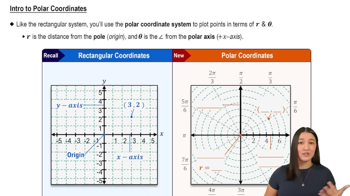
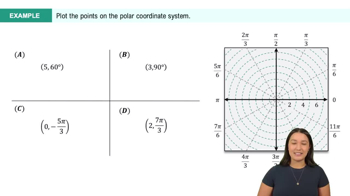
How are polar coordinates defined, and how do you plot a point given its polar coordinates (r, θ)?
Polar coordinates are defined by the ordered pair (r, θ), where r is the distance from the pole (origin) and θ is the angle measured from the polar axis (positive x-axis). To plot a point, first locate the angle θ from the polar axis, then move r units away from the pole along that direction.
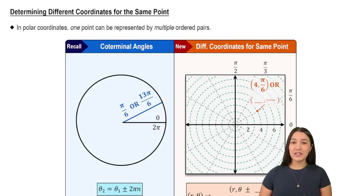
How can a single point in the polar coordinate system be represented by multiple polar coordinate pairs?
A single point in polar coordinates (r, θ) can be represented by multiple pairs by adding or subtracting multiples of 2π to θ: (r, θ + 2πn), where n is any integer. Additionally, the point can be represented as (−r, θ + π), which is the same location but with the radius in the opposite direction and the angle shifted by π.
What is the general form of the polar equation for a curve where the radius r is a function of the angle θ, such as r = 2 + 5sin(θ)?
The general form of a polar equation for a curve is r = f(θ), where r is the radius and θ is the angle. For example, r = 2 + 5sin(θ) describes a curve where the radius depends on the sine of the angle θ.
How do you find other polar coordinate pairs that label the same point as a given pair (r, θ)?
Other polar coordinate pairs for the same point can be found by (r, θ + 2πn) for any integer n, or by (−r, θ + π + 2πn), which uses the negative radius and shifts the angle by π plus any multiple of 2π.
What is the name for a set of coordinates that use a distance from a fixed point and an angle from a fixed direction?
This set of coordinates is called polar coordinates.
How do you express the same point in polar coordinates using a negative radius?
To express the same point with a negative radius, use (−r, θ + π), where r is the original radius and θ is the original angle. This shifts the angle by π and reverses the direction of the radius.
How do you find all possible polar coordinate pairs for a given point (r, θ)?
All possible polar coordinate pairs for a point are (r, θ + 2πn) and (−r, θ + π + 2πn), where n is any integer.
How do you convert the Cartesian equation x = y to polar form using r and θ?
In polar coordinates, x = r cos(θ) and y = r sin(θ). So, x = y becomes r cos(θ) = r sin(θ), or cos(θ) = sin(θ), which simplifies to θ = π/4 + nπ, where n is any integer.
What is the formula for the distance between two points with polar coordinates (r₁, θ₁) and (r₂, θ₂)?
The distance d between two points (r₁, θ₁) and (r₂, θ₂) in polar coordinates is d = sqrt(r₁² + r₂² − 2r₁r₂ cos(θ₁ − θ₂)).
What is the general formula for the length of a polar curve r = f(θ) from θ = a to θ = b?
The length L of a polar curve r = f(θ) from θ = a to θ = b is L = ∫ₐᵇ sqrt([dr/dθ]² + r²) dθ.
How do you find a Cartesian equation for the polar curve r = 5 cos(θ)?
Using x = r cos(θ) and y = r sin(θ), substitute r = 5 cos(θ): x = r cos(θ) = 5 cos(θ) cos(θ) = 5 cos²(θ). Alternatively, multiply both sides by r: r = 5 cos(θ) ⇒ r = 5x/r ⇒ r² = 5x ⇒ x² + y² = 5x.
How do you write the polar equation for the curve given by the Cartesian equation x² + y² = 3?
In polar coordinates, x² + y² = r², so the equation x² + y² = 3 becomes r² = 3.