Skip to main content
Trigonometry
My Course
Learn
Exam Prep
AI Tutor
Study Guides
Textbook Solutions
Flashcards
Explore
Try the app
My Course
Learn
Exam Prep
AI Tutor
Study Guides
Textbook Solutions
Flashcards
Explore
Try the app
Back
Powers of Complex Numbers (DeMoivre's Theorem) definitions
You can tap to flip the card.
Polar Form
You can tap to flip the card.
👆
Polar Form
Representation of a complex number using a modulus and an angle, simplifying multiplication and exponentiation.
Track progress
Control buttons has been changed to "navigation" mode.
1/15
Related flashcards
Related practice
Recommended videos
Powers of Complex Numbers (DeMoivre's Theorem) quiz
Powers of Complex Numbers (DeMoivre's Theorem)
15 Terms
Powers of Complex Numbers (DeMoivre's Theorem)
11. Graphing Complex Numbers
4 problems
Topic
Patrick
Products and Quotients of Complex Numbers
11. Graphing Complex Numbers
2 problems
Topic
Patrick
11. Graphing Complex Numbers
4 topics
8 problems
Chapter
Patrick
Guided course
07:37
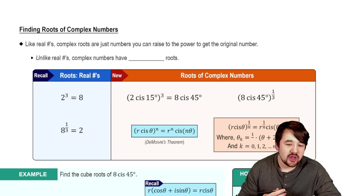
Complex Roots
627
views
2
rank
Guided course
07:55
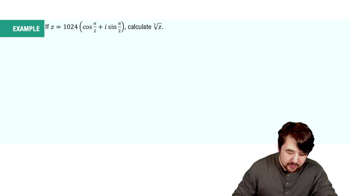
Complex Roots Example 1
694
views
2
rank
Guided course
03:41
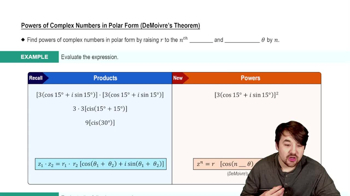
Powers Of Complex Numbers In Polar Form (DeMoivre's Theorem)
746
views
3
rank
Terms in this set (15)
Hide definitions
Polar Form
Representation of a complex number using a modulus and an angle, simplifying multiplication and exponentiation.
Modulus
The distance from the origin to a complex number in the complex plane, used as the r value in polar form.
Argument
The angle measured from the positive real axis to the complex number, crucial for polar representation.
De Moivre's Theorem
A shortcut for raising complex numbers in polar form to powers, involving exponentiation of modulus and multiplication of angle.
cis
Abbreviation for cosine plus i times sine of an angle, used to express complex numbers compactly in polar form.
Root
A value that, when raised to a specific power, yields the original complex number; often results in multiple solutions.
Cube Root
A specific root where the exponent is three, producing three distinct complex solutions due to periodicity.
Square Root
A specific root where the exponent is two, resulting in two distinct complex solutions.
Theta k
An angle calculated for each root, using a formula involving division by n and addition of a full rotation times k.
Full Rotation
A complete turn in the complex plane, represented as 360 degrees or 2π radians, used to find all roots.
Radians
A unit for measuring angles, often used in complex number calculations alongside degrees.
Integer k
A variable representing different root solutions, ranging from zero to n minus one in root calculations.
Exponent
A value indicating the power to which a complex number is raised, affecting both modulus and argument.
Multiple Solutions
The phenomenon where root operations on complex numbers yield several distinct answers due to periodicity.
Complex Plane
A two-dimensional space where complex numbers are visualized, with real and imaginary axes.
 BackBack
 07:37
07:37