Skip to main content
Trigonometry
My Course
Learn
Exam Prep
AI Tutor
Study Guides
Textbook Solutions
Flashcards
Explore
Try the app
My Course
Learn
Exam Prep
AI Tutor
Study Guides
Textbook Solutions
Flashcards
Explore
Try the app
Back
Powers of Complex Numbers (DeMoivre's Theorem) quiz
You can tap to flip the card.
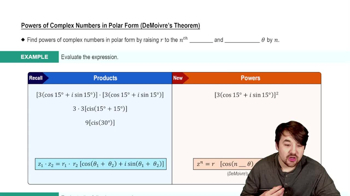
What does De Moivre's Theorem state for raising a complex number in polar form to a power n?
You can tap to flip the card.
👆
What does De Moivre's Theorem state for raising a complex number in polar form to a power n?
Raise the modulus r to the nth power and multiply the angle θ by n: (r cis θ)^n = r^n cis(nθ).
Track progress
Control buttons has been changed to "navigation" mode.
1/15
Related flashcards
Related practice
Recommended videos
Powers of Complex Numbers (DeMoivre's Theorem) definitions
Powers of Complex Numbers (DeMoivre's Theorem)
15 Terms
Powers of Complex Numbers (DeMoivre's Theorem)
11. Graphing Complex Numbers
4 problems
Topic
Patrick
Products and Quotients of Complex Numbers
11. Graphing Complex Numbers
2 problems
Topic
Patrick
11. Graphing Complex Numbers
4 topics
8 problems
Chapter
Patrick
Guided course
07:37
Complex Roots
626
views
2
rank
Guided course
07:55
Complex Roots Example 1
694
views
2
rank
Guided course
03:41
Powers Of Complex Numbers In Polar Form (DeMoivre's Theorem)
746
views
3
rank
Terms in this set (15)
Hide definitions
What does De Moivre's Theorem state for raising a complex number in polar form to a power n?
Raise the modulus r to the nth power and multiply the angle θ by n: (r cis θ)^n = r^n cis(nθ).
How do you multiply two complex numbers in polar form?
Multiply their r values and add their angles.
What is the shortcut provided by De Moivre's Theorem when raising a complex number to a power?
Raise the modulus to the power and multiply the angle by the power.
If z = 3 cis 15°, what is z^2 using De Moivre's Theorem?
z^2 = 9 cis 30°.
Why is De Moivre's Theorem useful for higher powers of complex numbers?
It simplifies calculations that would otherwise require repeated multiplication.
How do you find the nth root of a complex number in polar form?
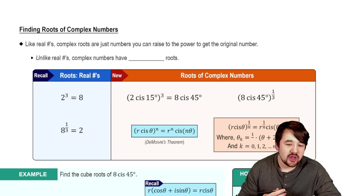
Take the nth root of r and divide the angle by n, then add 360°k/n (or 2πk/n) for all integer k from 0 to n-1.
What formula do you use to find all nth roots of a complex number?
z_k = r^(1/n) cis[(θ + 360°k)/n] for k = 0, 1, ..., n-1.
How many distinct nth roots does a complex number have?
It has n distinct roots.
What does the variable k represent when finding roots of complex numbers?
k is an integer from 0 to n-1, used to find all possible roots.
If you want the cube roots of 8 cis 45°, what is the modulus of each root?
The modulus is 2, since 8^(1/3) = 2.
How do you calculate the angles for the cube roots of 8 cis 45°?
Use θ_k = (45° + 360°k)/3 for k = 0, 1, 2.
What are the three angles for the cube roots of 8 cis 45°?
15°, 135°, and 255°.
What is the general form for the kth root of a complex number in polar form?
z_k = r^(1/n) cis[(θ + 360°k)/n].
Why do you add 360°k (or 2πk) when finding roots of complex numbers?
To account for all possible solutions around the unit circle.
What is the abbreviation 'cis' short for in complex numbers?
'cis θ' stands for 'cos θ + i sin θ'.
 BackBack
 07:37
07:37