Pythagorean Theorem & Basics of Triangles quiz #1 Flashcards

Pythagorean Theorem & Basics of Triangles quiz #1
Control buttons has been changed to "navigation" mode.
1/39
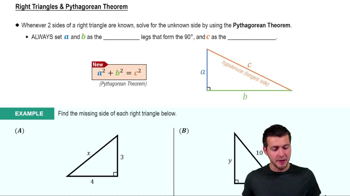
  • How do you find the length of the hypotenuse in a right triangle when the lengths of the two legs are known?
    Use the Pythagorean theorem: c = sqrt(a^2 + b^2), where a and b are the lengths of the legs and c is the hypotenuse.
  • What is the general formula for the length of the hypotenuse in a right triangle with legs of length a and b?
    The length of the hypotenuse is c = sqrt(a^2 + b^2).
  • What steps do you follow to find the hypotenuse of a right triangle if necessary?
    Square the lengths of both legs, add the results, and take the square root to find the hypotenuse.
  • How can you determine if three positive numbers form a Pythagorean triple?
    Three positive numbers form a Pythagorean triple if the sum of the squares of the two smaller numbers equals the square of the largest number: a^2 + b^2 = c^2.
  • Which equation is used to find the length of the hypotenuse in a right triangle?
    The equation is a^2 + b^2 = c^2, where c is the hypotenuse.
  • What should you keep in mind when finding the length of the hypotenuse of a right triangle?
    Ensure the triangle is a right triangle and use the Pythagorean theorem: a^2 + b^2 = c^2.
  • What is the length of the hypotenuse in a right triangle with legs of length 14 and 48?
    The hypotenuse is sqrt(14^2 + 48^2) = sqrt(196 + 2304) = sqrt(2500) = 50.
  • How do you find the hypotenuse of a right triangle?
    Apply the Pythagorean theorem: c = sqrt(a^2 + b^2), where a and b are the legs.
  • What is the relationship between the sides of a right triangle based on Pythagorean identities?
    The sum of the squares of the legs equals the square of the hypotenuse: a^2 + b^2 = c^2.
  • How do you calculate the hypotenuse of a triangle using the Pythagorean theorem?
    Square the lengths of the two legs, add them, and take the square root to find the hypotenuse.
  • What is a set of side lengths that forms a Pythagorean triple?
    A set like (3, 4, 5) forms a Pythagorean triple because 3^2 + 4^2 = 5^2.
  • What is the sum of the interior angles of a polygon with 19 sides?
    The sum is (19 - 2) × 180 = 17 × 180 = 3060 degrees.
  • How can you determine if three numbers could represent the sides of a right triangle?
    Check if the sum of the squares of the two smaller numbers equals the square of the largest: a^2 + b^2 = c^2.
  • What is the sum of two interior angles of a regular pentagon?
    Each angle in a regular pentagon is 108 degrees, so the sum of two is 216 degrees.
  • Which Pythagorean identity is correct for right triangles?
    a^2 + b^2 = c^2, where a and b are legs and c is the hypotenuse.
  • How can similarity of triangles be used to prove the Pythagorean theorem?
    By constructing two smaller right triangles within a larger right triangle and showing their sides are proportional, leading to a^2 + b^2 = c^2.
  • What is another example of a Pythagorean triple?
    The set (5, 12, 13) is a Pythagorean triple because 5^2 + 12^2 = 13^2.
  • What equation can be used to determine if a triangle is a right triangle?
    Use a^2 + b^2 = c^2, where c is the longest side.
  • How can you identify an obtuse triangle?
    An obtuse triangle has one angle greater than 90 degrees.
  • What is unique about Pythagorean triples?
    Pythagorean triples are sets of three positive integers that satisfy a^2 + b^2 = c^2.
  • What is the length of the hypotenuse in a right triangle with legs of 18 and 36 units?
    The hypotenuse is sqrt(18^2 + 36^2) = sqrt(324 + 1296) = sqrt(1620) ≈ 40.2 units.
  • What is the length of the hypotenuse of a right triangle with legs that are 7 and 8 inches long?
    The hypotenuse is sqrt(7^2 + 8^2) = sqrt(49 + 64) = sqrt(113) ≈ 10.6 inches.
  • How do you determine if a set of side lengths forms a right triangle?
    Check if the sum of the squares of the two shorter sides equals the square of the longest side.
  • What is true regarding the Pythagorean theorem?
    It applies only to right triangles and relates the squares of the sides: a^2 + b^2 = c^2.
  • How do you solve for the hypotenuse using the equations 5^2 + 12^2 = c^2 and 25 + 144 = c^2?
    Add the squares of the legs: 25 + 144 = 169, so c^2 = 169 and c = 13.
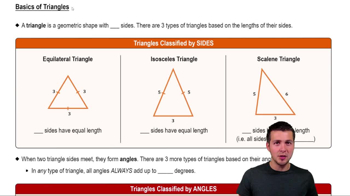
  • What are the main types of triangles based on sides and angles?
    Based on sides: equilateral, isosceles, scalene. Based on angles: acute, obtuse, right.
  • What is the difference between the height and the slant height of a pyramid?
    The height is the perpendicular distance from the base to the apex; the slant height is the distance along the face from the base to the apex.
  • How can you apply the Pythagorean theorem to word problems involving right triangles?
    Identify the legs and hypotenuse, set up a^2 + b^2 = c^2, and solve for the unknown side.
  • How do you check if given side lengths form a right triangle?
    Verify if a^2 + b^2 = c^2, where c is the longest side.
  • What is necessarily true if a segment is an altitude to the hypotenuse of a right triangle?
    The altitude creates two smaller right triangles that are similar to the original triangle.
  • How do you find the hypotenuse of a right triangle and round to the nearest tenth if necessary?
    Use c = sqrt(a^2 + b^2) and round the result to the nearest tenth.
  • If (20, 21, x) is a Pythagorean triple, what is the value of x?
    x = sqrt(20^2 + 21^2) = sqrt(400 + 441) = sqrt(841) = 29.
  • Which equation can be used to find x, the hypotenuse of a right triangle with legs a and b?
    x^2 = a^2 + b^2.
  • Which equation is true based on Pythagorean identities?
    a^2 + b^2 = c^2 for right triangles.
  • Which of the following sets of side lengths is a Pythagorean triple: (2, 3, 13), (5, 7, 12), (10, 24, 29), (11, 60, 61)?
    Both (10, 24, 29) and (11, 60, 61) are Pythagorean triples.
  • Which of the following sets of side lengths is a Pythagorean triple: (1, 3, 10), (4, 5, 9), (9, 40, 41), (16, 30, 44)?
    (9, 40, 41) is a Pythagorean triple.
  • What is the measure of each angle of a regular hexagon?
    Each angle is (6 - 2) × 180 ÷ 6 = 120 degrees.
  • How can a geometric figure be used to prove the Pythagorean theorem?
    By constructing squares on each side of a right triangle and showing the area of the largest square equals the sum of the areas of the other two.
  • How can you best describe a triangle based on its sides and angles?
    A triangle can be described as equilateral, isosceles, or scalene by sides, and as acute, obtuse, or right by angles.