How can you determine whether two linear equations (representing lines) intersect, and if they do, how do you find their point of intersection?
To determine if two lines intersect, set their linear equations equal to each other and solve for the variable. If a unique solution exists, the lines intersect at that point. If the equations are equivalent (identity), the lines coincide (infinite intersections). If the equations lead to a contradiction (no solution), the lines are parallel and do not intersect. To find the intersection point, solve the system of equations for the variables; the solution gives the coordinates of the intersection.
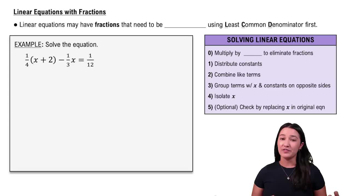
What is the first step you should take when solving a linear equation that contains fractions?
Multiply both sides of the equation by the least common denominator (LCD) to eliminate the fractions. This step is often called step 0 before proceeding with other solving techniques.
Why is it important to perform the same operation on both sides of a linear equation?
Performing the same operation on both sides maintains the equality of the equation. This ensures that the solution remains valid throughout the solving process.
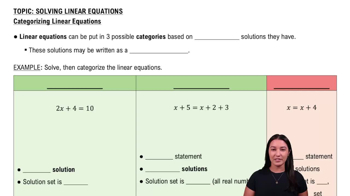
What does it mean if, after simplifying a linear equation, you end up with a statement like 0 = 0?
It means the equation is an identity and has infinitely many solutions. Any value for the variable will satisfy the equation.
How do you check if your solution to a linear equation is correct?
Substitute your solution back into the original equation and verify that both sides are equal. If the statement is true, your solution is correct.
What is the solution set notation for a linear equation with no solutions?
The solution set is written as an empty set, denoted by curly brackets with a zero and a slash through it. This indicates that there are no values that satisfy the equation.
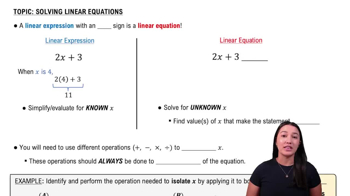
What is the opposite operation to use when a variable is being multiplied by a constant in a linear equation?
The opposite operation is division. You divide both sides of the equation by the constant to isolate the variable.
What is a conditional linear equation?
A conditional linear equation is true only for one specific value of the variable. It has exactly one solution.
What is the purpose of distributing constants when solving linear equations?
Distributing constants helps to eliminate parentheses and simplify the equation. This makes it easier to combine like terms and isolate the variable.
What does it indicate if simplifying a linear equation results in a false statement like 0 = 4?
It indicates the equation is inconsistent and has no solutions. No value for the variable will make the equation true.