Skip to main content
Trigonometry
My Course
Learn
Exam Prep
AI Tutor
Study Guides
Textbook Solutions
Flashcards
Explore
Try the app
My Course
Learn
Exam Prep
AI Tutor
Study Guides
Textbook Solutions
Flashcards
Explore
Try the app
Back
Solving Right Triangles quiz #1
You can tap to flip the card.
How do you find the length of the hypotenuse in a right triangle when the lengths of the two legs are known?
You can tap to flip the card.
👆
How do you find the length of the hypotenuse in a right triangle when the lengths of the two legs are known?
Use the Pythagorean theorem: hypotenuse = sqrt(a^2 + b^2), where a and b are the lengths of the legs.
Track progress
Control buttons has been changed to "navigation" mode.
1/40
Related flashcards
Related practice
Recommended videos
Solving Right Triangles quiz #2
Solving Right Triangles
29 Terms
Solving Right Triangles definitions
Solving Right Triangles
15 Terms
Solving Right Triangles
2. Trigonometric Functions on Right Triangles
4 problems
Topic
Patrick
Cofunctions of Complementary Angles
2. Trigonometric Functions on Right Triangles
3 problems
Topic
2. Trigonometric Functions on Right Triangles
4 topics
7 problems
Chapter
Patrick
Guided course
5:13
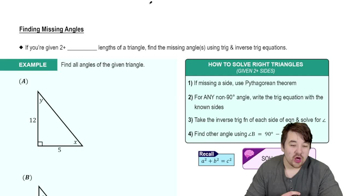
Finding Missing Angles
1619
views
15
rank
Guided course
4:56
Example 1
1063
views
9
rank
1
comments
Guided course
3:22
Example 2
1039
views
15
rank
Terms in this set (40)
Hide definitions
How do you find the length of the hypotenuse in a right triangle when the lengths of the two legs are known?
Use the Pythagorean theorem: hypotenuse = sqrt(a^2 + b^2), where a and b are the lengths of the legs.
What is always true about the angles of an isosceles triangle?
An isosceles triangle always has two congruent angles opposite the equal sides.
How do you find the length of one leg of a right triangle if you know the hypotenuse and the other leg?
Use the Pythagorean theorem: leg = sqrt(hypotenuse^2 - other leg^2).
How do you find the length of a side in a right triangle if you know one side and one non-right angle?
Use a trigonometric function (sine, cosine, or tangent) relating the known side and angle to the unknown side.
How do you find the length of the missing leg in a right triangle if you know the hypotenuse and one leg?
Use the Pythagorean theorem: missing leg = sqrt(hypotenuse^2 - known leg^2).
How do you find the value of an unknown side x in a right triangle given one side and one angle?
Set up a trigonometric equation using sine, cosine, or tangent, and solve for x.
How do you determine the length of the side opposite a given angle in a right triangle?
Use the sine function: opposite = hypotenuse × sin(angle).
How do you find the length of the side opposite a given angle in a right triangle using trigonometry?
Use the sine function: opposite = hypotenuse × sin(angle).
If two parallel lines are crossed by a transversal, how can you determine the value of an unknown angle formed?
Use the properties of parallel lines and transversals: corresponding angles are equal, and alternate interior angles are equal.
How do you find the length of the hypotenuse in a right triangle if the legs are known?
Apply the Pythagorean theorem: hypotenuse = sqrt(a^2 + b^2).
How do you find the length of an unknown leg in a right triangle if the hypotenuse and one leg are known?
Use the Pythagorean theorem: unknown leg = sqrt(hypotenuse^2 - known leg^2).
How do you find the value of x in a right triangle if you know two sides?
Use the Pythagorean theorem or trigonometric ratios to solve for x.
How do you find the measure of an angle in a right triangle if you know two sides?
Use the inverse trigonometric function (arcsin, arccos, or arctan) with the known side ratios.
In an isosceles triangle, which angles are congruent?
The two base angles opposite the equal sides are congruent.
How do you find the measure of an angle in a parallelogram if the other three angles are known?
Use the property that the sum of the angles in a parallelogram is 360°, and opposite angles are equal.
In an isosceles triangle, how do you find the length of a side if you know the other two sides?
If two sides are equal, the third side can be found using the triangle's properties or the Law of Cosines if an angle is known.
If the vertex angle of an isosceles triangle is 110 degrees, what are the measures of the base angles?
Each base angle is (180° - 110°) / 2 = 35°.
How do you find the value of x in a right triangle if you know one side and one angle?
Use a trigonometric function (sine, cosine, or tangent) to relate the known side and angle to x.
How do you find the length of a side in triangle PQR if you know two sides and the included angle?
Use the Law of Cosines: c^2 = a^2 + b^2 - 2ab cos(C).
How do you determine if two right cones are similar based on their dimensions?
Two right cones are similar if the ratios of their corresponding linear dimensions (such as height and radius) are equal.
How do you find the degree measure of an angle in a right triangle if you know two sides?
Use the inverse trigonometric function (arcsin, arccos, or arctan) with the appropriate side ratio.
If two triangles are similar, how do you find the value of a missing side?
Set up a proportion between corresponding sides and solve for the missing value.
How do you find the length of a side in a triangle if the triangle is similar to another triangle with known side lengths?
Use the ratio of corresponding sides to set up a proportion and solve for the unknown length.
How do you solve a right triangle if you are given one side and one non-right angle?
Find the other non-right angle by subtracting the given angle from 90°, then use trigonometric functions to find the missing sides.
How do you prove that a triangle is an isosceles right triangle?
A triangle is an isosceles right triangle if it has a right angle and the two legs are congruent.
If the length of a segment in a right triangle is 18 units, how do you find the other sides?
Use the Pythagorean theorem or trigonometric functions, depending on what other information is given.
If an isosceles triangle has a 130° angle at the vertex, what are the measures of the base angles?
Each base angle is (180° - 130°) / 2 = 25°.
How do you find the lengths of two sides of a kite if you know the lengths of the other sides?
Use the properties of kites: two pairs of adjacent sides are equal.
How do you find the height of a triangle if you know the area and the base?
Use the formula: area = (1/2) × base × height, and solve for height.
Which set of three angles could represent the interior angles of a triangle?
Any set of three positive angles that sum to 180° can represent the interior angles of a triangle.
How do you determine which triangle has an unknown side length of 7 units?
Use the Pythagorean theorem or trigonometric ratios to solve for the unknown side and check if it equals 7 units.
How do you find the perimeter of a triangle if you know the lengths of all three sides?
Add the lengths of the three sides together: perimeter = a + b + c.
How do you find the length of the longer diagonal in a kite if you know the lengths of the sides?
Use the properties of kites and the Pythagorean theorem if the diagonals are perpendicular and bisect each other.
How do you find the measure of the obtuse angle in a triangle if the other two angles are known?
Subtract the sum of the two known angles from 180° to find the measure of the third angle.
How do you find the measure of an angle in a triangle if the other two angles are 21° and 60°?
Subtract the sum of the two angles from 180°: 180° - (21° + 60°) = 99°.
In a right triangle, if one angle measures 20°, what is the measure of the other acute angle?
The other acute angle is 90° - 20° = 70°.
How do you find the length of the hypotenuse of a right triangle if the legs are 26 ft and 34 ft?
Use the Pythagorean theorem: hypotenuse = sqrt(26^2 + 34^2).
How do you set up an equation to find the value of x in a right triangle?
Use a trigonometric ratio (sine, cosine, or tangent) or the Pythagorean theorem, depending on the known values.
How do you find the length of the unknown leg in a right triangle if the hypotenuse is 64 yd and one leg is 8 yd?
Use the Pythagorean theorem: unknown leg = sqrt(64^2 - 8^2).
How do you find the length of the unknown leg in a right triangle if the hypotenuse is 9 ft and one leg is 3 ft?
Use the Pythagorean theorem: unknown leg = sqrt(9^2 - 3^2).
 BackBack
 5:13
5:13