How do you find the length of a side in triangle ABC if you know the lengths of the other two sides?
Use the Pythagorean theorem if it is a right triangle: missing side = sqrt(hypotenuse^2 - known leg^2) or sqrt(a^2 + b^2) if the missing side is the hypotenuse.
How do you find the length of a line segment in a right triangle if you know the other two sides?
Use the Pythagorean theorem: missing side = sqrt(hypotenuse^2 - known leg^2) or sqrt(a^2 + b^2) if the missing side is the hypotenuse.
How do you find the length of the missing leg in a right triangle if the hypotenuse is 26 mm and one leg is 18 mm?
Use the Pythagorean theorem: missing leg = sqrt(26^2 - 18^2).
In a right triangle, if one angle measures 80°, what is the measure of the other acute angle?
The other acute angle is 90° - 80° = 10°.
How do you find the length of a side in a right triangle if you know the lengths of the other two sides?
Use the Pythagorean theorem: missing side = sqrt(hypotenuse^2 - known leg^2) or sqrt(a^2 + b^2) if the missing side is the hypotenuse.
How do you find the length of the unknown leg in a right triangle if the hypotenuse is 40 cm and one leg is 8 cm?
Use the Pythagorean theorem: unknown leg = sqrt(40^2 - 8^2).
How many triangles can exist with a given set of angle measures that sum to 180°?
Exactly one triangle can exist for a given set of angle measures that sum to 180°.
In a right triangle, if one angle measures 10°, what is the measure of the other acute angle?
The other acute angle is 90° - 10° = 80°.
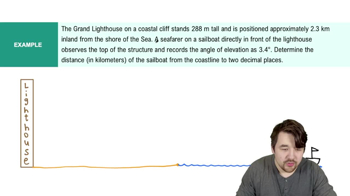
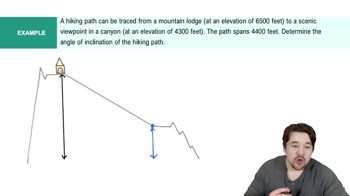
How do you find the approximate values of missing side lengths in a right triangle if you know one side and one angle?
Use trigonometric functions (sine, cosine, or tangent) to set up equations and solve for the missing sides.
How many distinct triangles can be formed for which one angle is 51°?
If the other two angles sum to 129°, exactly one triangle can be formed.
How do you find the length of one leg of a right triangle if the other leg and the hypotenuse are known?
Use the Pythagorean theorem: leg = sqrt(hypotenuse^2 - other leg^2).
How do you find the perimeter of a triangle if you know the coordinates of its vertices?
Calculate the distance between each pair of vertices using the distance formula, then sum the three side lengths.
How do you find the length of each leg of an isosceles right triangle if the hypotenuse is known?
Each leg = hypotenuse / sqrt(2).
If point P is the center of a circle, how do you find the value of an unknown angle or segment in a triangle inscribed in the circle?
Use properties of circles and triangles, such as the inscribed angle theorem or the Pythagorean theorem if applicable.
How do you find the missing angle measures in triangle ABC if two angles are known?
Subtract the sum of the two known angles from 180° to find the third angle.
How do you find the value of x in a triangle if you know the other two angles?
x = 180° minus the sum of the other two angles.
How many triangles can be constructed with sides measuring 15 cm, 15 cm, and 15 cm?
Exactly one equilateral triangle can be constructed with three sides of 15 cm.
How do you find the length of the third side of a triangle if you know the other two sides and the included angle?
Use the Law of Cosines: c^2 = a^2 + b^2 - 2ab cos(C).
If two interior angles of a triangle each measure 34°, what is the measure of the third angle?
The third angle is 180° - 34° - 34° = 112°.
How do you find the base of a triangle if you know the area and the height?
Use the formula: area = (1/2) × base × height, and solve for base.
How do you find the radius of a circle that has a circumference of 16 units?
Use the formula: circumference = 2πr, so r = 16 / (2π).
How do you find the length of the hypotenuse of a right triangle if the legs are known?
Use the Pythagorean theorem: hypotenuse = sqrt(a^2 + b^2).
In a right triangle, if the lengths of two sides are known, how do you find the length of the third side?
Use the Pythagorean theorem: missing side = sqrt(hypotenuse^2 - known leg^2) or sqrt(a^2 + b^2) if the missing side is the hypotenuse.
How do you find the length of the missing leg in a right triangle if the hypotenuse and one leg are known?
Use the Pythagorean theorem: missing leg = sqrt(hypotenuse^2 - known leg^2).
How do you find the length of a side in a triangle after a dilation transformation with a given scale factor?
Multiply the original side length by the scale factor.
How do you find the length of a side labeled x in a right triangle if you know one side and one angle?
Use a trigonometric function (sine, cosine, or tangent) to relate the known side and angle to x.
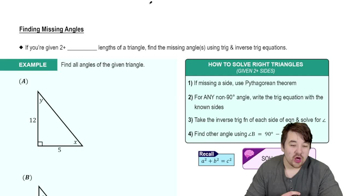
How do you solve for an unknown angle x in a right triangle if you know two sides?
Use the inverse trigonometric function (arcsin, arccos, or arctan) with the appropriate side ratio.
How do you find the length of a side labeled x in a right triangle if you know the other two sides?
Use the Pythagorean theorem: x = sqrt(hypotenuse^2 - known leg^2) or x = sqrt(a^2 + b^2) if x is the hypotenuse.
For a right triangle, how do you find a side length to the nearest hundredth if you know one side and one angle?
Use a trigonometric function to set up an equation and solve for the side, rounding the answer to the nearest hundredth.
 Back
Back
 5:13
5:13