 Back
BackAcute Angles and Right Triangles: Trigonometric Functions and Applications
Study Guide - Smart Notes
 Tailored notes based on your materials, expanded with key definitions, examples, and context.
Acute Angles and Right Triangles
Trigonometric Functions of Acute Angles
Trigonometric functions relate the angles of a right triangle to the ratios of its sides. For any acute angle in a right triangle, the six primary trigonometric functions are defined as follows:
Sine (sin): Ratio of the side opposite the angle to the hypotenuse.
Cosine (cos): Ratio of the side adjacent to the angle to the hypotenuse.
Tangent (tan): Ratio of the side opposite the angle to the side adjacent.
Cotangent (cot): Reciprocal of tangent.
Secant (sec): Reciprocal of cosine.
Cosecant (csc): Reciprocal of sine.
For triangle ABC with sides 77, 36, and 85:
sin A =
cos A =
tan A =
sin B =
cos B =
tan B =
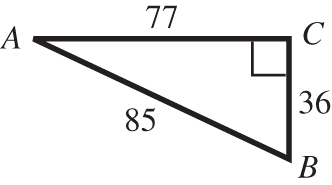
Example: In a right triangle, if the side opposite angle A is 36, the adjacent is 77, and the hypotenuse is 85, then , , .
Special Right Triangles and Trigonometric Values
Special right triangles, such as the 30°-60°-90° triangle, have side ratios that allow for exact trigonometric values:
For a 30°-60°-90° triangle: sides are 1, , and 2.
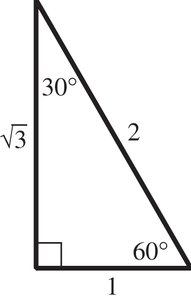
Example: In a 30°-60°-90° triangle, the side opposite 30° is 1, opposite 60° is , and the hypotenuse is 2.
Trigonometric Functions of Non-Acute Angles
Trigonometric functions can be extended to angles greater than 90°, using reference angles and quadrant analysis. The reference angle is the acute angle formed with the x-axis, and the sign of the function depends on the quadrant.
Reference angle for 294°: (Quadrant IV)
Reference angle for 883°: (Quadrant II)
Reference angle for 225°: (Quadrant III)
Signs in Quadrant III: tan and cot are positive; sin, cos, sec, and csc are negative.
Example: , , .
Finding Trigonometric Function Values Using a Calculator
Calculators are used to find decimal approximations of trigonometric functions for arbitrary angles:
Example: To find when , solve .
Solutions and Applications of Right Triangles
Solving Right Triangles
Solving a right triangle involves finding all unknown sides and angles using trigonometric ratios and the Pythagorean theorem.
Given one side and one acute angle, use sine, cosine, or tangent to find other sides.
Pythagorean theorem:
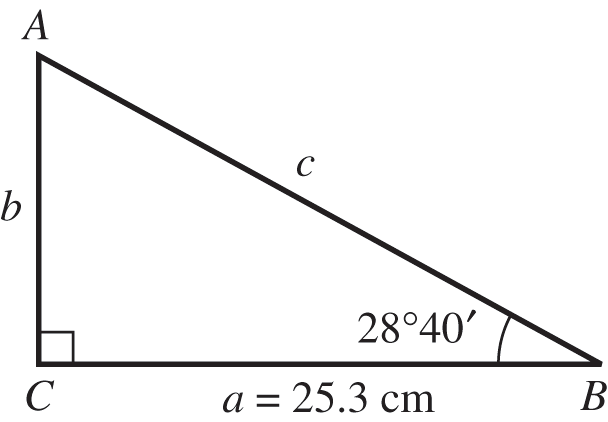
Example: In triangle ABC, with angle B = 28°40' and side AB = 25.3 cm:
, cm, cm
, cm
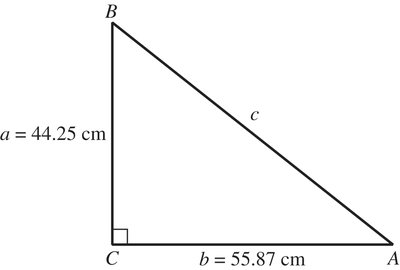
Example: In triangle ABC, with sides AC = 44.25 cm and BC = 55.87 cm:
cm
Angle A
Applications: Height and Distance Problems
Trigonometric functions are used to solve real-world problems involving heights and distances, such as finding the height of a tree or the distance across a river.
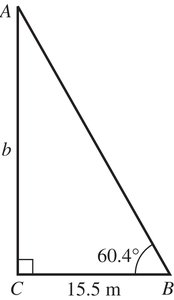
Example: To find the height of a tree:
Given angle B = 60.4°, side adjacent = 15.5 m
m
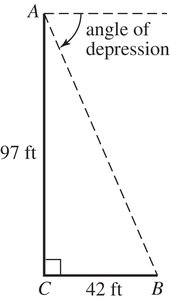
Example: To find the distance using the angle of depression:
Height = 97 ft, horizontal distance = 42 ft
,
Further Applications of Right Triangles
Navigation and Surveying Problems
Trigonometry is essential in navigation and surveying, where distances and angles are used to determine positions and routes.
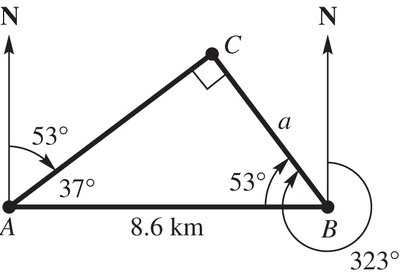
Example: To find the distance a ship travels:
Given , km
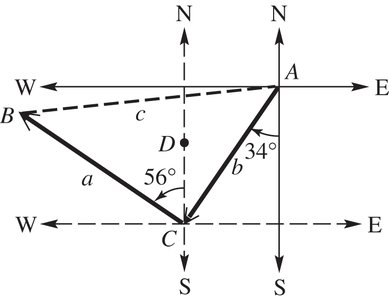
Example: In navigation, use the Pythagorean theorem:
Ship travels 45 nautical miles (b) and 54 nautical miles (a)
nautical miles
Precision Measurement Problems
Trigonometric functions are used in precision measurement, such as determining the distance between two points using small angles.
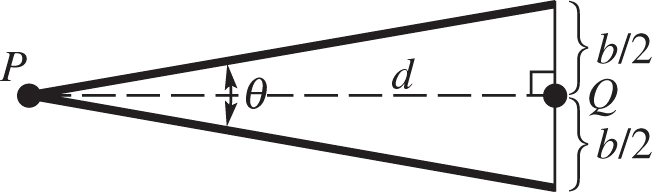
Example: For small angle and base :
Small changes in result in small changes in
Algebraic and Graphical Solutions to Right Triangle Problems
Some right triangle problems require algebraic manipulation or graphical solutions using coordinate axes and slopes.
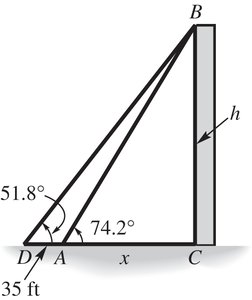
Example: To find the height of a building:
Set up equations using tangent for two angles:
Solve for and algebraically
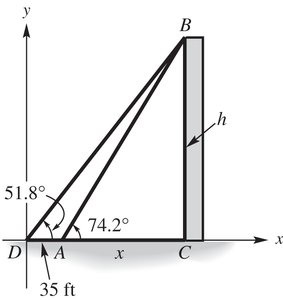
Graphical Solution: Use coordinate axes and graph the lines representing the two tangent equations. The intersection gives the height .
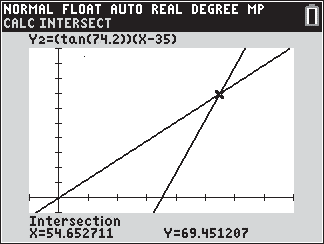
Example: The intersection point on the calculator graph gives ft and ft, which is the height of the building.
Additional info: These notes cover the main concepts and applications from Chapter 2: Acute Angles and Right Triangles, including trigonometric functions, solving triangles, and real-world applications in navigation, surveying, and measurement.
