 Back
BackAngle Relationships and Similar Triangles: Foundations for Trigonometry
Study Guide - Smart Notes
 Tailored notes based on your materials, expanded with key definitions, examples, and context.
Section 1.2 – Angle Relationships and Similar Triangles
Introduction to Angle Relationships
Understanding angle relationships is fundamental in geometry and trigonometry. These relationships help us analyze geometric shapes, solve problems involving parallel lines, and lay the groundwork for studying trigonometric functions.
Vertical Angles: Formed by intersecting lines, vertical angles are always equal. They are opposite each other and share a common vertex.
Adjacent Angles: Angles that share a common side and vertex but do not overlap.
Linear Pair: Two adjacent angles whose non-common sides form a straight line. The sum of their measures is .
Example: If two lines intersect, the angles opposite each other are vertical angles and are congruent.
Angles Formed by Parallel Lines and a Transversal
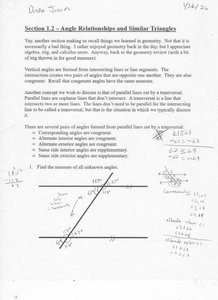
When a transversal crosses two parallel lines, several pairs of angles are formed. These relationships are crucial for solving geometric and trigonometric problems.
Corresponding Angles: Angles in matching corners when a transversal crosses parallel lines. They are congruent.
Alternate Interior Angles: Angles located between the parallel lines on opposite sides of the transversal. They are congruent.
Alternate Exterior Angles: Angles located outside the parallel lines on opposite sides of the transversal. They are congruent.
Consecutive Interior Angles (Same-Side Interior): Angles on the same side of the transversal and inside the parallel lines. Their measures add up to .
Example: If a transversal intersects two parallel lines, the alternate interior angles are equal. If one angle measures , its alternate interior angle also measures $63^\circ$.
Finding Angle Measures
To find unknown angle measures, use the relationships described above. For example, if you know one angle formed by a transversal and parallel lines, you can determine the measures of all related angles using congruence and supplementary properties.
Step 1: Identify the type of angle relationship (vertical, corresponding, alternate interior, etc.).
Step 2: Use congruence or supplementary rules to solve for unknown angles.
Step 3: Check your answers by ensuring the sum of angles around a point or along a straight line is correct.
Example: Given a transversal and parallel lines, if one angle is , the corresponding angle is also $117^\circ$, and the adjacent angle on the straight line is (since ).
Similar Triangles
Triangles are similar if their corresponding angles are equal and their corresponding sides are proportional. Similar triangles are foundational in trigonometry, as they allow us to relate side lengths and angles using ratios.
Definition: Two triangles are similar if their corresponding angles are equal and their sides are in proportion.
Application: Similar triangles are used to solve problems involving indirect measurement, such as finding heights or distances.
Example: If triangle ABC is similar to triangle DEF, then .
Summary Table: Angle Relationships
Angle Pair | Relationship | Property |
|---|---|---|
Vertical Angles | Opposite angles formed by intersecting lines | Congruent |
Corresponding Angles | Same position relative to parallel lines and transversal | Congruent |
Alternate Interior Angles | Between parallel lines, opposite sides of transversal | Congruent |
Alternate Exterior Angles | Outside parallel lines, opposite sides of transversal | Congruent |
Consecutive Interior Angles | Same side of transversal, between parallel lines | Supplementary () |
Additional info: These angle relationships are foundational for understanding trigonometric functions, as they establish the properties of angles and triangles used in later chapters.
