 Back
BackAngles and Their Measurement: Fundamental Concepts in Trigonometry
Study Guide - Smart Notes
 Tailored notes based on your materials, expanded with key definitions, examples, and context.
Angles: Basic Terminology and Measurement
Basic Terminology
Understanding the foundational elements of geometry is essential for trigonometry. Two distinct points determine a line, a line segment, or a ray, each with unique properties:
Line Segment AB: The portion of a line between points A and B, including both endpoints.

Line AB: Extends infinitely in both directions through points A and B.

Ray AB: Starts at point A and continues through B and beyond.

An angle consists of two rays in a plane with a common endpoint called the vertex. The rays are the sides of the angle.
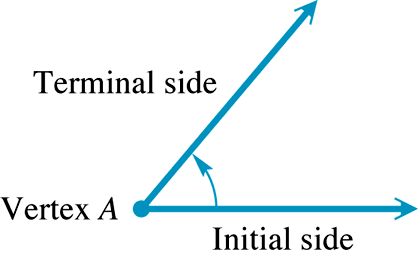
Angle Formation and Sides
The measure of an angle is generated by a rotation about the vertex. The ray in its initial position is called the initial side, and after rotation, it becomes the terminal side.
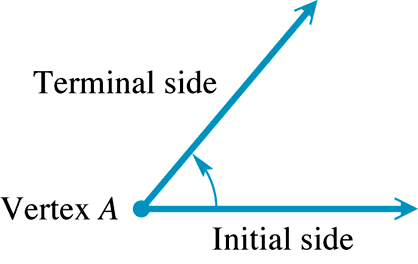
Positive and Negative Angles
Angles are classified based on the direction of rotation:
Positive Angle: Rotation is counterclockwise.
Negative Angle: Rotation is clockwise.
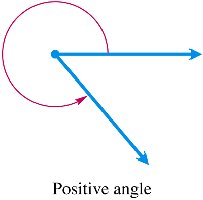
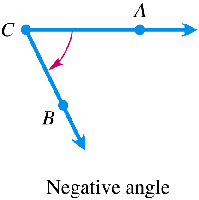
Degree Measure and Classification of Angles
Degree Measure
The most common unit for measuring angles is the degree. A complete rotation of a ray gives an angle whose measure is 360°.
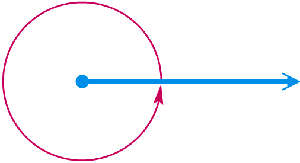
One degree is defined as 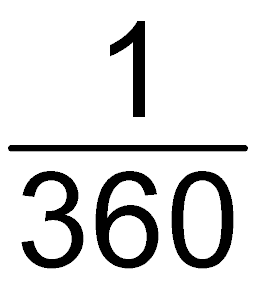 of a complete rotation.
Classification of Angles
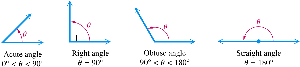
Angles are classified by their measures:
Acute Angle:
Right Angle:
Obtuse Angle:
Straight Angle:
Complementary and Supplementary Angles
Definitions
Complementary Angles: Two angles whose measures add up to 90°.
Supplementary Angles: Two angles whose measures add up to 180°.
Finding Complements and Supplements
To find the complement or supplement of a given angle:
Complement:
Supplement:
Example: For an angle measuring 40°, its complement is , and its supplement is .
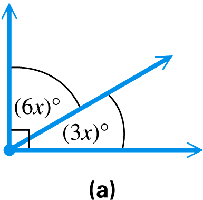
Solving for Complementary and Supplementary Angles
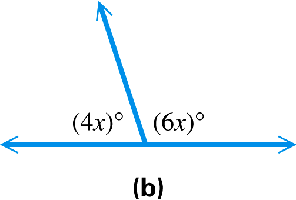
When angles are expressed in terms of a variable, set up equations based on their relationship:
Complementary:
Supplementary:



Degrees, Minutes, and Seconds
Definitions
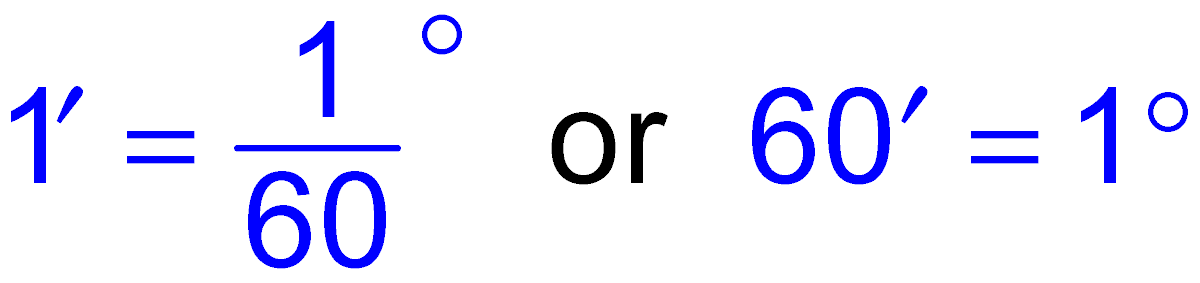
One minute (1′): of a degree
One second (1″): of a minute or of a degree
Calculating with Degrees, Minutes, and Seconds
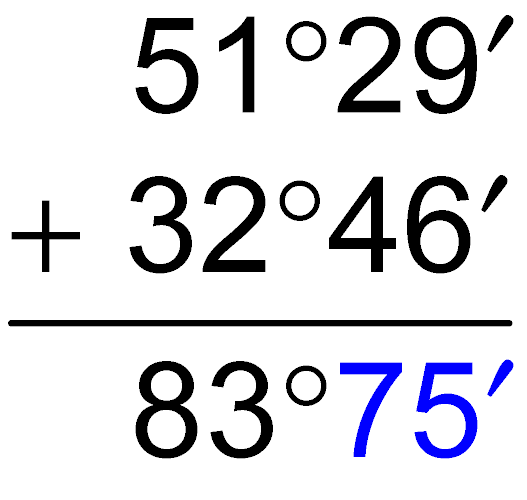
When adding or subtracting angles in degrees, minutes, and seconds, treat each unit separately and convert as needed.
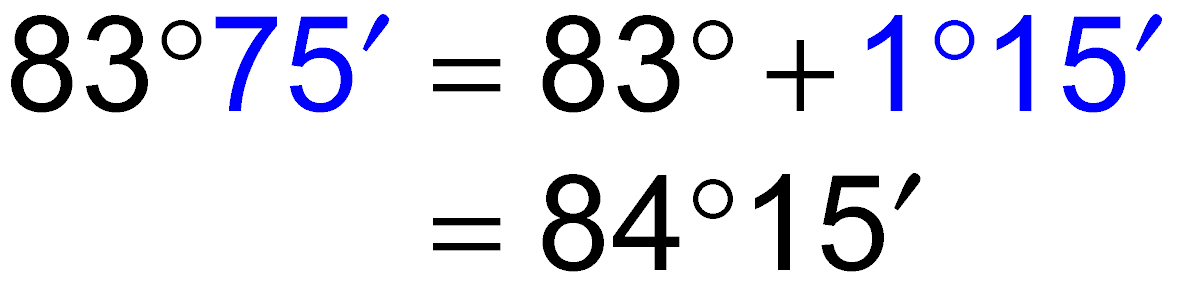
Add: Add degrees, minutes, and seconds separately. If minutes or seconds exceed 60, convert to the next higher unit.
Subtract: Borrow as needed from degrees or minutes to perform subtraction.


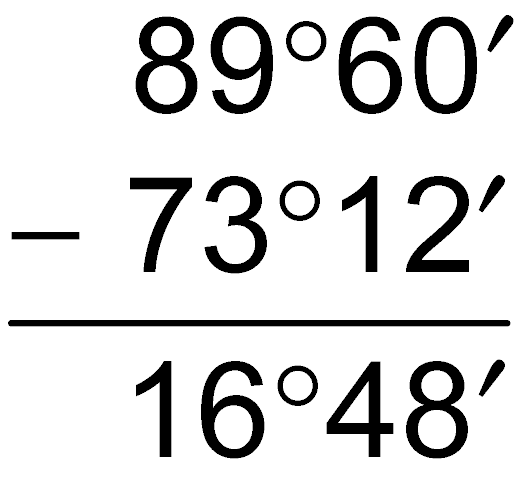
Converting Between Angle Measures
To Decimal Degrees: Convert minutes and seconds to fractions of a degree and add to the degree value.
To Degrees, Minutes, Seconds: Separate the decimal part into minutes and seconds.

Standard Position and Quadrantal Angles
Standard Position
An angle is in standard position if its vertex is at the origin and its initial side lies along the positive x-axis.
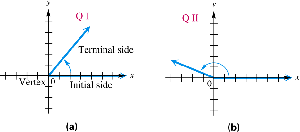
Quadrantal Angles
Angles in standard position whose terminal sides lie along the x-axis or y-axis (e.g., 0°, 90°, 180°, 270°) are called quadrantal angles.
Coterminal Angles
Definition and Calculation
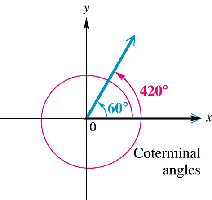
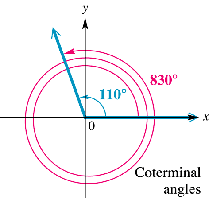
Coterminal angles are angles that share the same initial and terminal sides but may differ in their measures by multiples of 360°.
To find coterminal angles, add or subtract integer multiples of 360° to the given angle.

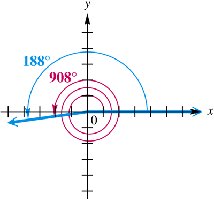
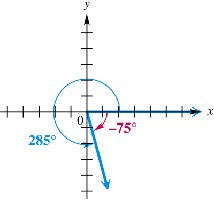



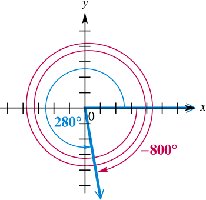
General Expression for Coterminal Angles
All angles coterminal with a given angle θ can be expressed as:
, where n is any integer.

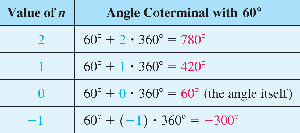
Table: Coterminal Angles for 60°
The following table shows values of n and the corresponding coterminal angles for 60°:
Value of n | Angle Coterminal with 60° |
|---|---|
2 | 60° + 2·360° = 780° |
1 | 60° + 1·360° = 420° |
0 | 60° + 0·360° = 60° (the angle itself) |
-1 | 60° + (-1)·360° = -300° |
Applications: Angular Velocity and Revolutions
Analyzing Revolutions of a Disk Drive
Angular velocity problems often involve converting revolutions per minute to degrees moved in a given time.
One revolution = 360°
To find total degrees moved: Multiply the number of revolutions by 360°.
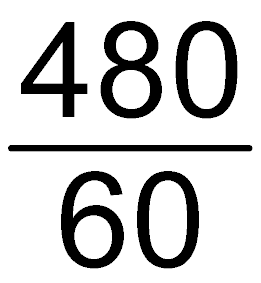
Example: If a disk makes 480 revolutions per minute, in 2 seconds it makes:
revolutions per second
In 2 seconds: revolutions
Total degrees:

Additional info: These concepts are foundational for later topics such as radian measure, unit circle, and trigonometric functions.
