 Back
BackArc Length, Sector Area, and Angular/Linear Speed in Trigonometry
Study Guide - Smart Notes
 Tailored notes based on your materials, expanded with key definitions, examples, and context.
Arc Length and Area of a Sector
Key Concepts
Understanding the measurement of arcs and sectors is fundamental in trigonometry, especially when working with circles and angles measured in radians.
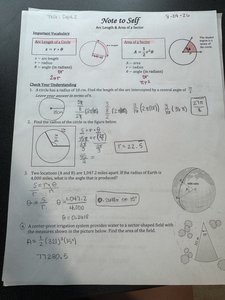
Arc Length (s): The distance along a section of a circle's circumference, calculated using the central angle in radians.
Area of a Sector (A): The region bounded by two radii and the arc between them.
Formulas
Arc Length:
Area of a Sector:
Where is the radius and is the central angle in radians.
Example
Given a circle with radius and central angle radians:
Arc Length:
Area of Sector:
Applications
Finding the distance between two points on a circle given the central angle and radius.
Calculating the area of a pizza slice or any sector-shaped region.
Linear and Angular Speed
Key Concepts
Linear and angular speed describe how fast an object moves along a circular path and how quickly the angle changes, respectively.
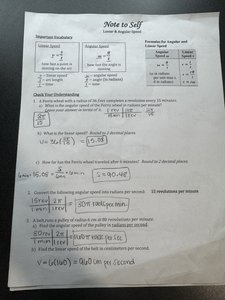
Linear Speed (v): The rate at which the arc length is traversed.
Angular Speed (\omega): The rate at which the central angle changes, measured in radians per unit time.
Formulas
Linear Speed:
Angular Speed:
Relationship:
Example
If a wheel of radius $6 radians per second, the linear speed at the rim is:
ft/sec
Conversions and Applications
To convert revolutions per minute (rpm) to radians per second, use $1= 2\pi$ radians.
Applications include calculating the speed of rotating machinery, wheels, and celestial objects.
Table: Common Angle Conversions
Degrees | Radians | Revolutions |
|---|---|---|
360° | 1 | |
180° | 0.5 | |
90° | 0.25 | |
60° | 1/6 | |
45° | 1/8 |
Summary
Arc length and sector area are directly related to the radius and central angle (in radians).
Linear and angular speed are essential for understanding rotational motion in trigonometry.
Mastery of these concepts is foundational for further study in trigonometry, physics, and engineering.
