 Back
BackChapter 3: Radian Measure and the Unit Circle – Study Notes
Study Guide - Smart Notes
 Tailored notes based on your materials, expanded with key definitions, examples, and context.
Section 3.1: Radian Measure
Definition and Conversion
Radian measure is a way of expressing angles based on the radius of a circle. One radian is the angle subtended at the center of a circle by an arc whose length is equal to the radius of the circle.
Degrees to Radians: To convert degrees to radians, use the formula:
Radians to Degrees: To convert radians to degrees, use the formula:
Examples:
radians
radians
radians
Key Point: Radian measure is essential for calculus and higher mathematics because it relates angles directly to arc length and is dimensionless.
Section 3.2: Applications of Radian Measure
Arc Length and Sector Area
Radian measure allows for straightforward calculation of arc lengths and areas of sectors in circles.
Arc Length: , where is the arc length, is the radius, and is the angle in radians.
Sector Area:
Examples:
Given cm, , cm
Given cm, radians, cm
Distance between two cities on Earth (radius km), radians, km
Key Point: Always convert angles to radians before using these formulas.
Section 3.3: The Unit Circle and Circular Functions
The Unit Circle
The unit circle is a circle of radius 1 centered at the origin of the coordinate plane. It is fundamental in defining the trigonometric functions for all real numbers.
Coordinates: Any point on the unit circle corresponding to an angle has coordinates .
Reference Angles: The values of trigonometric functions for any angle can be determined using reference angles and the unit circle.
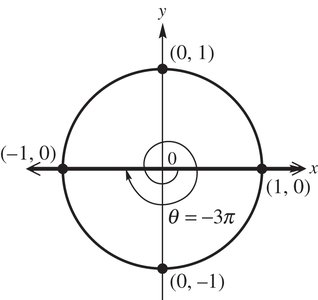
Example: An angle of intersects the unit circle at . Thus, , , is undefined.
Key Points on the Unit Circle
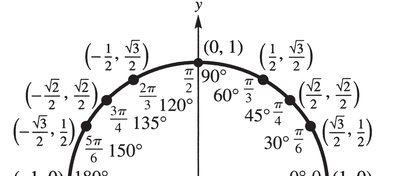
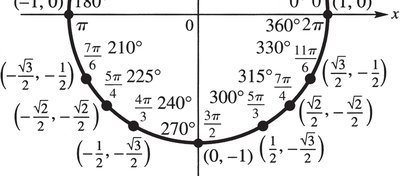
The unit circle contains several important angles and their corresponding coordinates, which are used to evaluate trigonometric functions.
Common Angles: , etc.
Coordinates: For example, at (45°), the coordinates are .
Symmetry: The unit circle is symmetric about the x- and y-axes, which helps in determining the signs of trigonometric functions in different quadrants.
Evaluating Trigonometric Functions Using the Unit Circle
Trigonometric functions can be evaluated for any angle using the unit circle. The sine of an angle is the y-coordinate, and the cosine is the x-coordinate of the corresponding point on the unit circle.
Example: ,
Example:
Reference Angles: Use the reference angle and the quadrant to determine the sign of the function value.
Special Right Triangles and Trigonometric Ratios
Special right triangles, such as the 45°-45°-90° and 30°-60°-90° triangles, are used to derive the values of trigonometric functions for common angles.
45°-45°-90° Triangle: The legs are equal, and the hypotenuse is times a leg.
30°-60°-90° Triangle: The sides are in the ratio .
Application: These triangles help in finding the coordinates on the unit circle for , etc.
Geometric Representation of Trigonometric Functions
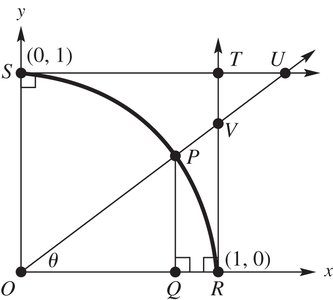
Trigonometric functions can be represented geometrically using the unit circle and associated right triangles.
Cosine and Sine: The x- and y-coordinates of a point on the unit circle.
Secant and Cosecant: Represented as line segments from the origin to the circle or extended lines.
Tangent and Cotangent: Represented as lengths of segments tangent to the circle at specific points.
Example: For , , , .
Section 3.4: Linear and Angular Speed
Definitions and Formulas
Linear and angular speed describe the motion of objects along circular paths.
Angular Speed (): , where is in radians and is time.
Linear Speed (): , where is the radius.
Examples:
Given in, rad/s, s, radians
Arc length: in
Linear speed: in/s
Key Point: Linear speed is the rate at which distance is covered along the arc, while angular speed is the rate at which the angle changes.
Summary Table: Key Formulas
Concept | Formula | Variables |
|---|---|---|
Degrees to Radians | ||
Radians to Degrees | ||
Arc Length | = radius, = radians | |
Sector Area | = radius, = radians | |
Angular Speed | = radians, = time | |
Linear Speed | = radius, = angular speed |
