 Back
BackGeometric Trigonometry Review – Step-by-Step Guidance
Study Guide - Smart Notes
 Tailored notes based on your materials, expanded with key definitions, examples, and context.
Q1. Write two equations for the graphs below. One equation should use the sine function, and the other should use the cosine function.
Background
Topic: Graphs of Trigonometric Functions
This question tests your ability to analyze the features of a trigonometric graph (such as amplitude, period, phase shift, and vertical shift) and write equations using both sine and cosine functions to represent the same graph.
Key Terms and Formulas:
Amplitude: The maximum distance from the midline to the peak/trough.
Period: The length of one complete cycle.
Phase Shift: Horizontal shift of the graph.
Vertical Shift: Up/down movement of the graph.
General Sine Equation:
General Cosine Equation:
Step-by-Step Guidance
Examine the graph to determine the amplitude (), period (), phase shift (), and vertical shift (). For amplitude, measure the distance from the midline to the peak.
Find the period by identifying the length of one full cycle on the -axis. Use for the equation.
Determine the midline (vertical shift ) by averaging the maximum and minimum values.
Identify the phase shift () by locating where the sine or cosine function starts its cycle relative to the -axis.
Write the sine and cosine equations using the values found for , , , and . Do not plug in the final values yet—just set up the equations.
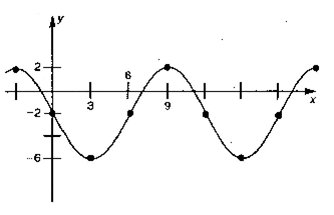
Try solving on your own before revealing the answer!
Final Answer:
Sine:
Cosine:
Both equations represent the same graph, just with different starting points. The amplitude, period, and vertical shift are consistent with the features of the graph.
Q5. a) Given the sinusoid below, draw the reciprocal function that has the same transformations.
Background
Topic: Reciprocal Trigonometric Functions
This question tests your understanding of how to graph reciprocal functions (such as secant and cosecant) based on a given sine or cosine graph, including the same amplitude, period, and shifts.
Key Terms and Formulas:
Reciprocal Functions: ,
Asymptotes: Occur where the original function is zero.
Transformations: Amplitude, period, phase shift, and vertical shift apply to reciprocal functions as well.
Step-by-Step Guidance
Identify the equation for the original sinusoid (sine or cosine) and note its amplitude, period, phase shift, and vertical shift.
To graph the reciprocal function, mark the points where the original function is zero—these will be vertical asymptotes for the reciprocal function.
Plot the reciprocal values at the maximum and minimum points of the original function. The reciprocal function will approach infinity near the zeros.
Apply the same transformations (amplitude, period, shifts) to the reciprocal function.
Write the equation for the reciprocal function using the same transformations as the original sinusoid.
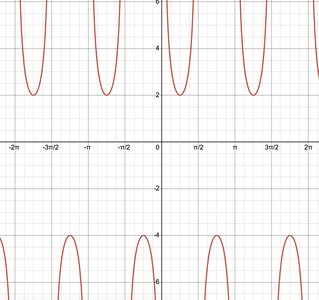
Try solving on your own before revealing the answer!
Final Answer:
Sinusoid:
Reciprocal:
The reciprocal function has the same amplitude and period, but includes vertical asymptotes where the original function is zero.
