 Back
BackLabeling Common Angles in Degrees and Radians on the Unit Circle
Study Guide - Smart Notes
 Tailored notes based on your materials, expanded with key definitions, examples, and context.
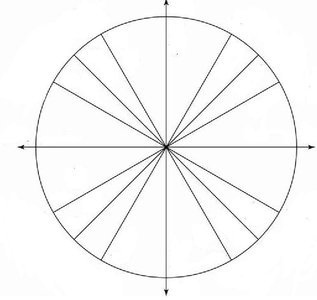
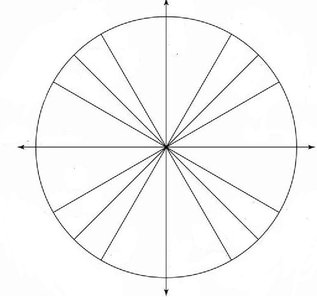
Q1. On the first circle below, label each common angle in degrees. Begin with 0° and end with 360°. On the second circle, label each common angle in radians. Begin with 0 and end with 2π.
Background
Topic: Unit Circle and Angle Measurement
This question is testing your understanding of how to label the unit circle with common angles in both degrees and radians. The unit circle is fundamental in trigonometry for visualizing angles and their corresponding coordinates.
Key Terms and Formulas:
Degree: A unit of angle measurement. One full rotation is 360°.
Radian: Another unit of angle measurement. One full rotation is radians.
Conversion Formula: and
Common Angles: 0°, 30°, 45°, 60°, 90°, 120°, 135°, 150°, 180°, 210°, 225°, 240°, 270°, 300°, 315°, 330°, 360°
Common Radian Values: $0\frac{\pi}{6}\frac{\pi}{4}\frac{\pi}{3}$, $\frac{\pi}{2}$, $\frac{2\pi}{3}$, $\frac{3\pi}{4}$, $\frac{5\pi}{6}$, $\pi$, $\frac{7\pi}{6}$, $\frac{5\pi}{4}$, $\frac{4\pi}{3}$, $\frac{3\pi}{2}$, $\frac{5\pi}{3}$, $\frac{7\pi}{4}$, $\frac{11\pi}{6}
Step-by-Step Guidance
Start by identifying the positions for each common angle on the unit circle. The circle is divided into equal sections for these angles.
Label the first circle with degree values, beginning at 0° (positive x-axis) and moving counterclockwise: 0°, 30°, 45°, 60°, 90°, etc., up to 360°.
For the second circle, use the conversion formula to label each position with its radian equivalent: $0\frac{\pi}{6}\frac{\pi}{4}\frac{\pi}{3}$, $\frac{\pi}{2}.
Make sure to place each label at the correct location corresponding to its degree or radian measure.
Try solving on your own before revealing the answer!
Final Answer:
The first circle should be labeled with the common angles in degrees (0°, 30°, 45°, 60°, 90°, ... 360°). The second circle should be labeled with the common angles in radians ($0\frac{\pi}{6}\frac{\pi}{4}\frac{\pi}{3}$, $\frac{\pi}{2}).
These labels help you visualize the relationship between degrees and radians and are essential for solving trigonometric problems.
