 Back
BackLibrary of Functions: Fundamental Graphs and Their Properties
Study Guide - Smart Notes
 Tailored notes based on your materials, expanded with key definitions, examples, and context.
Library of Functions
Introduction to Fundamental Functions
Understanding the basic types of functions and their graphs is essential in trigonometry and precalculus. These fundamental functions serve as building blocks for more complex mathematical models. Below are the most common types of functions, their definitions, properties, and graphical representations.
Identity Function
Definition: The identity function is defined as f(x) = x.
Domain and Range: Both are all real numbers, .
Key Properties: Passes through the origin, has a slope of 1, and is symmetric about the line .
Example: For , .
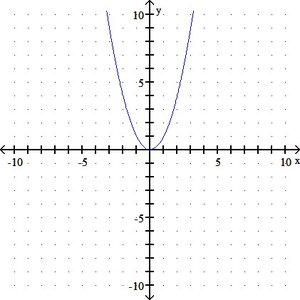
Square Function
Definition: The square function is .
Domain: All real numbers, .
Range: .
Key Properties: The graph is a parabola opening upwards, vertex at the origin, symmetric about the y-axis (even function).
Example: .
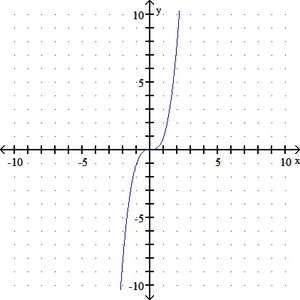
Cube Function
Definition: The cube function is .
Domain and Range: Both are all real numbers, .
Key Properties: The graph is symmetric about the origin (odd function), passes through the origin, and increases faster than the identity function for large .
Example: , .
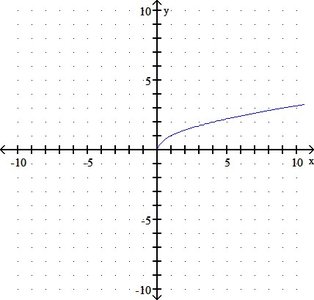
Square Root Function
Definition: .
Domain: (since you cannot take the square root of a negative number in the real numbers).
Range: .
Key Properties: The graph starts at the origin and increases slowly, only defined for non-negative .
Example: .
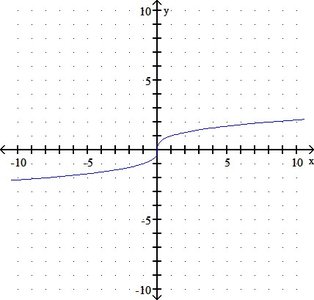
Cube Root Function
Definition: .
Domain and Range: Both are all real numbers, .
Key Properties: The graph is symmetric about the origin (odd function), passes through the origin, and is defined for all real .
Example: .
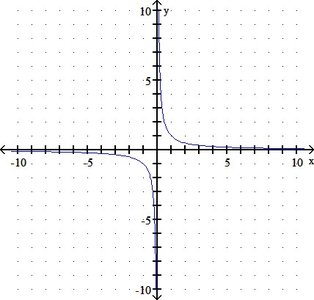
Reciprocal Function
Definition: .
Domain: .
Range: .
Key Properties: The graph has two branches, one in the first quadrant and one in the third, with vertical and horizontal asymptotes at and respectively. It is an odd function.
Example: , .
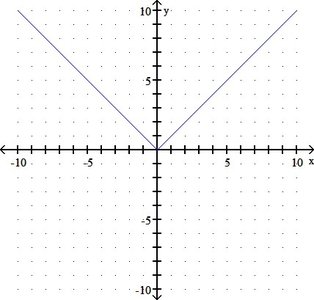
Absolute Value Function
Definition: .
Domain: All real numbers, .
Range: .
Key Properties: The graph is V-shaped, symmetric about the y-axis (even function), with vertex at the origin.
Example: .
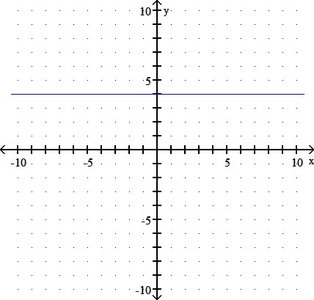
Constant Function
Definition: , where is a constant.
Domain: All real numbers, .
Range: (a single value).
Key Properties: The graph is a horizontal line at .
Example: for all .
Summary Table: Fundamental Functions
Function Name | Equation | Domain | Range | Symmetry |
|---|---|---|---|---|
Identity | Odd | |||
Square | Even | |||
Cube | Odd | |||
Square Root | None | |||
Cube Root | Odd | |||
Reciprocal | Odd | |||
Absolute Value | Even | |||
Constant | Even |
Additional info: These fundamental functions are foundational for understanding more advanced topics in trigonometry, calculus, and applied mathematics. Their properties, such as symmetry and domain/range, are frequently referenced when analyzing or transforming more complex functions.
