 Back
Measuring Angles: Standard Position, Types, Complementary & Supplementary Angles, and Radian Conversion
Study Guide - Smart Notes
 Tailored notes based on your materials, expanded with key definitions, examples, and context.
Measuring Angles
Angles in Standard Position
Angles are fundamental in trigonometry and are measured in degrees (°) or radians. An angle in standard position has its vertex at the origin of the coordinate plane, with its initial side along the positive x-axis. The amount of rotation from the initial side to the terminal side determines the angle's measure.
Initial Side: The starting position of the angle (along the positive x-axis).
Terminal Side: The position after rotation.
Positive Angles: Measured counterclockwise from the initial side.
Negative Angles: Measured clockwise from the initial side.
Types of Angles:
Acute Angle:
Right Angle:
Obtuse Angle:
Straight Angle:
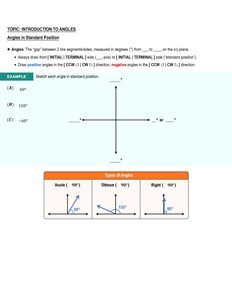
Example: Sketching angles such as , , and in standard position involves rotating from the positive x-axis by the specified amount, using the appropriate direction (counterclockwise for positive, clockwise for negative).
Complementary & Supplementary Angles
Introduction to Complementary & Supplementary Angles
Complementary and supplementary angles are pairs of angles with specific sum properties:
Complementary Angles: Two angles whose measures add up to .
Supplementary Angles: Two angles whose measures add up to .
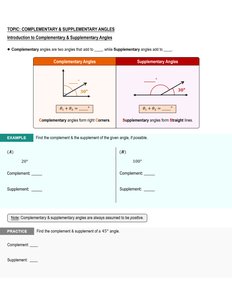
Example: The complement of is because . The supplement of $20^\circ$ is because .
Note: Complementary and supplementary angles are always considered positive in standard trigonometric problems.
Solving Problems with Complementary & Supplementary Angles
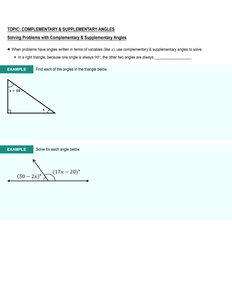
When solving for unknown angles, use the definitions above. In right triangles, the two non-right angles are always complementary. For algebraic expressions, set up equations based on the sum properties.
Example: If one angle is , its complement is and its supplement is .
Example: If and are supplementary, then .
Radian Measure and Converting Between Degrees & Radians
Converting Between Degrees & Radians
Radians are another unit for measuring angles, based on the arc length of a circle. One full revolution (circle) is or radians. The conversion formulas are:
From degrees to radians:
From radians to degrees:
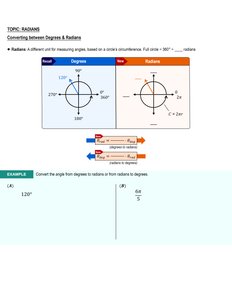
Example: To convert to radians: radians. To convert radians to degrees: .
