 Back
BackRadian Measure and the Unit Circle: Circular Functions and Their Applications
Study Guide - Smart Notes
 Tailored notes based on your materials, expanded with key definitions, examples, and context.
Radian Measure and the Unit Circle
Introduction to the Unit Circle and Circular Functions
The unit circle is a fundamental concept in trigonometry, defined as a circle with a radius of 1 unit centered at the origin of the coordinate plane. The trigonometric functions of an angle measured in radians can be interpreted as functions of the arc length on the unit circle, known as circular functions.
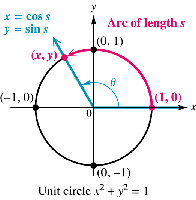
Definition: For any real number s (arc length), the coordinates of the corresponding point on the unit circle are (x, y), where x = cos s and y = sin s.
Equation of the Unit Circle:
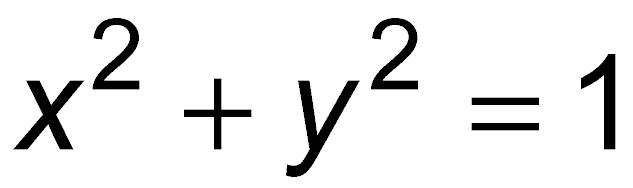
The unit circle is symmetric with respect to the x-axis, y-axis, and the origin. If a point (a, b) lies on the unit circle, so do (a, –b), (–a, b), and (–a, –b).
Definition of Circular Functions
The six circular functions are defined for a real number s as follows:
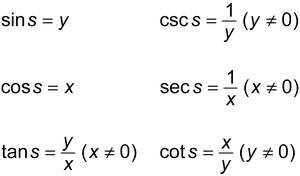
Sine:
Cosine:
Tangent: ,
Cosecant: ,
Secant: ,
Cotangent: ,
Reference Arcs and Symmetry
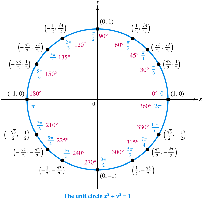
For any point on the unit circle, the reference arc is the shortest arc from the point to the nearest point on the x-axis. The unit circle's symmetry allows for the determination of function values in all quadrants using reference angles.
Pythagorean Identity
By substituting and into the unit circle equation, we obtain the fundamental Pythagorean identity:

Domains of the Circular Functions
Domains of Sine, Cosine, Tangent, and Their Reciprocals
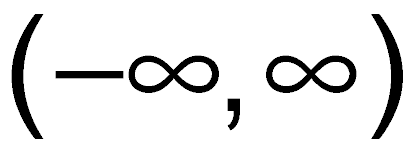
Sine and Cosine: Defined for all real numbers .
Tangent and Secant: Defined for all real numbers except where (i.e., , integer).
Cotangent and Cosecant: Defined for all real numbers except where (i.e., , integer).


Evaluating Circular Functions
Exact Values Using the Unit Circle
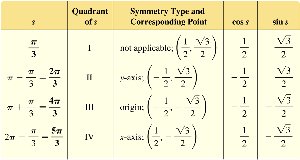
Exact values of circular functions can be found using the unit circle and reference angles. For example, to find , locate the corresponding point on the unit circle.
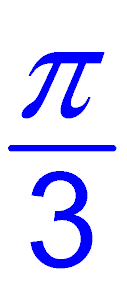
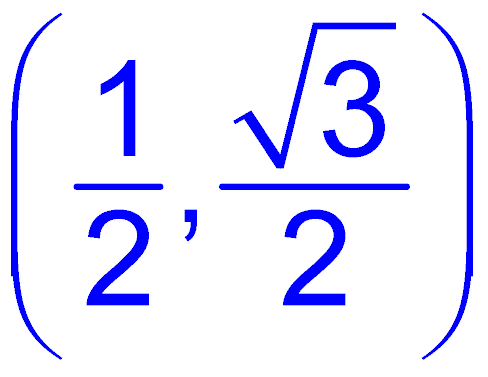
s | Quadrant of s | Symmetry Type and Corresponding Point | cos s | sin s |
|---|---|---|---|---|
I | not applicable; | |||
II | y-axis; | |||
III | origin; | |||
IV | x-axis; |
Example: Finding Exact Values
Find , , and .
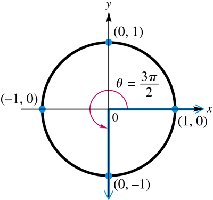

is undefined
Reference Angles and Radian-Degree Conversion
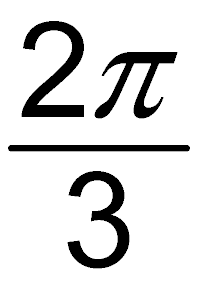
Reference angles help in finding the values of trigonometric functions for angles outside the first quadrant. For example, is found using the reference angle in quadrant II, where cosine is negative.

Calculator Approximations
Using Calculators for Circular Functions
When evaluating circular functions for arbitrary real numbers, calculators must be set to radian mode. For example:
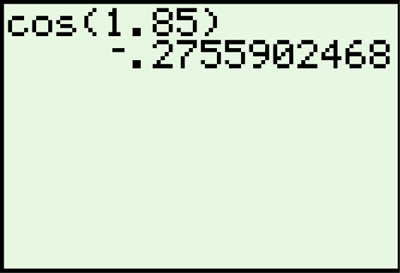
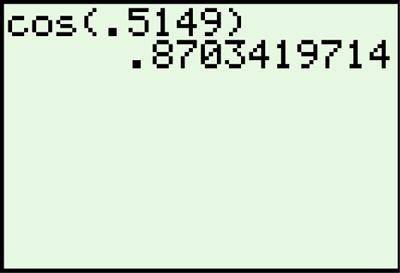
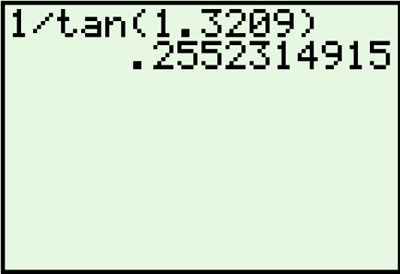
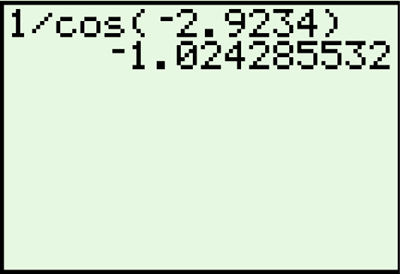
Caution: Always ensure your calculator is in radian mode when working with circular functions of real numbers.
Inverse Circular Functions and Applications
Finding a Number Given Its Circular Function Value
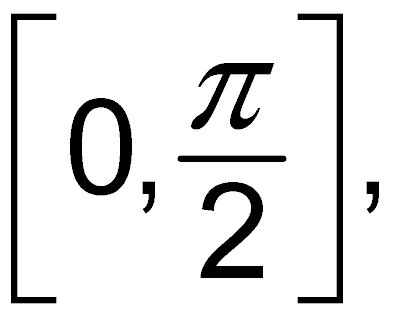
To find a real number s given a circular function value, use the appropriate inverse function. For example, if and , then radians.
Modeling with Circular Functions: Angle of Elevation of the Sun
The angle of elevation of the sun at latitude is modeled by:

Where is the sun's declination, is latitude, and is the number of radians the Earth has rotated since noon.
Function Values as Lengths of Line Segments
Geometric Interpretation on the Unit Circle
The six trigonometric functions can be interpreted as lengths of line segments in right triangles inscribed in the unit circle. For example, and correspond to the y- and x-coordinates of a point on the unit circle, respectively.
For and , use triangle VOR.
For and , use triangle USO.
Example: Finding Lengths of Line Segments
Suppose angle TVU measures 60°. Find the exact lengths of segments OQ, PQ, VR, OV, OU, and US. Use right triangle relationships and the properties of the unit circle to determine these lengths.
Since , use the known values for sine and cosine at this angle to compute the segment lengths.
