Back
BackReview of College Algebra: Foundations for Trigonometry
Study Guide - Smart Notes
 Tailored notes based on your materials, expanded with key definitions, examples, and context.
Review of College Algebra
Number Systems
The number system forms the basis of algebraic operations and includes several classifications:
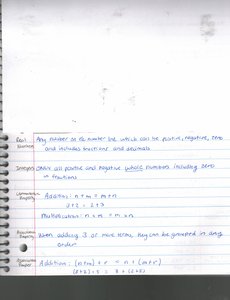
Real Numbers: Any number on the number line, including positive, negative, zero, fractions, and decimals.
Integers: Positive and negative whole numbers, including zero.
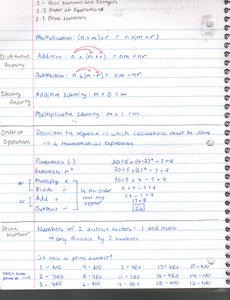
Prime Numbers: Numbers greater than 1 with only two positive divisors: 1 and itself.
Properties of Operations
Algebraic operations follow specific properties that simplify calculations:
Commutative Property: Addition: Multiplication:
Associative Property: Addition: Multiplication:
Identity Property: Addition: Multiplication:
Order of Operations
To evaluate expressions correctly, follow the order of operations:
Parentheses
Exponents
Multiplication and Division (left to right)
Addition and Subtraction (left to right)
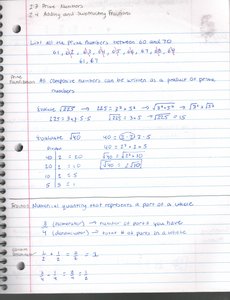
Prime Factorization
Prime factorization expresses a number as a product of prime numbers. This is useful for simplifying fractions and finding least common multiples.
Example:
Fractions
Fractions represent a part of a whole and are fundamental in algebraic manipulation.
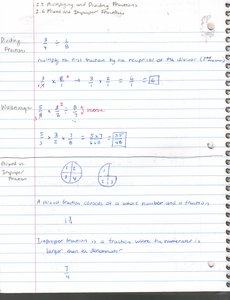
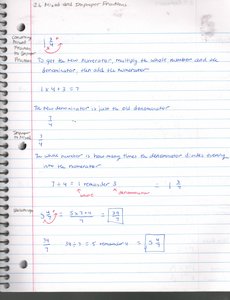
Proper Fraction: Numerator is less than denominator.
Improper Fraction: Numerator is greater than or equal to denominator.
Mixed Number: Combination of a whole number and a fraction.
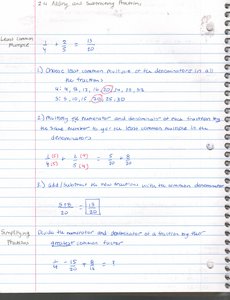
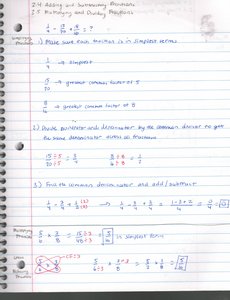
Adding and Subtracting Fractions
To add or subtract fractions, follow these steps:
Find the least common denominator (LCD).
Convert each fraction to an equivalent fraction with the LCD.
Add or subtract the numerators, keeping the denominator the same.
Multiplying and Dividing Fractions
Multiplication and division of fractions involve:
Multiplication: Multiply numerators and denominators directly.
Division: Multiply by the reciprocal of the divisor.
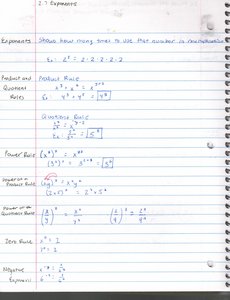
Exponents
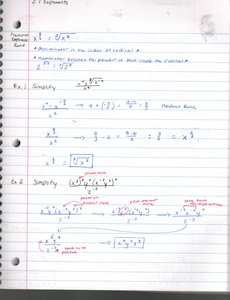
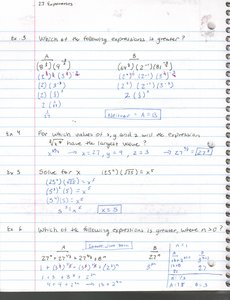
Exponents indicate repeated multiplication of a number. Several rules govern their manipulation:
Product Rule:
Quotient Rule:
Power Rule:
Zero Rule: (for )
Negative Exponent:
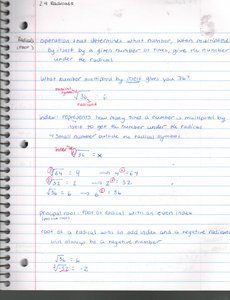
Radicals
Radicals represent roots of numbers. The principal root is the positive root for even indices.
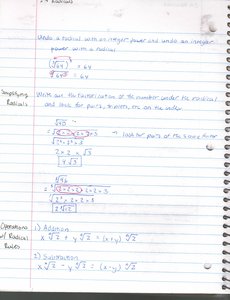
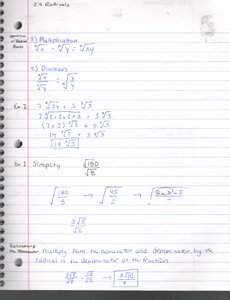
Product Rule:
Quotient Rule:
Simplifying Radicals: Factor the radicand and extract perfect squares.
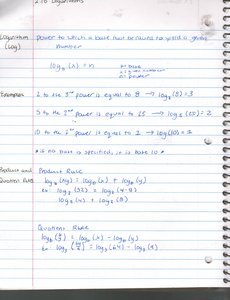
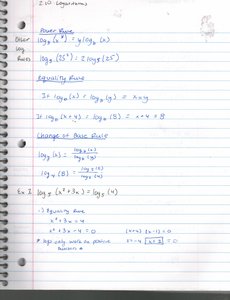
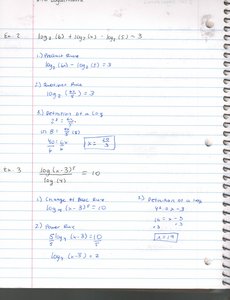
Logarithms
Logarithms are the inverse of exponents and are used to solve equations involving exponentials.
Definition: means
Product Rule:
Quotient Rule:
Power Rule:
Change of Base Rule:
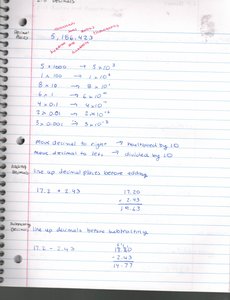
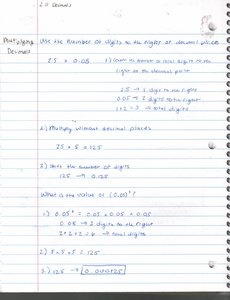
Decimals
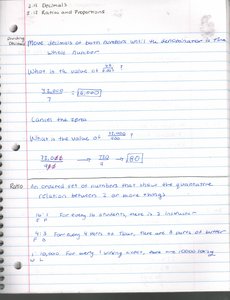
Decimals are another way to represent fractions and are used in arithmetic operations:
Multiplying Decimals: Multiply as whole numbers, then place the decimal point according to the total number of decimal places.
Adding/Subtracting Decimals: Line up decimal points before performing the operation.
Ratios and Proportions
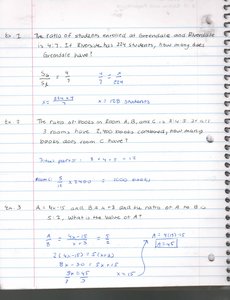
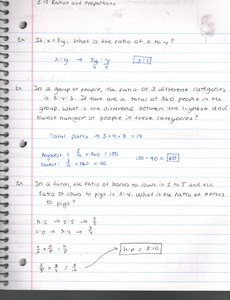
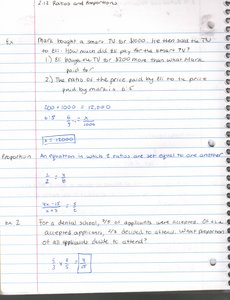
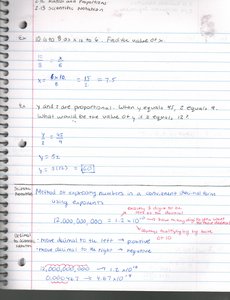
Ratios compare two quantities, while proportions set two ratios equal to each other.
Ratio: or
Proportion:
Scientific Notation
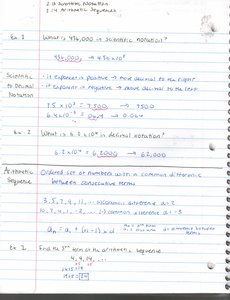
Scientific notation expresses very large or small numbers in the form .
Move the decimal point to create a number between 1 and 10, then multiply by a power of 10.
Example:
Arithmetic Sequences
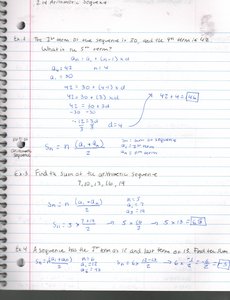
An arithmetic sequence is a list of numbers with a constant difference between consecutive terms.
General Term:
Sum of Sequence:
Prime Numbers
Prime numbers are fundamental in factorization and number theory.
List of primes between 60 and 70: 61, 67
Examples and Applications
Finding LCD for fractions
Prime factorization for simplifying radicals
Solving proportions in real-world contexts
Expressing numbers in scientific notation
Calculating terms and sums in arithmetic sequences