 Back
BackReview of College Algebra: Sets, Real Numbers, and Polynomials
Study Guide - Smart Notes
 Tailored notes based on your materials, expanded with key definitions, examples, and context.
R.1 Sets & Notation
Set Theory and Notation
Set theory is a foundational concept in mathematics, involving the study of collections of objects, called sets. Understanding sets and their operations is essential for higher-level mathematics, including trigonometry.
Set: A collection of distinct objects, denoted by curly braces { }.
Element: An object or member of a set, denoted by the symbol ∈ (e.g., 4 ∈ A means 4 is in set A).
Finite Set: Contains a limited number of elements.
Infinite Set: Contains an unending list of elements.
Set Builder Notation: Describes a set by a property its members satisfy, e.g., { x | x is a natural number less than 5 } = {1, 2, 3, 4}.
Natural Numbers (\mathbb{N}): {1, 2, 3, 4, ...}
Universal Set (U): The set of all elements under consideration in a particular context.
Null or Empty Set (\emptyset): A set with no elements.
Subset (\subseteq): A set whose elements are all contained within another set.
Example: If A = {2, 5, 9} and B = {2, 3, 4, 5, 6, 9, 10}, then A \subseteq B but B \nsubseteq A.
Venn Diagrams
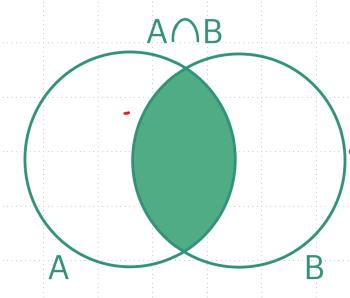
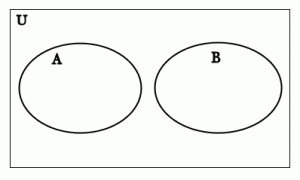
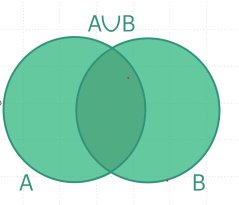
Venn diagrams visually represent relationships between sets, such as intersections, unions, and complements.
Operations on Sets
Complement (A'): Elements in the universal set U but not in set A.
Intersection (A \cap B): Elements common to both sets A and B. Set Builder Notation: { x | x ∈ A and x ∈ B } Example: {9, 15, 25, 36} \cap {15, 20, 25, 30, 35} = {15, 25}
Disjoint Sets: Sets with no elements in common (A \cap B = \emptyset).
Union (A \cup B): All elements in either set A or set B (or both). Set Builder Notation: { x | x ∈ A or x ∈ B } Example: {9, 15, 25, 36} \cup {15, 20, 25, 30, 35} = {9, 15, 20, 25, 30, 35, 36}
R.2 Real Numbers and Their Properties
Classification of Real Numbers
The set of real numbers (\mathbb{R}) includes all numbers that can be found on the number line. Real numbers are classified into several subsets:
Natural Numbers (\mathbb{N}): Counting numbers {1, 2, 3, ...}
Whole Numbers: Natural numbers plus zero {0, 1, 2, ...}
Integers (\mathbb{Z}): Whole numbers and their negatives {..., -2, -1, 0, 1, 2, ...}
Rational Numbers (\mathbb{Q}): Numbers that can be expressed as a fraction of two integers.
Irrational Numbers: Numbers that cannot be written as fractions (e.g., \sqrt{2}, \pi).
Real Numbers (\mathbb{R}): All rational and irrational numbers.
Order of Operations
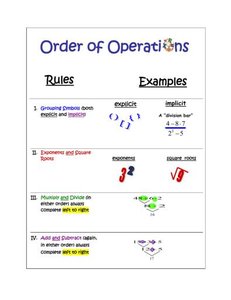
To evaluate mathematical expressions correctly, follow the order of operations (PEMDAS):
P: Parentheses (grouping symbols)
E: Exponents and roots
M/D: Multiplication and Division (left to right)
A/S: Addition and Subtraction (left to right)
Properties of Real Numbers
Real numbers follow several important properties:
Property | Addition | Multiplication |
|---|---|---|
Commutative | a + b = b + a | ab = ba |
Associative | (a + b) + c = a + (b + c) | (ab)c = a(bc) |
Identity | a + 0 = a | 1(a) = a |
Inverse | a + (-a) = 0 | a * (1/a) = 1, a ≠ 0 |
Closure | a + b is real | ab is real |
Distributive | a(b + c) = ab + ac | |
Absolute Value and Inequalities
Absolute Value: The distance from zero on the number line. Definition:
Inequalities: Symbols such as <, >, ≤, ≥ are used to compare numbers.
R.3 Exponents and Polynomials
Exponent Rules
Product Rule:
Power Rule:
Power of a Product:
Power of a Quotient:
Negative Exponent:
Zero Exponent: (a ≠ 0)
Quotient Rule:
Polynomials: Vocabulary and Operations
Polynomial: An algebraic expression consisting of terms with non-negative integer exponents.
Term: A single product of numbers and variables.
Coefficient: The numerical factor of a term.
Degree: The highest exponent of the variable in the polynomial.
Standard (Descending) Order: Terms are written from highest to lowest degree.
Like Terms: Terms with the same variables and exponents.
Types of Polynomials by Degree:
Linear: Degree 1
Quadratic: Degree 2
Cubic: Degree 3
Quartic: Degree 4
Polynomial: Degree greater than 4
Types by Number of Terms: Monomial (1), Binomial (2), Trinomial (3), Polynomial (more than 3)
Operations with Polynomials
Addition/Subtraction: Combine like terms.
Multiplication: Use distributive property or FOIL for binomials.
Special Products:
Sum and Difference:
Square of a Binomial:
Division: Use long division or synthetic division for polynomials.
R.4 Factoring Polynomials
Factoring with Greatest Common Factor (GCF)
Always factor out the greatest common factor (GCF) first when factoring polynomials.
Example:
Example:
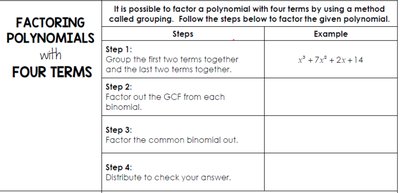
Factoring by Grouping
Factoring by grouping is used for polynomials with four terms. Group terms, factor out the GCF from each group, and factor the common binomial.
Factoring Trinomials
Type 1:
Type 2: (use the ac method: multiply a and c, factor, divide off a, and move denominators up)
Perfect Square Trinomials:
Factoring Special Forms
Difference of Squares:
Sum and Difference of Cubes:
Factoring by Substitution
For complex expressions, use substitution to simplify the polynomial before factoring.
Example: (let )
Factoring is a critical skill that will be used throughout algebra and trigonometry.
