 Back
BackTrigonometric Functions: Definitions, Properties, and Applications
Study Guide - Smart Notes
 Tailored notes based on your materials, expanded with key definitions, examples, and context.
Trigonometric Functions and Related Concepts
The Pythagorean Theorem
The Pythagorean Theorem is a fundamental result in geometry, especially relevant to trigonometry. It states that in a right triangle, the sum of the squares of the lengths of the legs equals the square of the length of the hypotenuse.
Formula: where a and b are the legs, and c is the hypotenuse.
Application: Used to find missing side lengths in right triangles, which is essential for defining trigonometric functions.
Example: If a triangle has legs of length 3 and 4, the hypotenuse is .
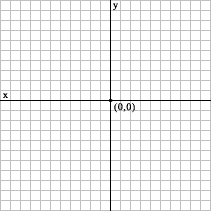
The Distance Formula
The Distance Formula is used to calculate the distance between two points in a rectangular coordinate system. This formula is derived from the Pythagorean Theorem and is crucial for determining the radius in trigonometric function definitions.
Formula:
Application: Used to find the length of the segment connecting two points, which is often the radius in trigonometric contexts.
Example: The distance between points (1, 2) and (4, 6) is .
The Six Trigonometric Functions
There are six fundamental trigonometric functions associated with an angle θ in standard position. These functions relate the coordinates of a point on the terminal side of the angle to the radius (distance from the origin).
Sine (sin θ):
Cosine (cos θ):
Tangent (tan θ):
Cotangent (cot θ):
Secant (sec θ):
Cosecant (csc θ):
Where r is the distance from the origin to the point (x, y), calculated as .
Examples
Example 1: For the point (12, 5) on the terminal side of θ, . The six functions are:
Example 2: For the point (8, -6), . The six functions are:
Signs of Trigonometric Functions in Quadrants
The sign of a trigonometric function depends on the quadrant in which the terminal side of the angle lies.
Quadrant II: is positive (since y > 0, r > 0)
Quadrant III: is positive (since both y < 0 and x < 0, their ratio is positive)
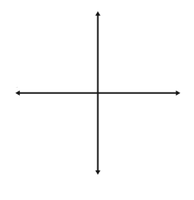
Quadrantal Angles
A quadrantal angle is an angle whose terminal side lies along the x-axis or y-axis. Common quadrantal angles include 0º, 90º, 180º, 270º, and 360º. For these angles, it is often convenient to select r = 1.
Definition: Quadrantal angles are multiples of 90º.
Application: Used to quickly determine trigonometric function values without calculation.
Function Values of Quadrantal Angles
θ | sin θ | cos θ | tan θ | cot θ | sec θ | csc θ |
|---|---|---|---|---|---|---|
0º | 0 | 1 | 0 | undefined | 1 | undefined |
90º | 1 | 0 | undefined | 0 | undefined | 1 |
180º | 0 | -1 | 0 | undefined | -1 | undefined |
270º | -1 | 0 | undefined | 0 | undefined | -1 |
360º | 0 | 1 | 0 | undefined | 1 | undefined |
Examples
Example 5: Find the values of the six trigonometric functions for 360º and for an angle whose terminal side passes through (0, -5):
For 360º: sin = 0, cos = 1, tan = 0, cot = undefined, sec = 1, csc = undefined
For (0, -5): r = 5, sin = -1, cos = 0, tan = undefined, cot = 0, sec = undefined, csc = -1
Example 6: Find the indicated function values, if undefined say so:
is undefined
