Back
BackTrigonometry Study Guide 3: Step-by-Step Guidance
Study Guide - Smart Notes
 Tailored notes based on your materials, expanded with key definitions, examples, and context.
Q1. Find csc(−𝜃) given sin(𝜃) = \frac{3}{4}
Background
Topic: Reciprocal and Negative Angle Identities
This question tests your understanding of how to find the cosecant of a negative angle using the sine value and reciprocal identities.
Key Terms and Formulas:
Cosecant:
Negative Angle Identity:
Step-by-Step Guidance
Recall that .
Use the negative angle identity: .
Substitute the given value: , so .
Set up and simplify the expression.
Try solving on your own before revealing the answer!
Final Answer: -\frac{4}{3}
We used the reciprocal and negative angle identities to find the exact value.
Q2. Find cos(−𝜃) given sec(𝜃) = 0.84
Background
Topic: Reciprocal and Negative Angle Identities
This question tests your ability to use reciprocal identities and properties of cosine for negative angles.
Key Terms and Formulas:
Secant:
Negative Angle Identity:
Step-by-Step Guidance
Recall that .
Use the reciprocal identity: .
Given , solve for .
Set up and substitute the value you found.
Try solving on your own before revealing the answer!
Final Answer: 1.19
Since cosine is an even function, .
Q3. Find sin 𝜃 if cos 𝜃 = -\frac{3}{5} and 𝜃 \in QIII
Background
Topic: Pythagorean Identity and Quadrant Analysis
This question tests your ability to use the Pythagorean identity and determine the sign of sine based on the quadrant.
Key Terms and Formulas:
Pythagorean Identity:
Quadrant III: Both sine and cosine are negative.
Step-by-Step Guidance
Use the Pythagorean identity: .
Substitute into the equation.
Calculate .
Find and then take the square root, remembering the sign for Quadrant III.
Try solving on your own before revealing the answer!
Final Answer: -\frac{4}{5}
because sine is negative in Quadrant III.
Q4. Use the information in problem #3 to find tan 𝜃
Background
Topic: Tangent Identity and Quadrant Analysis
This question tests your ability to use the values of sine and cosine to find tangent, considering the quadrant.
Key Terms and Formulas:
Tangent:
Step-by-Step Guidance
Recall .
Use and from the previous problem.
Set up and simplify.
Try solving on your own before revealing the answer!
Final Answer: \frac{4}{3}
because both sine and cosine are negative, so tangent is positive in Quadrant III.
Q5. Simplify: \frac{\cot x}{\csc x}
Background
Topic: Simplifying Trigonometric Expressions
This question tests your ability to simplify trigonometric expressions using basic identities.
Key Terms and Formulas:
Cotangent:
Cosecant:
Step-by-Step Guidance
Write and in terms of sine and cosine.
Set up .
Simplify the expression by multiplying numerator and denominator.
Try solving on your own before revealing the answer!
Final Answer: \cos x
After simplification, .
Q6. Find an exact value for: cos(30° −𝜃)
Background
Topic: Sum and Difference Identities
This question tests your ability to use the cosine difference identity to find an exact value.
Key Terms and Formulas:
Cosine Difference Identity:
Values for and
Step-by-Step Guidance
Apply the cosine difference identity: .
Substitute and .
Set up the expression: .
Try solving on your own before revealing the answer!
Final Answer: \frac{\sqrt{3}}{2} \cos \theta + \frac{1}{2} \sin \theta
We used the sum and difference identity and substituted the known values for 30°.
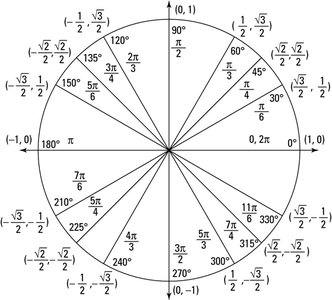
Unit Circle Reference
The unit circle is a fundamental tool in trigonometry for finding exact values of sine, cosine, and tangent at standard angles. It helps visualize the relationships between angles and their trigonometric values.