 Back
BackTrigonometry Study Guide: Circular Functions, Graphs, and Applications
Study Guide - Smart Notes
 Tailored notes based on your materials, expanded with key definitions, examples, and context.
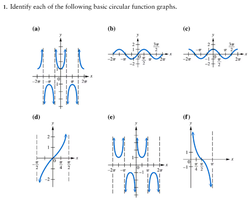
Q1. Identify each of the following basic circular function graphs.
Background
Topic: Circular (Trigonometric) Functions and Their Graphs
This question tests your ability to recognize the graphs of the six basic trigonometric functions: sine, cosine, tangent, cotangent, secant, and cosecant.
Key Terms:
Sine (), Cosine (), Tangent (), Cotangent (), Secant (), Cosecant ()
Periodicity, Asymptotes, Amplitude
Step-by-Step Guidance
Examine each graph for key features: periodicity, symmetry, and the presence of vertical asymptotes.
Recall that and are continuous and oscillate between -1 and 1, while , , , and have vertical asymptotes.
Match each graph to its function by identifying these features. For example, and have repeating vertical asymptotes, while and have U-shaped branches.
Label each graph with the corresponding function name, but stop before confirming all identifications.
Try solving on your own before revealing the answer!
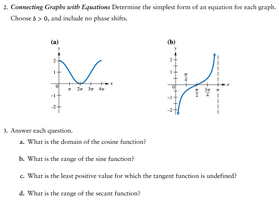
Q2. Connecting Graphs with Equations: Determine the simplest form of an equation for each graph. Choose b > 0, and include no phase shifts.
Background
Topic: Matching Trigonometric Graphs to Equations
This question tests your ability to identify the equation of a trigonometric function based on its graph, focusing on amplitude, period, and vertical shifts.
Key Terms and Formulas:
General form: or
Period:
Amplitude:
Step-by-Step Guidance
Analyze the graph to determine if it represents a sine or cosine function based on its starting point and shape.
Measure the amplitude by finding the maximum and minimum values of the graph.
Calculate the period by measuring the distance between repeating points (e.g., peaks).
Write the equation in the form or , but do not substitute the values yet.
Try solving on your own before revealing the answer!
Q3. Answer each question:
a. What is the domain of the cosine function?
b. What is the range of the sine function?
c. What is the least positive value for which the tangent function is undefined?
d. What is the range of the secant function?
Background
Topic: Properties of Trigonometric Functions
This question tests your understanding of the domain and range of basic trigonometric functions, as well as where certain functions are undefined.
Key Terms:
Domain: Set of all possible input values (x)
Range: Set of all possible output values (y)
Undefined: Points where the function does not exist (e.g., division by zero)
Step-by-Step Guidance
Recall that and are defined for all real numbers, while and are undefined at certain points.
For the range, remember that and oscillate between -1 and 1.
For tangent and secant, identify the points where their denominators are zero (e.g., is undefined when ).
Write the domain and range in interval notation, but stop before listing the exact values.
Try solving on your own before revealing the answer!
Q4. Consider the function .
a. What is its period?
b. What is the amplitude of its graph?
c. What is its range?
d. What is the y-intercept of its graph?
e. What is its phase shift?
Background
Topic: Transformations of Sine Functions
This question tests your ability to analyze a sine function with amplitude, period, phase shift, and vertical translation.
Key Terms and Formulas:
General form:
Amplitude:
Period:
Phase shift:
Vertical shift:
Step-by-Step Guidance
Identify , , , and from the given function.
Use the formulas above to calculate period, amplitude, phase shift, and vertical shift.
For the y-intercept, substitute into the function and simplify, but do not finish the calculation.
For the range, use the amplitude and vertical shift to determine the minimum and maximum values.
Try solving on your own before revealing the answer!
Q10–12. Write the equations for the following trigonometric functions:
10.
11.
12.
Background
Topic: Trigonometric Function Transformations
This question tests your ability to interpret and write equations for cotangent and cosecant functions with transformations.
Key Terms:
Cotangent (), Cosecant ()
Vertical shift, phase shift, amplitude
Step-by-Step Guidance
Identify the type of function and the transformations applied (vertical shift, phase shift, amplitude).
Write the general form for each function and note the effect of each parameter.
For , recognize the negative sign and the effect of the coefficient on the period.
For , note the amplitude and period change.
Try solving on your own before revealing the answer!
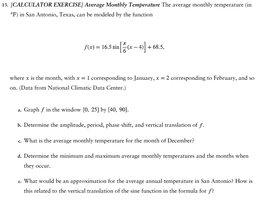
Q13. Average Monthly Temperature: The average monthly temperature (in °F) in San Antonio, Texas can be modeled by the function .
a. Graph in the window [0, 25] by [40, 90].
b. Determine the amplitude, period, phase shift, and vertical translation of .
c. What is the average monthly temperature for the month of December?
d. Determine the minimum and maximum average monthly temperatures and the months when they occur.
e. What would be an approximation for the average annual temperature in San Antonio? How is this related to the vertical translation of the sine function in the formula for ?
Background
Topic: Sinusoidal Modeling of Real-World Data
This question tests your ability to interpret and analyze a sinusoidal function representing real-world data, including amplitude, period, phase shift, and vertical translation.
Key Terms and Formulas:
Amplitude:
Period:
Phase shift:
Vertical translation:
Step-by-Step Guidance
Identify , , , and from the function.
Use the formulas to calculate amplitude, period, phase shift, and vertical translation.
To find the temperature for December, substitute into the function and simplify, but do not finish the calculation.
For minimum and maximum, use the amplitude and vertical translation to determine the values and months.
Try solving on your own before revealing the answer!
Q14. Spring Motion: The position of a weight attached to a spring is inches after seconds.
a. Find the maximum height that the weight rises above the equilibrium position of .
b. When does the weight first reach its maximum height if ?
c. What are the frequency and period?
Background
Topic: Sinusoidal Motion and Harmonic Oscillation
This question tests your ability to analyze a cosine function representing the motion of a spring, including amplitude, period, and frequency.
Key Terms and Formulas:
Amplitude:
Period:
Frequency:
Step-by-Step Guidance
Identify the amplitude from the coefficient of .
Calculate the period using the formula above.
Find the frequency as the reciprocal of the period.
To find the time when the weight first reaches its maximum, set and solve for , but do not finish the calculation.
Try solving on your own before revealing the answer!
Q1. If and is in quadrant IV, find the other five trigonometric functions of $\theta$.
Background
Topic: Trigonometric Functions and Quadrants
This question tests your ability to use the value of cosine and quadrant information to find all six trigonometric functions for a given angle.
Key Terms and Formulas:
Pythagorean identity:
Sign conventions for each quadrant
Step-by-Step Guidance
Use the Pythagorean identity to solve for .
Determine the sign of in quadrant IV.
Calculate , , , and using the values found, but do not finish the calculations.
Try solving on your own before revealing the answer!
Q2. Express as a single function of .
Background
Topic: Trigonometric Identities and Simplification
This question tests your ability to simplify trigonometric expressions using identities.
Key Terms and Formulas:
Step-by-Step Guidance
Rewrite each term in terms of sine and cosine.
Combine the terms over a common denominator.
Simplify the expression, but stop before the final simplification.
Try solving on your own before revealing the answer!
Q3. Express in terms of and , and simplify.
Background
Topic: Trigonometric Identities and Simplification
This question tests your ability to rewrite and simplify trigonometric expressions using basic identities.
Key Terms and Formulas:
Step-by-Step Guidance
Rewrite and in terms of sine and cosine.
Combine the terms over a common denominator.
Simplify the expression, but stop before the final simplification.
Try solving on your own before revealing the answer!
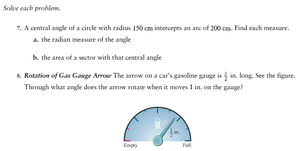
Q7. A central angle of a circle with radius 150 cm intercepts an arc of 200 cm. Find each measure:
a. The radian measure of the angle
b. The area of a sector with that central angle
Background
Topic: Radian Measure and Area of a Sector
This question tests your ability to use the arc length and radius to find the radian measure of a central angle and the area of a sector.
Key Terms and Formulas:
Arc length:
Area of sector:
Step-by-Step Guidance
Use the arc length formula to solve for .
Plug the value of into the area formula, but do not finish the calculation.
Try solving on your own before revealing the answer!
Q8. Rotation of Gas Gauge Arrow: The arrow on a car's gasoline gauge is in. long. Through what angle does the arrow rotate when it moves 1 in. on the gauge?
Background
Topic: Arc Length and Radian Measure
This question tests your ability to relate arc length to the angle in radians for a given radius.
Key Terms and Formulas:
Arc length:
Step-by-Step Guidance
Set up the equation with in. and in.
Solve for , but do not finish the calculation.
Try solving on your own before revealing the answer!
Q18. Angular and Linear Speed of a Point: Suppose that point is on a circle with radius 60 cm, and ray is rotating with angular speed rad/sec.
a. Find the angle generated by in 8 sec.
b. Find the distance traveled by along the circle in 8 sec.
c. Find the linear speed of .
Background
Topic: Angular and Linear Speed
This question tests your ability to relate angular speed to angle and linear speed, and to calculate distance traveled along a circle.
Key Terms and Formulas:
Angular speed:
Linear speed:
Distance:
Step-by-Step Guidance
Calculate the angle generated in 8 sec using angular speed.
Find the distance traveled using the arc length formula.
Calculate the linear speed using , but do not finish the calculation.
Try solving on your own before revealing the answer!
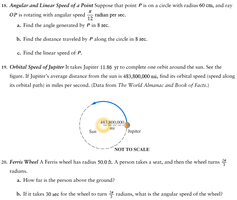
Q19. Speed of Jupiter: It takes Jupiter 11.86 yr to complete one orbit around the sun. If Jupiter's average distance from the sun is 483,800,000 mi, find its orbital speed (speed along its orbital path) in miles per second.
Background
Topic: Circular Motion and Orbital Speed
This question tests your ability to calculate the speed of an object moving in a circular orbit using its period and radius.
Key Terms and Formulas:
Orbital circumference:
Speed:
Step-by-Step Guidance
Calculate the circumference of Jupiter's orbit.
Convert the period from years to seconds.
Calculate the speed using , but do not finish the calculation.
Try solving on your own before revealing the answer!
Q20. Ferris Wheel: A Ferris wheel has radius 30.0 ft. A person takes a seat, and then the wheel turns radians.
a. How far is the person above the ground?
b. If it takes 30 sec for the wheel to turn radians, what is the angular speed of the wheel?
Background
Topic: Circular Motion and Angular Speed
This question tests your ability to relate angular displacement to height and calculate angular speed.
Key Terms and Formulas:
Height above ground: Use trigonometric relationships and the radius.
Angular speed:
Step-by-Step Guidance
Use the radius and the angle to find the vertical position of the person.
Calculate angular speed using the formula above, but do not finish the calculation.
Try solving on your own before revealing the answer!
