 Back
Study1
Study Guide - Smart Notes
 Tailored notes based on your materials, expanded with key definitions, examples, and context.
Angles and Right Triangle Trigonometry
Right Triangle Definitions and Trigonometric Functions
Right triangles are fundamental in trigonometry, allowing the definition of the six trigonometric functions based on the ratios of their sides. The sides are typically labeled as follows: the side opposite the angle θ, the side adjacent to θ, and the hypotenuse (the longest side, opposite the right angle).
Sine (sin θ): Ratio of the length of the side opposite θ to the hypotenuse.
Cosine (cos θ): Ratio of the length of the side adjacent to θ to the hypotenuse.
Tangent (tan θ): Ratio of the length of the side opposite θ to the side adjacent to θ.
Cosecant (csc θ): Reciprocal of sine.
Secant (sec θ): Reciprocal of cosine.
Cotangent (cot θ): Reciprocal of tangent.
Example: In the triangle below, with , , and unknown :
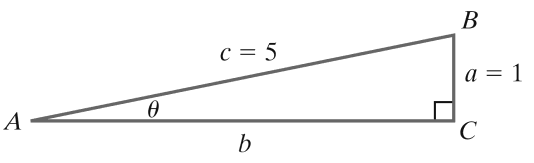
Trigonometric functions for angle θ can be written as:
Special Right Triangles: 45°-45°-90° Triangle
Special right triangles have side ratios that are useful for evaluating trigonometric functions of common angles. The 45°-45°-90° triangle has legs of equal length and a hypotenuse of times the leg.
Each leg: 1
Hypotenuse:
Angles: 45°, 45°, 90°
Example:
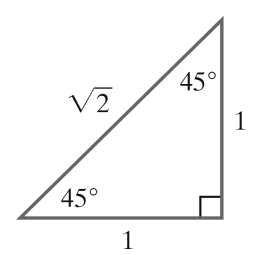
Trigonometric values for 45°:
Applied Right Triangle Problems
Trigonometry is used to solve real-world problems involving distances and angles, such as finding the width of a lake or the height of a structure using right triangles.
Key Steps: Identify the right triangle, label known sides and angles, and use trigonometric ratios to solve for unknowns.
Example: To find the width across a lake, use the tangent function if the angle and one side are known.
Example:
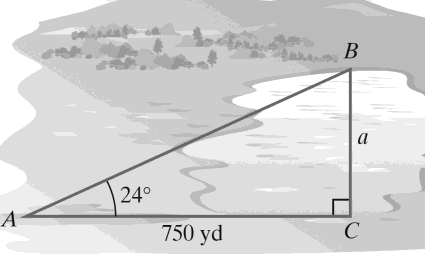
Given angle and adjacent side $750a$ is:
Example:
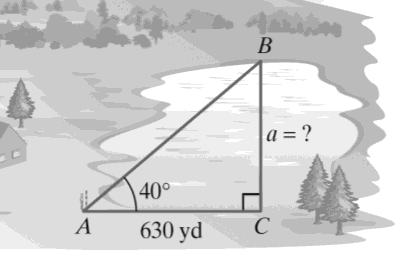
Given angle and adjacent side $630a$ is:
Trigonometric Functions and the Unit Circle
The Unit Circle and Trigonometric Functions
The unit circle is a circle of radius 1 centered at the origin. It is used to define trigonometric functions for all real numbers, not just angles in right triangles. The coordinates of a point on the unit circle correspond to and for an angle measured from the positive x-axis.
Equation:
Coordinates:
Example:
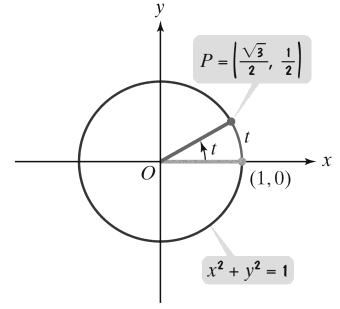
For such that , and .
Example:
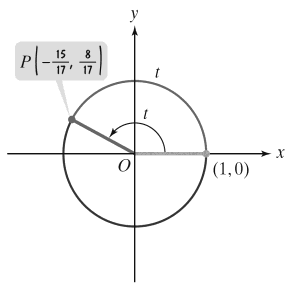
For such that , and .
Applications of Trigonometric Functions
Modeling Periodic Behavior
Trigonometric functions such as sine and cosine are used to model periodic phenomena, including tides, daylight hours, and oscillations. The general form for a cosine function modeling periodic behavior is:
A: Amplitude (maximum deviation from the mean)
B: Frequency (related to the period)
D: Vertical shift (mean value)
Example: Modeling the depth of water at a dock:
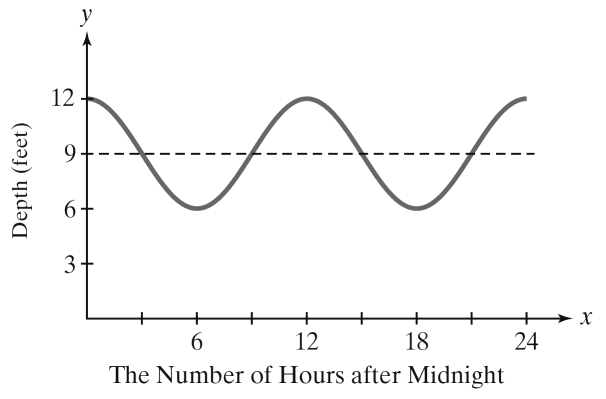
The graph shows periodic variation in water depth, which can be modeled by a cosine function.
Oblique Triangles and the Law of Sines
Solving Oblique Triangles
Oblique triangles (non-right triangles) are solved using the Law of Sines, which relates the sides and angles:
Example:
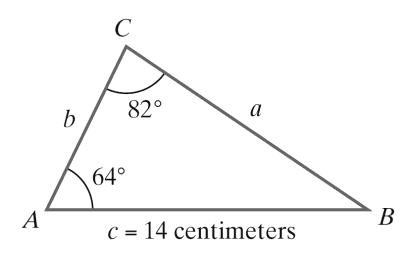
Given two angles and one side, use the Law of Sines to find the remaining sides.
Example:
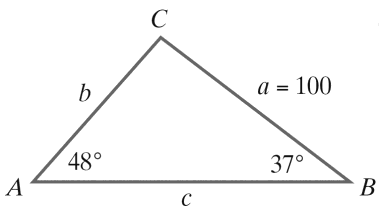
Given two angles and one side, use the Law of Sines to solve for the unknown sides.
Example:
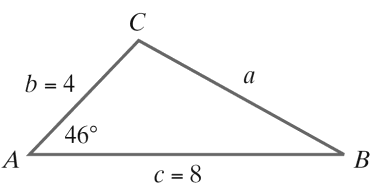
Given one angle and two sides, use the Law of Sines to solve for the unknown angle and side.
Applied Law of Sines Problems
Trigonometry is used to solve real-world problems involving bearings and distances, such as finding the distance across a lake or between two points.
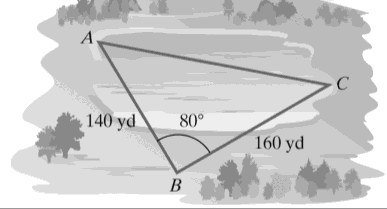
Given two sides and the included angle, use the Law of Sines to find the unknown side.
Vectors in Trigonometry
Vector Representation and Operations
Vectors are quantities with both magnitude and direction. In trigonometry, vectors are often represented in the rectangular coordinate system using components and .
Vector addition: Add corresponding components.
Scalar multiplication: Multiply each component by the scalar.
Example:
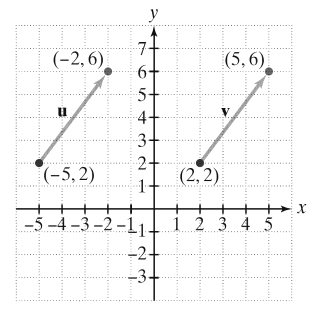
Vectors and are shown as arrows from their initial to terminal points.
Example:
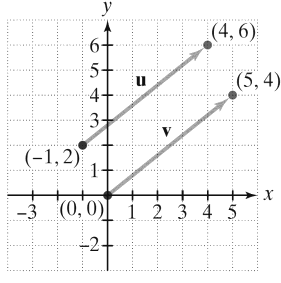
Vectors and are shown as arrows from the origin to their terminal points.
