 Back
BackTrigonometry Test #4 Review – Laws of Sines and Cosines, Vectors, and Trigonometric Equations
Study Guide - Smart Notes
 Tailored notes based on your materials, expanded with key definitions, examples, and context.
Trigonometric Equations and Solutions
Solving Trigonometric Equations
Solving trigonometric equations involves finding all angles that satisfy a given equation within a specified interval, often [0, 2π) or [0°, 360°). Common strategies include factoring, using identities, and applying the unit circle.
Quadratic Equations in Trigonometric Functions: Equations like 4sin2x - 3 = 0 can be solved by isolating the trigonometric function and using inverse functions.
Using the Unit Circle: The unit circle helps identify all solutions for equations such as sin x = 1/2 or cos x = 0 within a given interval.
Multiple Angle Equations: For equations like cos 3x = 1/2, solve for 3x first, then divide the solutions by 3 to find all x in the interval.
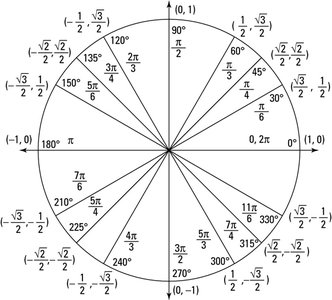
Example: Solve sin x = 1/2 for x in [0°, 360°): The solutions are x = 30°, 150° (or x = π/6, 5π/6 in radians).
Law of Sines and Law of Cosines
Law of Sines
The Law of Sines relates the sides and angles of any triangle, not just right triangles. It is especially useful for solving triangles when given two angles and one side (AAS or ASA) or two sides and a non-included angle (SSA).
Formula:
Application: Use to find unknown sides or angles.
Ambiguous Case (SSA): May yield 0, 1, or 2 possible triangles.
Example: Given sin 63°/a = sin 52°/7, solve for a:
Law of Cosines
The Law of Cosines generalizes the Pythagorean Theorem for any triangle and is used when two sides and the included angle (SAS) or all three sides (SSS) are known.
Formulas:
Application: Use to find unknown sides or angles, especially when the Law of Sines is not applicable.
Example: Find angle B if a = 3.1, b = 7.3, c = 5.4:
Area of a Triangle
Area Formulas
The area of a triangle can be found using trigonometric relationships when two sides and the included angle are known, or using Heron's formula when all three sides are known.
Trigonometric Area Formula:
Heron's Formula:
where
Example: Find the area if a = 8 in, b = 12 in, c = 16 in:
Ambiguous Case (SSA) and Number of Triangles
Determining the Number of Possible Triangles
When given two sides and a non-included angle (SSA), the Law of Sines may yield zero, one, or two possible triangles. This is known as the ambiguous case.
Zero Triangles: No solution if the side opposite the given angle is too short.
One Triangle: Unique solution if the side is long enough or the angle is right.
Two Triangles: Two possible solutions if the side is long enough to form two different triangles.
Example: Given a = 20, b = 12, B = 25°, determine the number of triangles possible using the Law of Sines.
Vectors in Trigonometry
Vector Components
A vector in the plane can be described by its magnitude and direction, or by its horizontal (x) and vertical (y) components.
Component Formulas:
Example: For , :
v_y = 6 \sin 203^\circ$
Dot Product and Angle Between Vectors
The dot product of two vectors is a scalar value that can be used to find the angle between them.
Dot Product Formula:
Angle Between Vectors:
Example: For , :
Orthogonality of Vectors
Two vectors are orthogonal (perpendicular) if their dot product is zero.
Test for Orthogonality: If , then and are orthogonal.
Example: Are and orthogonal?
So, they are not orthogonal.
Summary Table: Key Trigonometric Laws and Formulas
Law/Formula | Equation | When to Use |
|---|---|---|
Law of Sines | ASA, AAS, SSA (ambiguous case) | |
Law of Cosines | SAS, SSS | |
Area (trig) | Two sides and included angle | |
Area (Heron's) | All three sides known | |
Dot Product | Angle between vectors, orthogonality | |
Vector Components | , | Magnitude and direction to components |
Additional info:
All equations are provided in LaTeX format for clarity and further study.
The unit circle diagram is included to reinforce the connection between angle measures and trigonometric values.
