 Back
BackVectors in Trigonometry: Definitions, Operations, and Applications
Study Guide - Smart Notes
 Tailored notes based on your materials, expanded with key definitions, examples, and context.
Vectors
Vector Vocabulary
Vectors are directed line segments used to describe quantities that have both magnitude (length or size) and direction. Understanding vectors is essential in trigonometry for solving problems involving forces, motion, and navigation.
Scalar: A quantity with only magnitude (e.g., mass, temperature).
Vector: A quantity with both magnitude and direction (e.g., velocity, force).
Magnitude: The length of the vector segment, denoted as .
Direction: The angle or orientation of the vector relative to a reference axis.
Initial Point: The starting point of the vector.
Terminal Point: The ending point of the vector.
Vector Notation and Representation
Vectors can be written in several forms, including ordered pairs, component form, and using arrows or boldface letters. The most common notation is:
Ordered pair:
Component form:
Vectors are often drawn from the origin to the terminal point in a coordinate plane.
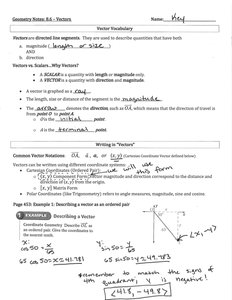
Describing Vectors as Ordered Pairs
Finding Vector Components
To describe a vector as an ordered pair, use trigonometric functions to find the x and y components:
Where is the magnitude and is the direction angle.
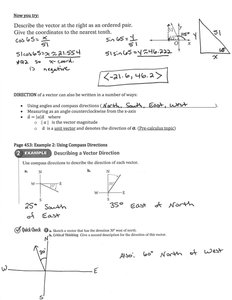
Direction of Vectors
The direction of a vector can be described using compass notation (e.g., "35° East of North") or as an angle from the positive x-axis. Directions are important for navigation and physics applications.
Compass directions: North, South, East, West
Angle notation: Measured from a reference axis
Magnitude of Vectors
Calculating Magnitude
The magnitude of a vector is always non-negative and represents the length of the vector. It is calculated as:
Magnitude can also be interpreted as the distance from the origin to the terminal point in the coordinate plane.
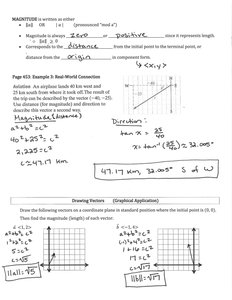
Drawing Vectors
Graphical Representation
Vectors can be drawn in standard position, starting at the origin and ending at the terminal point. The length and direction are determined by the vector's components.
Draw the vector from (0,0) to (x,y).
Label the magnitude and direction.
Adding Vectors
Algebraic Addition
Vectors can be added algebraically by summing their corresponding components:
If and , then
The result is called the resultant vector.
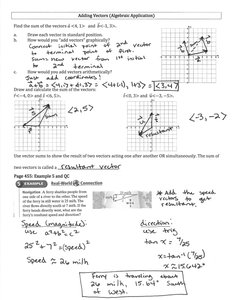
Applications: Real-World Vector Addition
Vector addition is used in physics and navigation to combine forces, velocities, or directions. For example, the speed and direction of a ferry traveling across a river can be found by adding the velocity vectors of the ferry and the river current.
Resultant speed and direction are calculated using trigonometric functions and vector addition.
Multiplying Vectors by Scalars
Scalar Multiplication
Multiplying a vector by a scalar changes its magnitude but not its direction. The operation is performed by multiplying each component by the scalar:
If is a scalar and , then
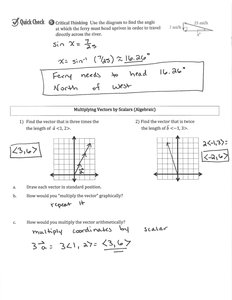
Graphical Interpretation
Scalar multiplication stretches or shrinks the vector in the direction it points. This is useful for scaling forces or velocitic43es in physics and engineering applications.
Example: Tripling the length of a vector results in .
Summary Table: Vector Operations
Operation | Formula | Result |
|---|---|---|
Addition | ||
Magnitude | Length of vector | |
Scalar Multiplication |
Additional info: These notes cover the essential concepts of vectors as applied in trigonometry, including definitions, notation, operations, and real-world applications. The examples and diagrams reinforce understanding of vector addition, scalar multiplication, and direction finding using trigonometric functions.
