
Teaching young learners: all just fun and games?

Jill Leighton
Children sat at desks in a classroom, with one in the middle smiling with her hand up
Reading time: 5 minutes

We want lots of fun in our lessons, with a good balance of activities and games with strong educational value. But in my opinion, today’s young learners need more than just fun and games to stay motivated. Fun and games can quickly become meaningless and boring for some students.

How do we create fun and engaging lessons for young learners aged 6-14?

  • Have a strong relationship with your students. Know about their natural talents, their weaker points and where they are in their development.
  • Encourage them to be active learners and engage them in learning that is meaningful to all of them. E.g. through project work.
  • Provide opportunities for students to use technology and develop success skills. E.g. collaboration, communication, critical thinking, creativity and self-learning.

Most teachers agree that we have to assume the responsibility of preparing students for life as well as helping them to acquire a language – and this is what I aim to demonstrate in this blog. Using Howard Gardner’s Model of Multiple Intelligences, I want to demonstrate how you can learn more about your students and care for individual needs in one classroom.

The students will also learn about themselves and their classmates. They will acquire vocabulary and language (at their level) in a dynamic way and create a project to explore their interests and demonstrate their talents. They will use technology and develop their success skills. Assessment will be fun and engaging. I hope you will be able to adapt the ideas and put them into practice with children aged 6-14.

Howard Gardner’s Model of Multiple Intelligences

Howard Gardner’s Model of Multiple Intelligences prompts us to ask: How is this child intelligent? He identified eight different types of intelligence which guide the way students learn:

  • Verbal-Linguistic Intelligence (Word Smart)
  • Logical-Mathematical Intelligence (Maths Smart)
  • Spatial Intelligence (Picture Smart)
  • Musical Intelligence (Music Smart)
  • Bodily-Kinesthetic Intelligence (Body Smart)
  • Naturalistic-Environmentalist Intelligence (Nature Smart)
  • Interpersonal Intelligence (People Smart)
  • Intrapersonal Intelligence (Self-Smart)
  • (He later went on to identify Existential Intelligence – Life Smart, and Pedagogical Intelligence -Teacher Smart)

Lesson 1: Outline the student’s learning goals

Explain to the students that they are going to learn about Howard Gardner’s Model of Multiple Intelligences and that you want them to achieve learning goals on completion of the project. Write the goals on a poster and discuss them with your students. Take a digital photo of the poster to use during the assessment.

Student learning goals – you will be able to:

  • Identify different intelligences and what they mean. Name eight different intelligences you have
  • Communicate ideas clearly through a project to demonstrate your talents and interests
  • Use your success skills more effectively.

Tip: Video parts of lesson 1, especially discussion of the learning goals, to use as part-assessment and reflection on completion of the project.

What do you know about the Multiple Intelligences? How are you smart?

  • Ask children what they know about multiple intelligences. Teach key language and vocabulary as necessary, depending on level.
  • Ask, “What does it mean be intelligent?” (They will probably say, good grades, be good at maths, English, reading, writing, computers...)
  • Tell them being intelligent or smart (get the younger children to repeat the word smart several times) isn’t only about getting good grades. Ask them to think of more ways to be smart.
  • Elicit the eight ways to be smart according to Gardner. (You may need to mime). E.g. mime playing the piano or clap a rhythm to elicit Music Smart.
  • Discuss what the different intelligences mean. (E.g. Word Smart (Linguistic Intelligence): you like reading, writing or speaking, you are probably good at languages…)
  • Teach career vocabulary associated with the different intelligences. (E.g. Word Smart: journalist, teacher, lawyer, editor, TV announcer, web editor.)

Lesson 2: Find out your smarts quiz

Tell students they are going to do a quiz to discover how they are smart. Model each stage of the activity and do the quiz with them to find out about your own strengths. Give each student a piece of paper.

  • Take your paper and show the students how to fold it into eight sections, then unfold it and draw lines along the folds to make a grid.
  • Write the different smarts in each section. (Use small handwriting to leave room to illustrate each smart with a picture).
  • Give a picture dictation to illustrate each smart. Here are some examples:

Word Smart: Draw a dictionary and children reading, writing and speaking.

Logic/Number Smart: Draw sums on a computer, a scientist with test tube.

Music Smart: Draw children singing and playing musical instruments.

Body Smart: Draw children playing a sport, dancing or cooking.

Nature Smart: Draw trees, animals, insects, child watering a plant.

Spatial/Picture Smart: Draw children drawing, painting or taking photos and a pilot in a plane.

People Smart: Draw a child helping or leading a group or a group of children holding hands.

Self-Smart: Draw children keeping a journal, researching on a computer, or meditating.

Encourage students to order their smarts from 1-8. For example, if you love music, write number 1 in the Music Smart section and continue to 8 in order of preference. (You may wish to model this first and order your smarts from 1-8 and then encourage the children to order their smarts.)

After the quiz

  • Encourage students to compare and discuss their results. Collect the papers and make notes about each student’s results. This will help you reach all your students when planning activities.
  • Explain that we have all the intelligences in different degrees and that all of the intelligences are equal (no intelligence is better than another). Also point out that it is important to know our strengths in order to help in all subjects. (E.g. a music smart student who finds maths challenging may want to sing multiplication tables). Remind students that we usually use several intelligences to do something and we can explore and develop all our smarts.

Tip: Video lesson 2 to use as part of assessment.

Lesson 3: Beginning the project

Encourage the students to create a project for enjoyment. Explain that you want them to collaborate in groups that share the same smarts and interests and using their creativity you want them come up with an interesting topic to explore. (Remind students to concentrate on developing their success skills when they are working with others and mention that you will also be monitoring this as part of the assessment).

Organize the students into groups of no more than five students in each. Give students time to brainstorm in their groups and come up with the best topic for the project, using their critical thinking skills. (E.g. Picture Smart students may decide to create a project about a famous artist, such as Salvador Dali).

You may wish to give each student a KWL chart (Know, Want-to-know, and Learned) to complete during the project process, asking questions such as: What do you know? What do you want to know? What have you learned?

Lesson 4: Planning the project

Inform students about the timing of the project. Encourage each group to make a project mind map, which will encourage them to be more creative and organized.

Remind all the groups to keep the following questions in mind:

  • What are you going to do/make? (Presentation, PowerPoint, website, video, posters.)
  • How will you research it? (Internet, tech tools, library.)
  • How will you delegate responsibilities?
  • How will you check that your audience has understood the message of your project? What questions will you ask?

Decide on how many lessons are needed to prepare the project and how much will be done in school or at home, depending on the age groups and timing.

Encourage the students to share their work with the rest of the class (or in assembly.)

Tip: Video the different groups sharing their work.

Can assessment also be fun and engaging?

Yes, it can; here are some tips and suggestions.

  • Show the videos you have recorded and ask the students to compare and contrast their knowledge in Lesson 1 and how it developed over the lessons. Encourage them to observe and comment on their success skills.
  • Display the photo of the Student Learning Goals poster from Lesson 1. Get the students to self-assess and decide whether they have achieved the goals that were set in Lesson 1. (You may wish to give the students three small pieces of colored paper: red to represent I understand quite well, orange to represent I understand well and green to represent I understand very well). Ask: Can you identify the different intelligences and say what they mean? Encourage the students to hold up a colored piece of paper according to their understanding. (Make a mental note of all red pieces of paper to be ready to give extra help to those students). Check understanding by getting several students to answer the question.
  • Get the children to reflect on the learning experience. What have they learned about the different intelligences? How can they develop weaker points using their strengths to help them? Can they use all eight intelligences inside and outside school? Did they manage to get along well with their classmates? Did they communicate the message of their project so that the audience understood?
  • Give individual feedback to each student. E.g. congratulate them on their attitude and effort or identify areas for improvement: “You managed to use vocabulary and language effectively when you shared your project, we understood your message perfectly.” Or “You need to work on being more collaborative.” “You weren’t on task during the project.” “How do you think you can improve that?”
  • Ask students to give you feedback on the activities they enjoyed. Get them to draw happy and sad face cards. Go through all the activities and get the students to show a happy or sad face according to whether or not they liked the activity. E.g. say “Did you like the ‘Find out your smarts’ quiz?” and ask them to hold up the happy or sad face depending on whether they liked the activity or not.

Create fun lessons to engage all your students keeping this model in mind: traditional activities such as short fun activities and games + Howard Gardner’s model of Multiple Intelligences + PBL (Project Based Learning) + success skills + meaningful assessment. Enjoy the results with your students.

How the Global Scale of English can help

The Global Scale of English (GSE) Learning Objectives for Young Learners provides ready-made learning objectives that can help with planning curriculums and lesson and benchmarking learners’ progress. They are great for young learners because they describe language functions in a granular way, enabling educators to give their learners credit for small achievements. They also clearly show the language functions to target next in order to take learners to the next level.

More blogs from Pearson

  • A teacher stood in front of a whiteboard teaching a class
    Lesson tips for Special Educational Needs
    Por Richard Cleeve
    Reading time: 5 minutes

    Creating an inclusive classroom is essential for helping every student reach their full potential. Students with Special Educational Needs (SEN) and neurodiverse learners bring unique strengths, perspectives and ways of thinking to the classroom. However, many teachers feel unsure about how to adapt lesson plans to effectively meet diverse learning needs.

    By implementing inclusive teaching strategies, educators can create engaging learning environments that support students with ADHD, dyslexia, autism spectrum disorder (ASD), anxiety disorders and other learning differences. These approaches not only benefit neurodiverse learners but often improve engagement and outcomes for the entire class.

    Drawing on insights from experienced SEN Coordinator James Laidler, this post explores practical lesson planning strategies that can help teachers create more accessible, supportive and effective learning experiences. Many of these tips are also great for keeping all students engaged, SEN or otherwise.

    Defining Special Educational Needs

    A child has Special Educational Needs (SEN) if they have a learning difficulty or disability that calls for special educational provision. Learners with conditions such as autistic spectrum disorder (ASD), attention deficit hyperactivity disorder (ADHD), dyslexia, dyspraxia or anxiety disorders come under this framework.

    Inclusive lesson tips for neurodiverse students

    Although teachers want to create inclusive lessons, many feel ill-equipped to support neurodiverse students. To help, James offers some tips for lesson planning that aim to turn learning diversities into strengths.

    Attention Deficit Hyperactivity Disorder (ADHD)

    ADHD is a condition that can include symptoms such as inattentiveness, hyperactivity and impulsiveness. Students with this disorder may have a short attention span, constantly fidget or act without thinking.

    Lesson tips for ADHD students:

    Movement breaks – Students with ADHD may struggle to sit still for extended periods of time. Include short breaks in your lessons that offer them the opportunity to get up and move around at regular intervals.

    Group work – To keep learners active and engaged, include group work in class. This means they don’t have to focus on the board for too long.

    Dramatize lessons – A really effective activity is to bring drama into the classroom. For example, students can act out role plays or other fun drama-based activities. It keeps them motivated, holds their attention and can be fun for all of the class.

    Dyslexia

    Dyslexia primarily affects the skills involved in accurate and fluent reading and spelling. It may affect a person’s phonological awareness, verbal memory and verbal processing speed.

    Lesson tips for dyslexic students:

    Visual aids – Learners with dyslexia tend to have excellent visual memories. Try bringing in pictures to illustrate ideas or add them to lengthy texts to help students when doing reading comprehension exercises.

    Font and spacing – When setting reading tasks, simply changing the font, enlarging the font size and double-spacing are hugely beneficial to dyslexic students. Simply adapting the text can make their learning experience much easier.

    Text-to-speech software – Using specialized text-to-speech software often provides significant support to those who struggle with reading or digesting text on computer screens. Tools such as ClaroRead or Kurzweil 3000 can help improve accessibility.

    Autism Spectrum Disorder (ASD)

    ASD is a developmental condition that involves challenges in social interaction, speech and nonverbal communication, as well as restricted or repetitive behaviors. The severity of symptoms is different in each person.

    Lesson tips for ASD students:

    Encourage systematic skills – Often students with ASD may be more systematic than other students. This means they favor routines, regular processes and predictable activities. Try bringing out these skills by asking students to spot patterns, analyze numbers or evaluate data.

    Talk about interests – Autistic students may have specific interests they love to research. Engage them by getting them to talk about their hobbies or ask students to create projects on a topic they choose that they can present to the class.

    Teaching online or blended learning – If you have a learner who is struggling socially at school, it may be an option to include hybrid or blended learning. This takes away some of the social and emotional challenges of school and people interaction, which can benefit ASD students.

    Anxiety Disorders

    Anxiety disorders differ from normal feelings of nervousness or anxiousness. They involve intense fear or anxiety that can significantly affect a student’s ability to learn. This condition has become increasingly common in young people and can impact concentration, participation and confidence in the classroom.

    Lesson tips for students with anxiety disorders:

    Changing language and terminology – Our education system is often highly exam-driven, which can create stress for students. By offering reassurance, guidance and motivation, teachers can help reduce feelings of anxiety.

    Talk openly – Encourage learners to discuss their feelings if they are struggling. They can do this with you, a classmate or a support worker at the school. If they open up to you, focus on strategies to combat negative feelings and emotions.

    Mindfulness techniques – Try adding five minutes at the start of the day for guided meditation or breathing exercises. This can help students begin the day in a calm and relaxed manner.

  • Teenage students looking at a phone together outside
    Six easy ways to learn English
    Por Steffanie Zazulak
    Reading time: 3 minutes

    Learning English can open doors to better career opportunities, travel experiences and global communication. However, staying motivated while learning a new language can sometimes be challenging. The good news is that there are many easy ways to learn English that fit into your daily routine.

    Whether you're a beginner or looking to improve your fluency, these practical English learning tips will help you build confidence and develop your speaking, listening, reading and vocabulary skills faster.

    1. Play word games to build your English vocabulary

    One of the most enjoyable ways to learn English is through word games. Games like Scrabble, Words With Friends, crossword puzzles and word search apps can help you expand your English vocabulary while having fun.

    Word games encourage you to think in English, recognize spelling patterns and learn new words naturally. If you're studying with friends or classmates, make it a regular activity to practice together and challenge each other's vocabulary skills.

    Benefits:

    • Improves vocabulary retention
    • Enhances spelling skills
    • Makes learning English enjoyable
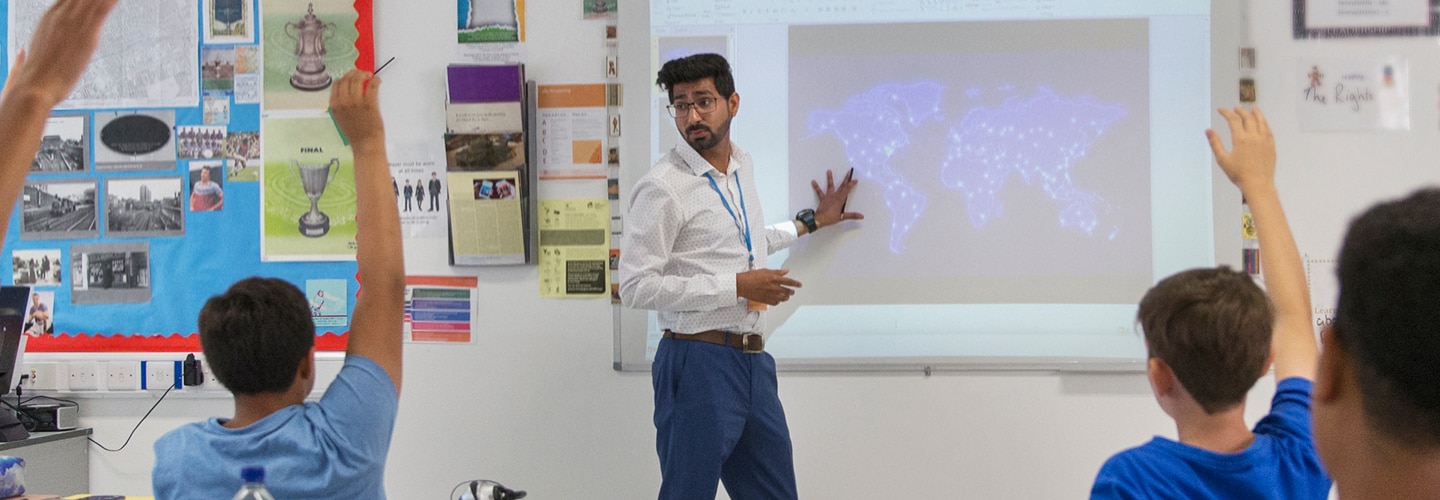
  • A teacher working on a interactive whiteboard and students raising their hands
    Universal Design for Learning (UDL) in language education
    Por Charlotte Guest
    Reading time: 5 minutes

    Language classrooms are naturally diverse. Some students are confident speakers but struggle with writing. Others may be multilingual learners, students with learning differences or learners who simply need more time and support. Universal Design for Learning (UDL) offers a practical framework for meeting these varied needs without creating separate lessons for every student.

    UDL was developed by CAST, a nonprofit organization focused on education research and development, and is based on the idea that barriers to learning often exist in the design of instruction rather than in the learners themselves. Instead of expecting all students to learn in the same way, UDL encourages teachers to provide flexible pathways that help everyone access and engage with learning. According to CAST's overview of UDL , UDL aims to improve learning for all students through flexible goals, methods, materials and assessments.

    The three core principles of UDL

    At the heart of UDL are three principles that help teachers design more inclusive learning experiences.

    1. Multiple means of engagement

    This principle focuses on motivation and participation. Students are more likely to learn when they see value in what they are doing and have some choice in how they learn.

    In a language classroom, this might include:

    • Allowing students to choose discussion topics related to their interests
    • Using authentic materials such as podcasts, songs, news articles or social media posts
    • Offering different levels of challenge within the same activity

    When students feel connected to the content, they are more willing to take risks and use the target language. The CAST UDL Guidelines provide detailed recommendations for increasing learner engagement and motivation.

    2. Multiple means of representation

    Students do not all process information in the same way. UDL encourages teachers to present information through different formats so that learners have several ways to understand new content.

    For language teachers, this could mean:

    • Combining written text with audio recordings
    • Using images, diagrams, gestures and videos to support comprehension
    • Pre-teaching key vocabulary before introducing a complex reading task
    • Providing transcripts for listening activities

    These supports are not only beneficial for students with identified learning needs; they often improve comprehension for the entire class. CAST's guidance on representation highlights how varied formats can support learner understanding.

    3. Multiple means of action and expression

    Students should have different opportunities to demonstrate what they know. Traditional language assessments often favor a narrow set of skills, but learners may show understanding in many ways.

    Examples include:

    • Recording an oral presentation instead of delivering it live.
    • Creating a video, podcast or digital story.
    • Participating in an interview or conversation.
    • Producing written work using supportive technologies.

    The learning objective remains the same, but students have more than one way to demonstrate achievement. The educational resource Understood.org explains this principle in its guide to UDL.

    Why UDL matters in language education

    Language learning involves reading, writing, listening, speaking, vocabulary development and cultural understanding. Because so many skills are involved, barriers can emerge in different places for different learners. UDL helps teachers anticipate these differences and design lessons that provide access from the start rather than adding accommodations later.

    Research from CAST suggests that designing for learner variability benefits all students, not just those with identified educational needs. This is particularly relevant in language classrooms, where students often have diverse linguistic backgrounds, proficiency levels and learning preferences.

    Importantly, UDL is not about creating separate lessons for every learner. Instead, it is about building flexibility into lesson design so that a wider range of students can participate successfully.

    UDL strategies for language teachers

    If you are new to UDL, start small. Consider adding one or two flexible options to your existing lessons.

    Here are a few simple ideas:

    • Provide both written and spoken instructions.
    • Use captions on videos whenever possible.
    • Offer vocabulary lists with visuals and examples.
    • Allow students to choose between speaking or writing for some tasks.
    • Include collaborative and independent learning opportunities.
    • Use digital tools that support translation, text-to-speech or speech-to-text functions.
    • Clearly communicate learning goals before each lesson.

    For additional classroom examples, CAST's UDL Guidelines website contains guidance that teachers can adapt across different age groups and language-learning contexts.