Effective classroom management routines for very young learners

Jeanne Perrett
Jeanne Perrett
A teacher with young students sitting at a table looking at flashcards
Reading time: 4 minutes

For very young learners, children aged 3-6, being in a classroom might be a completely new experience. Most of them won’t know any English words at all and might have very little idea of what English is or why they are learning it. Some of them may not yet be completely fluent in their mother tongue. 

At the beginning of the school year, some of them may find it distressing to be separated from their parents and they also have to learn to get along with their new classmates. 

If we want to keep them comfortable and safe and provide a friendly and welcoming environment, we need to establish routines. 

7 ways you can build routines into your classes

Here are some areas where you can easily incorporate classroom management routines into your English language class.

1. Think about your target language

Our target language for each lesson may be one or two short phrases or a few new words. We should always keep the presentation and practice of this simple and clear. 

However, we can use English for all our greetings, praise, instructions and explanations. After a few days, the children will begin to expect it and they will gradually understand what you are saying. 

2. Coming into the class

Take time to greet each child by name when they enter the classroom and encourage them to learn and use each other’s names too. This will change how they perceive themselves and each other and encourage friendly communication. 

Notice the small things about each child. They might have a new T-shirt on or have done their hair specially. They may not tell you that they have made an effort to look nice for their lesson, but they will be pleased when you notice and will feel encouraged to continue. 

3. Circle time

Make circle time the start of every lesson. It gets the children sitting down together and this helps them to get to know each other and feel part of a comfortable group. 

It’s the time where you present the target language for the day. Use a puppet to help you do this. Make the puppet part of the routine by keeping it in a certain place and bringing it out from there every day. The children can call its name. 

The puppet can greet the children by name and the children can answer back. First, use picture cards or objects to present the language to the puppet. Then, the puppet can show that it understands or ask for repetition. 

Let the children call out responses as a group. As they build their confidence in English they will want to speak by themselves. 

Always accept approximations of words and phrases. Rather than correcting the children, continue to model the words and gradually the students will self-correct. Pass this tip on to parents too. 

4. Book time

Give students time to discover pages and images they like in the books they are using. Always leave time to help each child find the correct page and then help them to focus their attention on that page. 

In Circle time you have introduced the language and presented it with flashcards or objects. In Book time, children can look at these images – the content will be familiar and they will start to feel ownership of what they are learning. 

5. Songs, games and miming

Singing, playing games and miming are the main ways in which the students will start to freely use and show they understand the target language. 

In My Disney Stars and Friends each stage of every game is detailed, along with the language you and the students can use. Students might become so involved in the action of the game that they forget to speak in English! That’s okay – continue using the language and eventually they will start to use it too. 

When a game or a song involves physical activity, have drinks of water ready and let them rest and relax afterwards. Always have a ‘sitting down’ activity ready for them to move on to so that they do not become overexcited or tired.

6. Craft and stickers

For any craft work there are four stages: preparation, production, playing with the completed craft work and tidying up. If you're using My Disney Stars and Friends, there is a special Tidy Up song and all the craft projects are press-outs so there is no need for scissors. 

Children of 3 or 4 years old will need to learn how to unpeel and then re-stick a sticker. Allow time for this and encourage them to learn from each other once some of them have mastered this fine motor skill. 

7. Leaving the class

Time your lessons so that the students don’t have to leave in a rush. It takes them a while to collect up their things and find their bags and coats. 

If you want the parents to know something, make sure that the children know where they have put the note. One notebook for such messages is a simple way of doing this, and you can tell parents to check it after every lesson. 

Just as you greeted each child by name when they came in, say goodbye to them individually as they leave. 

Incorporating effective classroom management routines makes young learners feel more comfortable as they know what to expect from their language classes. Familiarity is welcome for children, so exploit these times for more language learning opportunities. 

Find more ideas on effective classroom management routines in Jeanne Perrett’s webinar, where she focuses on practical ideas and teaching tips for how we can organise and manage a class of young learners.

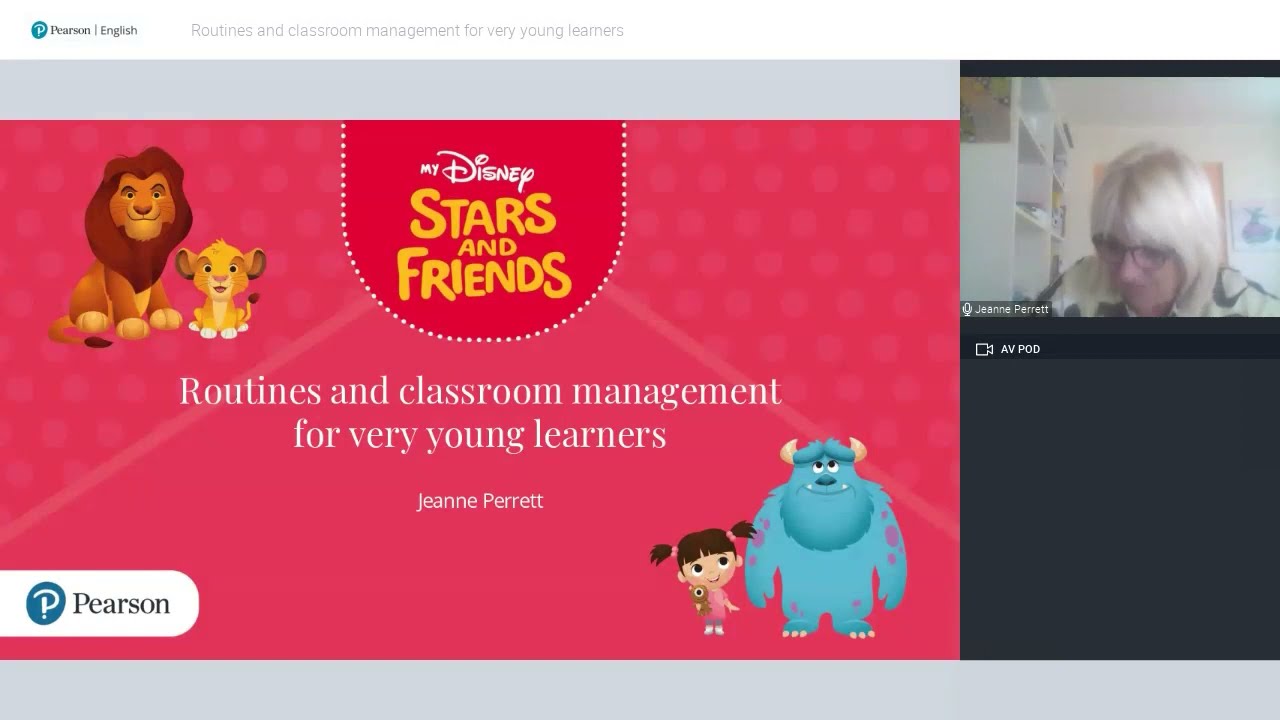
Routines and classroom management for very young learners I Pearson English Disney Day
Play
隱私和Cookies

觀看此視頻表示你同意培生可於一年內使用你觀看的數據以作分析及營銷之用。你可以通過清除cookies撤銷設定。

Want to learn more about teaching young learners? Read our post 'Young learners of English deserve more'.

More blogs from Pearson

  • Two business people standing together drawing on a notepad
    From first chat to offer letter: how PTE English simplifies admissions for international students
    By Alice Bazzi
    Reading time: 2 minutes

    Every step in the admissions process matters. For students, the journey from initial counselling to receiving an offer letter can feel overwhelming. For agents, delays and complications can often lead to missed deadlines and opportunities lost. The good news? PTE Express has recently been introduced and is designed to remove friction at every stage, making the process faster, simpler and more reliable for everyone involved.

    What slows down admissions success?

    Traditional English testing often introduces unnecessary friction. Students may have to travel to test centers, wait weeks for results or navigate complex booking systems. These delays create stress and a level of uncertainty, especially with international studies as there will be strict timelines. Agents know that every day counts; when scores do not arrive on time, applications stall, and the risk of students losing their place increases.

  • A teacher handing out papers to her students
    Elevating English Language teaching in the age of AI: Why the GSE matters more than ever
    By Nancy Reeves
    Reading time: 4 minutes

    Educators and schools share a common objective: to deliver high-quality learning experiences and support student success. As artificial intelligence rapidly transforms society, this objective becomes increasingly significant. English language instruction now requires preparing students to thrive in a globalized, digital and automated environment.

    The challenge: Teaching English amid rapid change

    Artificial intelligence has shifted expectations for language learning. Students now have access to instant translation, auto-generated texts, speech-to-text and various language applications. However, these tools can present challenges in the classroom. For instance, students may become overly dependent on instant translation rather than developing their own language proficiency. Educators must ensure that students engage in authentic learning rather than using technology to bypass difficult tasks. Additionally, some students may use AI to complete written assignments, hindering the development of their writing skills. These challenges underscore the need for schools to integrate technology thoughtfully while maintaining a focus on genuine learning.

    In response to these developments, it is essential to enhance both teaching and assessment practices. The emphasis should remain on teachers’ core strengths: guiding, mentoring and fostering critical thinking and communication skills that technology cannot replicate.

    Why standards matter more than ever

    In my role as a curriculum director, I recognized the critical importance of establishing clear standards and objectives. These standards serve as navigational tools, guiding instructional decisions and enabling timely adjustments in classroom practice. For example, if a teacher identifies a need to enhance students’ communication skills, they can incorporate additional group activities. Standards support educators in the following ways:

    • Understand what students can truly do at each proficiency level.
    • Measure progress in a meaningful, learner-centered way.
    • Build intentional learning pathways.
    • Design interventions based on evidence, not intuition.

    Upon discovering the GSE “Can Do” statements, I recognized a framework that is both transparent and practical. Unlike broad descriptors, the GSE delineates language learning into specific, measurable skills aligned with authentic English usage. For instance, rather than stating that a student can "understand basic spoken directions", the GSE specifies that a student can "follow detailed multi-step instructions in familiar contexts". This level of detail provides a clearer understanding of students’ actual capabilities.

    A shift in perspective: From measuring to understanding

    A key advantage of the GSE is its transformative approach to student assessment. The process begins by asking, “What can students do now? What should they work on next?” Research indicates that dividing tasks into manageable steps reduces student anxiety and increases motivation. This approach fosters a sense of accomplishment and self-efficacy, both of which are essential for sustained language acquisition.

    This shift is significant. It alleviates pressure on learners and promotes a deeper understanding of their strengths, learning preferences and challenges. Additionally, it equips teachers with actionable insights, encouraging the development of new strategies and evidence-based instructional decisions.

    Tiered intervention: Where the impact became visible

    At our school, we introduced the GSE to support students needing tiered intervention. The transformation was gradual but encouraging. For instance, at our school, we started using the GSE to help students who needed extra support. The changes took time, but we saw good results. In the first semester, 60% of students in the program improved their English by at least one level, as measured by the GSE "Can Do" statements.

    One student said, "For the first time, I felt like I was making real progress in understanding English." Teachers stopped using general support and focused on specific actions linked to the "Can Do" statements. Students kept improving in English and felt more confident as they reached clear goals. AI can generate text, translate, and simulate conversation, but cannot replace the teacher’s role in developing empathy and nuanced understanding.

    In one classroom moment, a student struggled to interpret the tone and emotion of a literary work, which AI could translate but could not fully convey the depth of feeling. The teacher stepped in and guided the class in exploring the subtleties of the text, illustrating the emotions, historical context, and cultural significance behind the words. This human interaction highlighted the teacher's unique ability to foster deeper comprehension and emotional intelligence.

    Frameworks such as the GSE ensure that language learning remains centered on student development and the human dimensions of education.

    Moving forward with purpose

    As artificial intelligence accelerates change, our responsibility is to utilize tools and frameworks that enhance, but do not supplant, the human aspects of learning.

    The GSE provides a structured approach to tracking progress, adapting to individual student needs and designing effective lessons.

    English teaching is not in competition with AI; it is growing alongside it. Good frameworks and thoughtful teaching help students learn language and succeed in a world where communication, flexibility and human connection are key. I encourage you to try the GSE in your classes or programs. By using this framework, we can make language learning more effective and inclusive for everyone. Let’s work together to help education grow with new technology.

  • Great-grandmother and child read book in park
    Learning my family language with Mondly by Pearson
    By Hannah Lawrence
    Reading time: 5 minutes

    Although I’ve worked as a copywriter and editor for most of my career, I’ve always struggled to learn any language other than English. I still remember the humiliation at school as our French teacher walked between the desks, asking each of my classmates if they would continue studying French at a higher level. When she reached my desk, she stopped, looked at me, shook her head, and moved on. I wasn’t even invited to try.