What is the function of the poly A tail in eukaryotic mRNA?
The poly A tail increases mRNA stability, facilitates export from the nucleus, and aids in translation.
What is the process called that removes sections of RNA during mRNA maturation?
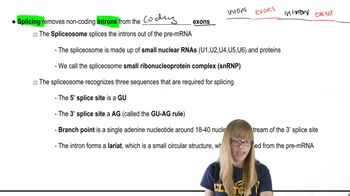
The process is called splicing, which removes non-coding introns from pre-mRNA.
When does mRNA processing take place in eukaryotic cells?
mRNA processing occurs after transcription and before translation.
Most mature eukaryotic mRNAs have a string of nucleotides referred to as a poly A tail. What is its composition?
The poly A tail is composed of approximately 150-200 adenine nucleotides.
During RNA processing, a(n) poly A tail is added to the 3' end of the RNA. What triggers its addition?
A polyadenylation signal (AAUAAA) triggers the addition of the poly A tail.
Most mature eukaryotic mRNAs have a string of nucleotides referred to as a poly A tail. What is its role?
The poly A tail helps stabilize mRNA and promotes its export from the nucleus.
Portions of eukaryotic mRNA sequence that are removed during RNA processing are called ________.
They are called introns.
Splicing of different exons together from the same mRNA molecule can result in what genetic phenomenon?
It can result in alternative splicing, producing multiple mRNA variants from a single gene.
One modification to mRNA transcripts is the addition of a tail that is composed of which nucleotide?
The tail is composed of adenine nucleotides.
In eukaryotic mRNA, sequences found in the mature mRNA are termed what?
They are termed exons.
A sequence of mRNA that is removed during processing is a(n) ________.
It is an intron.
What is produced by alternative splicing of mRNA?
Alternative splicing produces multiple mRNA variants, increasing protein diversity.
What are the main steps involved in the processing of eukaryotic mRNA after transcription?
The main steps in eukaryotic mRNA processing are the addition of a 5' cap (methylguanosine), addition of a polyadenylation (poly-A) tail at the 3' end, and splicing to remove non-coding introns. Additional modifications can include alternative splicing and RNA editing.
Which modifications occur during RNA processing to protect mRNA and facilitate its translation and export from the nucleus?
During RNA processing, a 5' cap is added to protect mRNA from degradation and assist in translation initiation, and a polyadenylation tail is added at the 3' end to facilitate export from the nucleus and enhance stability.
How can an RNA molecule be modified after transcription, and what is the role of the spliceosome in this process?
After transcription, an RNA molecule can be modified by the addition of a 5' cap, a poly-A tail, and by splicing, which removes introns. The spliceosome, a complex of small nuclear RNAs and proteins, recognizes specific splice sites and catalyzes the removal of introns, joining exons to form mature mRNA.
 Back
Back

 08:39
08:39