
Ch. 1 - Introduction to Statistics
Triola - Elementary Statistics 14th Edition
Triola14th EditionElementary StatisticsISBN: 9780137366446Not the one you use?Change textbook
Chapter 1, Problem 1.2.3.c

Discrete/Continuous Data Which of the following describe discrete data
c. The exact times that randomly selected students spend on smart phones during the preceding week

Verified step by step guidance
1
Understand the difference between discrete and continuous data. Discrete data refers to countable items, often integers, while continuous data can take any value within a range, often involving measurements.
Consider the nature of the data described: 'The exact times that randomly selected students spend on smartphones during the preceding week.'
Recognize that time is typically measured in units such as seconds, minutes, or hours, which can be divided into smaller increments, suggesting a continuous nature.
Reflect on whether the data can take any value within a range or if it is limited to specific countable values. Time, in this context, can be measured to any level of precision, indicating it is continuous.
Conclude that the data described is continuous because it involves measuring time, which can take any value within a given range.

Verified video answer for a similar problem:

This video solution was recommended by our tutors as helpful for the problem above.
Video duration:
2m
Was this helpful?

Key Concepts

Here are the essential concepts you must grasp in order to answer the question correctly.

Discrete Data

Discrete data refers to countable values that can only take specific, distinct values. Examples include the number of students in a class or the number of cars in a parking lot. Discrete data cannot be divided into smaller parts meaningfully, as it represents whole units.
Recommended video:
Guided course
04:48
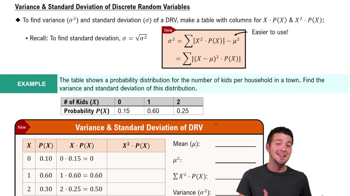
Variance & Standard Deviation of Discrete Random Variables

Continuous Data

Continuous data, in contrast, can take any value within a given range and can be divided into infinitely smaller parts. This type of data is often measured rather than counted, such as height, weight, or time. Continuous data allows for more precise measurements and can include fractions or decimals.
Recommended video:
Guided course
04:39
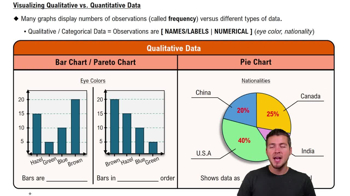
Visualizing Qualitative vs. Quantitative Data

Data Classification

Data classification involves categorizing data into types, primarily discrete and continuous. Understanding this classification is crucial for selecting appropriate statistical methods and analyses. Recognizing whether data is discrete or continuous helps in determining how to visualize and interpret the data effectively.
Recommended video:
Guided course
04:39
Visualizing Qualitative vs. Quantitative Data
Related Practice
Textbook Question

E-Cigarette Survey In a survey of 36,000 adults, 3.7% said that they regularly use E-cigarettes (based on data from the National Center for Health Statistics)


c. What is the level of measurement of the value of 3.7%? (nominal, ordinal, interval, ratio)

301
views
Textbook Question

E-Cigarette Survey In a survey of 36,000 adults, 3.7% said that they regularly use E-cigarettes (based on data from the National Center for Health Statistics).


a. Identify the sample and population.

272
views
Textbook Question

Countable For each of the following, categorize the nature of the data using one of these three descriptions: (1) discrete because the number of possible values is finite; (2) discrete because the number of possible values is infinite but countable; (3) continuous because the number of possible values is infinite and not countable.

a. Exact lengths of the feet of members of the band the Monkees

320
views
Textbook Question

Countable For each of the following, categorize the nature of the data using one of these three descriptions: (1) discrete because the number of possible values is finite; (2) discrete because the number of possible values is infinite but countable; (3) continuous because the number of possible values is infinite and not countable.

c. The number of albums sold by the Monkees band

246
views
Textbook Question

Sampling Method Assume that the population consists of all students currently in your statistics class. Describe how to obtain a sample of six students so that the result is a sample of the given type.


b. Systematic sample

279
views
Textbook Question

Sampling Method Assume that the population consists of all students currently in your statistics class. Describe how to obtain a sample of six students so that the result is a sample of the given type.


c. Stratified sample

333
views