Skip to main content
Analytical Chemistry
My Course
Learn
Exam Prep
AI Tutor
Study Guides
Flashcards
Explore
Try the app
My Course
Learn
Exam Prep
AI Tutor
Study Guides
Flashcards
Explore
Try the app
Back
Acid Strength definitions
You can tap to flip the card.
Binary Acid
You can tap to flip the card.
👆
Binary Acid
A molecule with a hydrogen ion bonded to a single electronegative nonmetal, such as halogens or chalcogens.
Track progress
Control buttons has been changed to "navigation" mode.
1/14
Related flashcards
Related practice
Recommended videos
Acid Strength quiz
Acid Strength
15 Terms
Acid Strength
6. Chemical Equilibrium
5 problems
Topic
The pH Scale
6. Chemical Equilibrium
5 problems
Topic
6. Chemical Equilibrium - Part 1 of 3
4 topics
12 problems
Chapter
6. Chemical Equilibrium - Part 2 of 3
4 topics
12 problems
Chapter
6. Chemical Equilibrium - Part 3 of 3
2 topics
6 problems
Chapter
Guided course
02:14
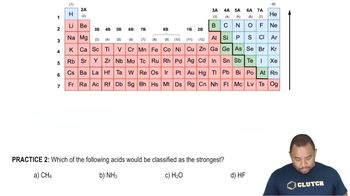
Binary Acid Strength
367
views
1
rank
Guided course
00:54
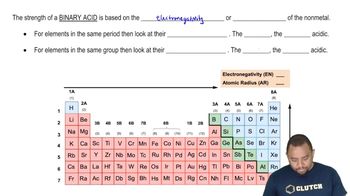
Binary Acid Strength
349
views
Guided course
03:29
Binary Acid Strength
435
views
1
rank
1
comments
Terms in this set (14)
Hide definitions
Binary Acid
A molecule with a hydrogen ion bonded to a single electronegative nonmetal, such as halogens or chalcogens.
Oxyacid
A compound containing hydrogen, a nonmetal, and oxygen, often with the nonmetal as part of a polyatomic ion.
Electronegativity
A measure of an atom's ability to attract shared electrons, increasing toward the top right of the periodic table.
Atomic Radius
The effective size of an atom, which increases down a group and influences acid strength in binary acids.
Strong Acid
A substance that completely ionizes in water, producing nearly 100% ions and acting as a strong electrolyte.
Weak Acid
A substance that only partially ionizes in water, establishing equilibrium and producing fewer ions.
Hydronium Ion
The H3O+ species formed when a hydrogen ion associates with water, functionally equivalent to H+ in solution.
Strong Electrolyte
A compound that dissociates completely in solution, resulting in high electrical conductivity.
Weak Electrolyte
A compound that only partially dissociates in solution, resulting in low electrical conductivity.
Ka Value
An equilibrium constant quantifying acid dissociation in water; values much greater than 1 indicate strong acids.
pKa Value
The negative logarithm of the acid dissociation constant; negative values correspond to strong acids.
Amphoteric Species
A molecule or ion capable of acting as either an acid or a base, often containing both hydrogen and a negative charge.
Polyatomic Ion
A charged species composed of multiple atoms, often serving as the nonmetal component in oxyacids.
Exception
A case where a compound does not follow the general rules for acid strength, such as oxalic acid or iodic acid.
 BackBack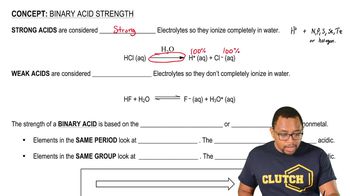
 02:14
02:14