Skip to main content
Analytical Chemistry
My Course
Learn
Exam Prep
AI Tutor
Study Guides
Flashcards
Explore
Try the app
My Course
Learn
Exam Prep
AI Tutor
Study Guides
Flashcards
Explore
Try the app
Back
Acid Strength quiz
You can tap to flip the card.
What is a binary acid composed of?
You can tap to flip the card.
👆
What is a binary acid composed of?
A binary acid consists of an H+ ion connected to an electronegative element, typically a nonmetal.
Track progress
Control buttons has been changed to "navigation" mode.
1/15
Related flashcards
Related practice
Recommended videos
Acid Strength definitions
Acid Strength
14 Terms
Acid Strength
6. Chemical Equilibrium
5 problems
Topic
The pH Scale
6. Chemical Equilibrium
5 problems
Topic
6. Chemical Equilibrium - Part 1 of 3
4 topics
12 problems
Chapter
6. Chemical Equilibrium - Part 2 of 3
4 topics
12 problems
Chapter
6. Chemical Equilibrium - Part 3 of 3
2 topics
6 problems
Chapter
Guided course
02:14
Binary Acid Strength
367
views
1
rank
Guided course
00:54
Binary Acid Strength
349
views
Guided course
03:29
Binary Acid Strength
437
views
1
rank
1
comments
Terms in this set (15)
Hide definitions
What is a binary acid composed of?
A binary acid consists of an H+ ion connected to an electronegative element, typically a nonmetal.
How do strong acids behave in water?
Strong acids completely ionize in water, producing 100% ions as products.
What is the difference in ionization between strong and weak acids?
Strong acids fully ionize in water, while weak acids only partially ionize, establishing an equilibrium.
How is the strength of a binary acid determined for elements in the same period?
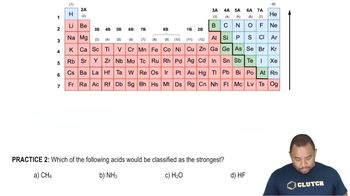
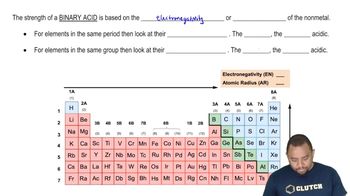
For elements in the same period, the strength is determined by electronegativity; higher electronegativity means stronger acid.
How is the strength of a binary acid determined for elements in the same group?
For elements in the same group, the strength is determined by atomic radius; larger atomic radius means stronger acid.
What is the most electronegative element on the periodic table?
Fluorine is the most electronegative element, with a value of 4.0.
When comparing binary acids separated by only one row, which property is used?
Electronegativity is used to compare binary acids separated by only one row.
When comparing binary acids separated by more than one row, which property is used?
Atomic radius (size) is used to compare binary acids separated by more than one row.
What is an oxyacid composed of?
An oxyacid is composed of an H+ ion, a nonmetal, and oxygen, often in the form of a polyatomic ion.
What rule is used to determine if an oxyacid is strong or weak when Ka is unknown?
If an oxyacid has 2 or more oxygens than hydrogens, it is classified as a strong acid; otherwise, it is weak.
How do you compare the strength of oxyacids with different numbers of oxygens?
The oxyacid with more remaining oxygens after subtracting hydrogens is more acidic.
How do you compare the strength of oxyacids with the same number of oxygens?
The oxyacid with the more electronegative nonmetal is stronger if the number of oxygens is equal.
Name three exceptions to the oxyacid strength rule.
Oxalic acid, iodic acid, and amphoteric species are exceptions and can be weak despite meeting the rule for strong oxyacids.
Why are oxalic acid and iodic acid weak despite having 2 or more oxygens than hydrogens?
They are weak because their nonmetals (carbon and iodine) have low electronegativity, reducing their acidity.
What is an amphoteric species and why is it not classified as a strong oxyacid?
Amphoteric species can act as acids or bases due to their hydrogen and negative charge, so they are not definitively strong oxyacids.
 BackBack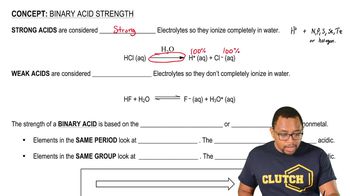
 02:14
02:14