Skip to main content
Analytical Chemistry
My Course
Learn
Exam Prep
AI Tutor
Study Guides
Flashcards
Explore
Try the app
My Course
Learn
Exam Prep
AI Tutor
Study Guides
Flashcards
Explore
Try the app
Back
Activity Coefficients definitions
You can tap to flip the card.
Activity Coefficient
You can tap to flip the card.
👆
Activity Coefficient
A numerical factor indicating deviation from ideal solution behavior, reflecting how ions interact differently in real solutions.
Track progress
Control buttons has been changed to "navigation" mode.
1/14
Related flashcards
Related practice
Recommended videos
Activity Coefficients quiz
Activity Coefficients
15 Terms
Activity Coefficients
7. Activity and the Systematic Treatment of Equilibrium
5 problems
Topic
pH Revisited
7. Activity and the Systematic Treatment of Equilibrium
5 problems
Topic
7. Activity and the Systematic Treatment of Equilibrium
3 topics
9 problems
Chapter
Guided course
05:42
Activity Coefficient
1284
views
4
rank
1
comments
Guided course
00:59
Non-Ideal Ionic Strength
340
views
1
comments
Guided course
03:39
Non-Ideal Ionic Strength
293
views
1
rank
Terms in this set (14)
Hide definitions
Activity Coefficient
A numerical factor indicating deviation from ideal solution behavior, reflecting how ions interact differently in real solutions.
Ionic Strength
A measure of the total concentration and charge of ions in a solution, influencing how ions affect each other's behavior.
Ideal Solution
A hypothetical mixture where all ions are treated equally, with no differences in size or charge affecting interactions.
Non-Ideal Solution
A real mixture where ions differ in size and charge, causing unequal interactions and deviations from ideal behavior.
Extended Debye-Hückel Equation
A mathematical relationship connecting activity coefficients to ionic strength, ionic charge, and ionic size.
Ionic Charge
The electrical property of an ion, positive or negative, that influences its effect on solution behavior.
Ionic Size
The physical dimension of an ion, often measured in picometers, affecting its influence on activity coefficients.
Unity
A value of one for the activity coefficient, indicating ideal solution behavior where all ions act identically.
Interpolation
A method for estimating unknown values, such as activity coefficients, using known data points within a range.
Solubility Product Expression
An equation relating the concentrations and activities of ions in a saturated solution to the solubility product constant.
Concentration
The amount of a substance present in a given volume of solution, used in calculating ionic strength and activities.
KSP
A constant representing the equilibrium between a solid and its ions in solution, often adjusted for non-ideal behavior.
Gamma
The symbol commonly used to represent the activity coefficient in equations and calculations.
Picometer
A unit of length, equal to one trillionth of a meter, frequently used to express ionic size in activity coefficient calculations.
 BackBack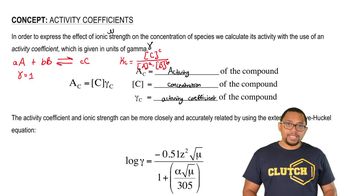
 05:42
05:42

