Back

Mean Evaluation definitions

Control buttons has been changed to "navigation" mode.
1/12
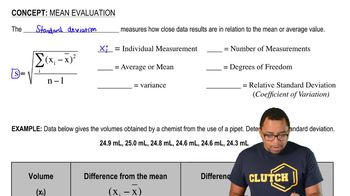
  • Standard Deviation

    Quantifies how closely grouped data points are around the average, with smaller values indicating higher measurement precision.
  • Mean

    Represents the average value of a data set, calculated by summing all measurements and dividing by their count.
  • Variance

    Represents the squared value of the standard deviation, reflecting overall data spread within a set.
  • Relative Standard Deviation

    Expresses standard deviation as a percentage of the mean, allowing comparison of variability across different data sets.
  • Coefficient of Variation

    Another term for relative standard deviation, used to compare precision between data sets with different units or means.
  • Precision

    Describes how closely repeated measurements agree with each other, regardless of their closeness to the true value.
  • Accuracy

    Indicates how close a measurement is to the actual or true value, distinct from how repeatable results are.
  • Degree of Freedom

    Refers to the number of independent values in a calculation, typically one less than the number of measurements.
  • Summation

    The process of adding together all individual measurement deviations from the mean, often used in statistical formulas.
  • Data Set

    A collection of individual measurements or values used for statistical analysis and calculation of averages and variability.
  • Measurement

    An individual value obtained during an experiment, contributing to the overall analysis of data precision and accuracy.
  • F Test

    A statistical method that compares variances to assess if two data sets have significantly different spreads.