Back

Mean Evaluation quiz

Control buttons has been changed to "navigation" mode.
1/15
  • What does standard deviation measure in a data set?

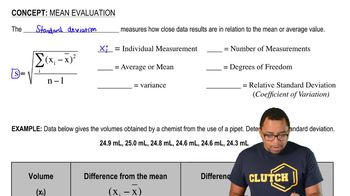
    Standard deviation measures how close data results are in relation to the mean or average value.
  • How does the size of the standard deviation relate to measurement precision?

    A smaller standard deviation indicates higher precision in your measurements.
  • What is the formula for standard deviation?

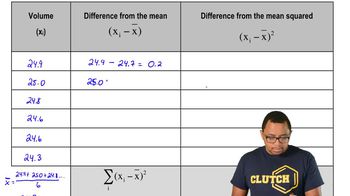
    The formula is s = sqrt(Σ(xi − x̄)² / (n − 1)).
  • In the standard deviation formula, what does xi represent?

    xi represents an individual measurement in the data set.
  • What does x̄ (x with a line on top) represent in the standard deviation formula?

    x̄ represents the mean or average value of the data set.
  • What does n represent in the standard deviation equation?

    n represents the number of measurements in the data set.
  • What does n − 1 represent in the standard deviation calculation?

    n − 1 represents the degrees of freedom in the calculation.
  • How is variance related to standard deviation?

    Variance is the standard deviation squared.
  • What is the formula for relative standard deviation (coefficient of variation)?

    Relative standard deviation is (standard deviation / mean) × 100.
  • What does a high relative standard deviation indicate about your data?

    A high relative standard deviation indicates greater variability relative to the mean.
  • How does precision differ from accuracy?

    Precision refers to how close measurements are to each other, while accuracy is how close they are to the true value.
  • Can measurements be precise but not accurate? Explain.

    Yes, measurements can be close to each other (precise) but still far from the true value (not accurate).
  • What statistical test is closely related to variance?

    The F test is closely related to the variance of calculations.
  • Why is understanding standard deviation important in scientific experiments?

    It helps analyze data variability and reliability, which are essential for interpreting experimental results.
  • What does a small standard deviation tell you about your data set?

    It tells you that your measurements are closely clustered around the mean, indicating high precision.