Back

Protic Acids and Bases definitions

Control buttons has been changed to "navigation" mode.
1/14
  • Binary Acid

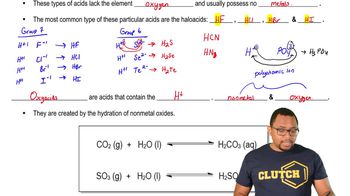
    A compound with H+ bonded to a nonmetal element, excluding oxygen, often forming strong polar bonds.
  • Oxyacid

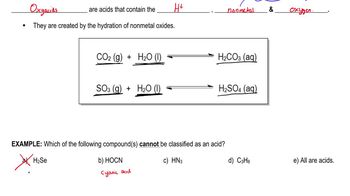
    A molecule containing H+, a nonmetal, and oxygen, typically formed by hydrating nonmetal oxides.
  • Haloacid

    A type of binary acid where H+ is bonded to a halogen from group 7A, such as HCl or HF.
  • Hydronium Ion

    A hydrated form of H+ in aqueous solution, responsible for acidic properties in water.
  • Salt

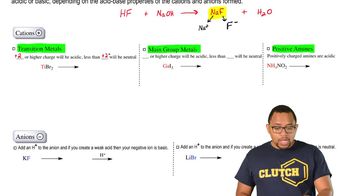
    An ionic compound produced from acid-base neutralization, composed of cations and anions.
  • Cation

    A positively charged ion, often a metal or amine, whose charge influences solution acidity.
  • Anion

    A negatively charged ion, whose basicity or neutrality depends on the strength of its conjugate acid.
  • Transition Metal

    A metallic element from the central block of the periodic table, forming cations that can be acidic if charge is +2 or higher.
  • Main Group Metal

    A metallic element from groups 1A to 4A, forming cations that are acidic only if charge is +3 or higher.
  • Positive Amine

    A cationic species containing nitrogen and hydrogen, sometimes with carbon, always classified as acidic.
  • Conjugate Base

    The species formed when an acid donates H+, its strength determines the basicity of the corresponding anion.
  • Amphoteric Species

    A compound capable of acting as either an acid or a base, classification depends on its Ka value.
  • Polarity

    A property of acids and bases that enables interaction in aqueous solutions via H+ donation or acceptance.
  • Hydration

    The process by which nonmetal oxides react with water to form oxyacids.